
Zero-click searches surpassed 60% in 2025 (up from 25% in 2020), which means decisions are increasingly influenced inside AI-generated answers — before a prospect ever lands on your site.
Since early 2025, we’ve been testing what actually drives ChatGPT citations for SaaS. In this guide, I break down what the research shows — and what we’ve verified through real-world execution.
So, let's first understand…
Why Most of ChatGPT’s Citations Are Off-Limits to You
Before you optimize for AI visibility, you need to understand how citations actually work; otherwise, you may waste time optimizing the wrong assets.
1. The citation breakdown you need to know
Ahrefs analyzed ChatGPT’s top 1,000 cited pages in September 2025. The content distribution looked like this:
- Wikipedia: 29.7%
- Homepages / Landing Pages: 23.8%
- Educational / How-To Content: 19.4%
- App Store Listings: 6.6%
- Reviews: 5.8%
- News / Media: 5.2%
- Blog Articles: 1.9%
- Q&A / Community / Forums: 0.9%
Now look at the math.
Nearly 53% of citations come from Wikipedia and homepages alone. Add app stores, and you’re well past the halfway mark.
For most SaaS companies, these are what Ahrefs calls “dead citations.” You can’t directly control Wikipedia. You don’t control app store ecosystems. And homepage citations are usually reserved for dominant brands.
That leaves only 32.3% of citation categories that businesses can realistically influence — educational content, reviews, news coverage, and blog articles.
That 32.3% is where your strategy lives.
2. The real opportunity space for SaaS
If you’re a SaaS founder, CMO, or SEO lead, this is the part that matters.
The influenceable slice of citations is smaller — but it’s actionable.
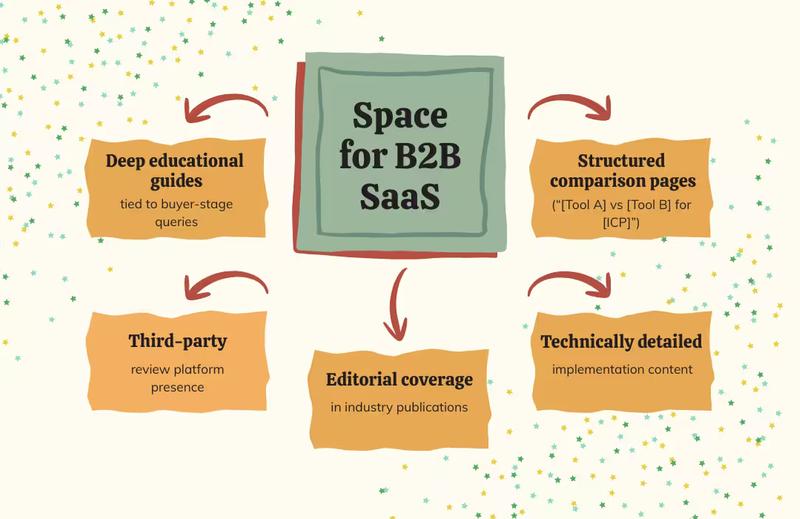
For SaaS companies specifically, we’ve seen the highest leverage in:
- Deep educational guides tied to buyer-stage queries
- Structured comparison pages (“[Tool A] vs [Tool B] for [ICP]”)
- Third-party review platform presence
- Editorial coverage in industry publications
- Technically detailed implementation content
There’s another stat most teams miss:
28% of ChatGPT’s most-cited pages have zero organic search visibility.
That means citation selection isn’t purely tied to Google rankings.
ChatGPT evaluates signals differently.
You can get cited before you rank.
For mid-market and niche SaaS companies, that’s not a small insight. It changes how you prioritize content.
So, instead of chasing only high-volume keywords, you build pages designed to be quotable, structured, entity-rich, and evidence-backed.
Because in AI search, the game isn’t just ranking.
It’s being referenced.
The Core Citation Signals — What the research actually shows
Two large-scale studies shape how we approach ChatGPT's citation strategy:
- SE Ranking: 129,000 domains / 216,524 pages / 20 niches
- A December 2025 XGBoost analysis of 120K+ domains
Different datasets. Same signal hierarchy.
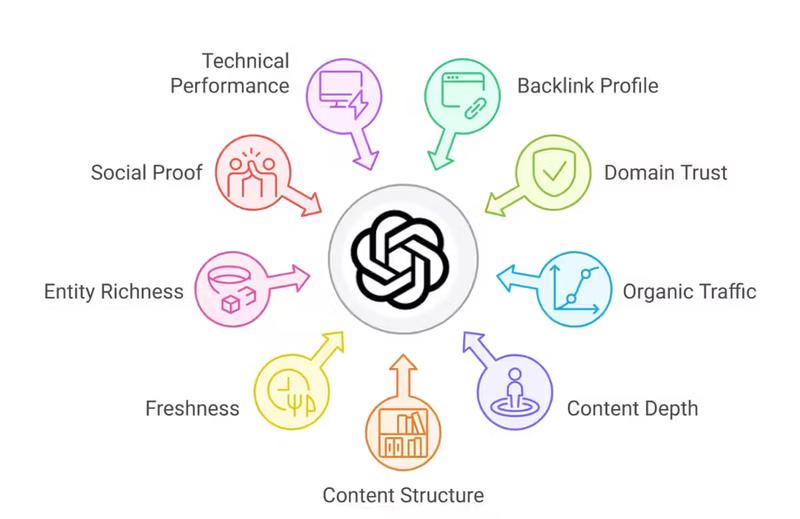
As we’ve aligned our SaaS content strategy for our clients around the factors with the highest measurable impact on citation frequency. We find the following 10 factors to get cited by ChatGPT for your product.
Factor 1: Backlink profile / referring domains
If you strip everything else away, this is the clearest signal.
Sites with 32,000+ referring domains are 3.5x more likely to be cited than sites with under 200 referring domains.
This isn’t subtle.
ChatGPT isn’t pulling from a neutral knowledge pool. It pattern-matches authority. And authority is reinforced by who links to you.
For SaaS, this changes how you think about link building.
Generic DR-chasing doesn’t move the needle the same way category-adjacent authority does.
So, we prioritize:
- SaaS-specific publications
- Review ecosystem editorial pages
- Industry blogs read by the actual ICP
- Original research that earns passive citations
Original benchmark reports, pricing analyses, and integration datasets — these assets attract links naturally. And those links compound citation probability.
If you want to influence AI answers, your backlink graph matters more than your keyword density.
Factor 2: Domain trust + page trust scores
Trust metrics correlate heavily with citation frequency.
Domains with Trust scores above 90 earn nearly 4x more citations than low-trust domains (DT < 43).
Ahrefs data also shows that cited pages often sit on domains with a median DR of 90. But here’s the nuance:
Page-level link strength matters less than domain authority.
ChatGPT frequently cites internal pages from authoritative domains — even when those pages don’t have massive backlink profiles themselves.
For SaaS, this is good news.
A strong domain can lift:
- Integration guides
- Comparison content
- ROI methodology pages
- Security documentation
Our approach: build topical clusters. One authoritative pillar. Supporting pages that inherit internal link equity. Citation-targeted pages get reinforced by your strongest URLs.
Factor 3: Organic traffic + homepage authority
Visibility feeds credibility.
Sites with 190,000+ monthly organic visitors receive nearly 2x more ChatGPT citations than lower-traffic domains.
There’s also a homepage signal.
Sites with 7,900+ organic visitors to their homepage have twice the citation likelihood versus those under 400.
Why?
Traffic is a proxy. It reflects behavioral signals, link velocity, and overall authority convergence.
Now, most niche B2B SaaS brands won’t hit 190K monthly visitors.
That’s fine.
The relationship is directional, not absolute.
More category visibility → higher citation probability.
This is why we don’t treat Generative Engine Optimization (GEO) as a replacement for SEO. It builds on it. Pages already ranking in the top 45 positions on Google receive ~60% more ChatGPT citations than those ranking 64–75.
Search strength compounds AI visibility.
Factor 4: Content depth and long-form evidence
Short content underperforms.
Articles with 2,900+ words average 5.1 citations, while those under 800 words average 3.2.
For smaller SaaS domains, content length has ~65% more impact on citations compared to top-tier domains.
So, depth is a leveling factor.
But word count alone doesn’t win.
Evidence density does.
Content with:
- Named expert quotes
- Specific statistics
- Case study references
- Defined methodologies
Outperforms content with vague claims — even at identical length.
The pages we see cited most in SaaS:
- Comparison pages
- Implementation guides
- ROI frameworks
- Integration documentation
- Security/compliance explainers
Factor 5: Content structure — answer-first architecture
Structure directly influences citation extraction.
From a 1.2M-response analysis covering 18,012 verified citations:
44% of ChatGPT citations come from the first 30% of page content.
That means traditional blog structure — long intro, slow buildup — works against you.
Then there’s the “Answer Capsule” effect.
72.4% of cited blog posts contained a 40–60 word direct answer immediately after an H1 or question-based H2.
Even more critical:
91%+ of answer capsules that received citations contained zero internal or external links inside the capsule itself.
Links signal that the authoritative answer exists elsewhere.
The template we deploy for SaaS clients:
- Question-based H2 mirroring buyer query
- 40–60 word bold, direct definition
- No links inside that capsule
- Supporting data immediately below
Sections between 120–180 words also receive significantly more citations than sub-50-word fragments.
So, in short, ChatGPT rewards: Clear hierarchy. Direct answers. Evidence up front.
Factor 6: Freshness — the recency bias is real
If you ignore update cadence, you lose citations. It’s that simple.
Content updated in the past 3 months averages 6 citations, compared to 3.6 for outdated pages — nearly a 2x gap.
Ahrefs found that 76.4% of ChatGPT’s most-cited pages were refreshed within the last 30 days, and 89.7% were updated in 2025.
Recency isn’t cosmetic. It’s a selection bias.
There’s also a compounding insight: the first user query (Turn 1) triggers citations at 12.6% frequency, more than 2.5x Turn 10.
That means:
If you want to win citations, optimize for “first-question” searches like:
- “What is revenue intelligence software?”
- “Best CRM for mid-market SaaS?”
- “How does usage-based pricing work?”
How we apply this for SaaS clients:
- Comparison and category pages → monthly refreshes
- ROI and benchmark pages → quarterly updates
- Technical documentation → version-triggered updates with visible “Last reviewed” stamps
Artificially updating dates without improving substance can also shift AI rankings — in some cases by up to 95 positions.
Factor 7: Entity richness — writing for systems that think in entities
LLMs don’t think in keywords.
They process entities.
Heavily cited text averages 20.6% proper noun density, compared to 5–8% in standard English writing.
Definitive phrasing (“X is defined as…”, “X refers to…”) makes content 2x more likely to be cited than vague language.
Balanced subjectivity (around 0.47 sentiment score) performs best — analyst tone over promotional tone.
For B2B SaaS, here’s the difference:
Low-entity sentence:
“Leading CRM platforms offer strong automation features.”
High-entity version:
“Platforms like Salesforce, HubSpot, and Pipedrive provide workflow automation, API access, and native integrations with Stripe and Slack.”
The second is 3–5x more extractable.
We need to intentionally increase:
- Named vendors
- Compliance standards (SOC 2, ISO 27001)
- Protocols (OAuth 2.0, REST API)
- File formats (CSV, JSON)
- Role titles (VP Sales, RevOps Manager)
Entity density increases citation probability because it increases clarity.
Factor 8: Off-site social proof — Reddit, Quora, review platforms
in 2026, backlinks aren’t the only authority signal.
Domains with brand mentions on Quora and Reddit show ~4x higher citation rates than those with minimal presence.
Domains with profiles on G2, Capterra, Trustpilot, and similar platforms have 3x higher citation likelihood than those without.
Why?
AI systems interpret community validation as authority.
For SaaS, that means:
- Technical subreddit discussions matter
- Quora threads tied to category definitions matter
- Structured review profiles matter
So, we should treat Reddit and Quora as structured channels, not random engagement:
- Answer category-defining questions
- Provide technical breakdowns
- Avoid promotional language
- Tie responses to evidence-backed resources
Factor 9: Technical performance — core web vitals as a citation signal
Content quality doesn’t matter if AI bots can’t crawl your page.
Pages with First Contentful Paint (FCP) under 0.4 seconds average 6.7 citations. Pages above 1.13 seconds drop to 2.1 — a 3x difference.
INP, LCP, and Speed Index also show meaningful correlation with citation frequency.
But speed is only one part.
AI crawlers include:
- ChatGPT-User
- GPTBot
- ClaudeBot
- PerplexityBot
If your robots.txt blocks them — or your site relies heavily on client-side JavaScript — your content may never enter the citation pool.
So, you should run a minimum of a 10-minute audit for your product:
- Check server logs for AI user agents
- Verify Cloudflare isn’t blocking AI bots by default
- Ensure key content is server-rendered
- Fix canonicalization issues (www/non-www, trailing slashes)
Factor 10: Google SERP position — SEO still multiplies AEO
Traditional rankings still correlate strongly with citation frequency.
Pages ranking in positions 1–45 on Google receive ~60% more ChatGPT citations than pages ranked 64–75.
This matters because many teams treat AI optimization as separate from SEO.
It’s not.
Strong organic performance increases citation likelihood.
So,
- Identify pages ranking in top 45 positions
- Add answer capsules
- Increase entity density
- Insert expert quotes
- Improve structure and evidence
Because in practice, AI visibility behaves like a multiplier.
If your SEO foundation is weak, citation growth is limited.
If your SEO foundation is solid, structured AEO improvements compound.
Frequently Asked Questions
Everything you need to know about this topic.
Yes. Articles over 2,900 words average more citations than short-form content under 800 words. For smaller SaaS domains, depth acts as a leveling factor against larger competitors. But length must include real evidence — not filler.
An answer capsule is a 40–60 word direct definition placed immediately after a question-based heading. Over 72% of cited blog posts contain one. Capsules work because they are easy for LLMs to extract and summarize — especially when they contain no links inside them.
Backlinks are the strongest predictive factor.
Sites with 32,000+ referring domains are 3.5x more likely to be cited than sites with under 200. Authority from other trusted domains signals credibility to AI systems.
Yes. Domains with strong presence on Reddit, Quora, and platforms like G2 or Capterra show materially higher citation rates. Community validation acts as an off-site authority signal beyond backlinks.
Schema helps, especially for Google AI Overviews, but it’s not a standalone solution. FAQPage or HowTo markup improves structure clarity, yet content quality and evidence density have greater impact on citation frequency.
It depends on sales cycle length — but increasingly, yes.
ChatGPT referral traffic has declined even as citation frequency rises. That means citations influence buyer perception earlier in the research journey, even if they don’t immediately drive clicks. For B2B SaaS, being cited shapes the shortlist before a prospect visits your site.
Written By
Want help getting your brand ranked on Google and cited by AI?
We help businesses build AI visibility through SEO, content, and authority with clear revenue impact.
Book a Strategy Call