
You spent years ranking, optimizing, and building backlinks. Then AI changed how people search. Clicks began to drop, even as demand stayed the same.
Actually, the traffic did not vanish. It moved into AI-generated answers. And, Generative Engine Optimization focuses on showing up there.
So, in this guide, I explain what is working, based on real data and our testing since 2021.
What Is Generative Engine Optimization (GEO)?
In short, Generative Engine Optimization (GEO) is the practice of optimizing your content so that AI platforms — ChatGPT, Perplexity, Google AI Overviews, Claude — cite or reference it when generating answers for users.
Traditional SEO gets you a ranking. GEO gets you inside the answer itself — even when no one clicks through to your site.
And, those are two very different things.
Where the term actually comes from
GEO isn't a marketing buzzword someone invented at a conference.
It came from a 2024 research paper out of Princeton University and IIT Delhi. The researchers analyzed 10,000 real-world search queries and tested which content optimization methods actually increased how often AI engines cited a source.
The result? Specific techniques boosted AI citation frequency by up to 40%.
That study is why GEO is worth taking seriously. And, it's based on controlled testing at scale.
You'll also see this practice called LLMO (Large Language Model Optimization), GSO (Generative Search Optimization), or AIO (AI Optimization).
Different people use different names. Same discipline.
The shift that changes everything
Think about how traditional SEO works.
You write a great article. It ranks in the top 3. Someone searches, sees your blue link, clicks it, lands on your page.
That's the whole game — get the click.
GEO is entirely different.
When someone asks ChatGPT "what's the best project management tool for a remote team?" — ChatGPT doesn't serve up a list of links.
It generates a full answer. It synthesizes information from across the web, picks the sources it trusts most, and writes the response itself.
Your job, with GEO, is to be one of the sources it trusts.
The interesting part: a page can rank #1 on Google and never get cited by ChatGPT once. And a page that ranks on page two can be cited constantly — if it's structured the way AI engines actually need.
The ranking and the citation are two separate outcomes.
A real example worth knowing
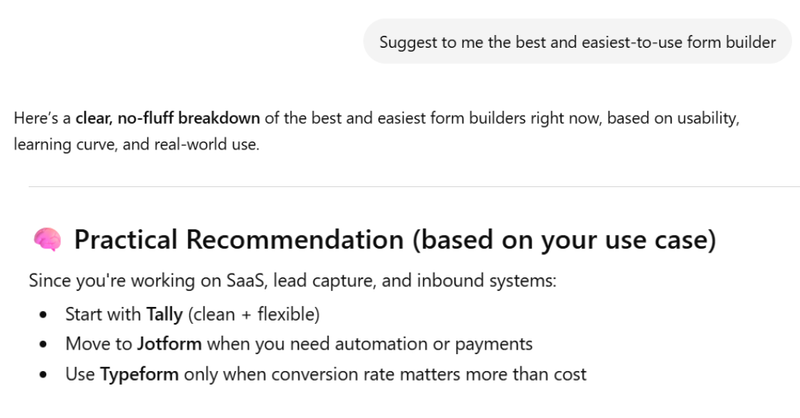
Tally is a bootstrapped form builder. Small team. No enterprise budget.
At some point, they noticed something unusual in their referral data: ChatGPT had become their #2 source of new traffic — above Google, and social.
They weren't doing anything exotic. They just had clear, helpful, well-structured content that AI engines could easily extract and cite. That was it.
It's a pattern. And it's happening across industries right now while most brands are still only watching their rankings.
GEO vs. SEO: An Overview
SEO optimizes for where you appear in search results.
GEO optimizes for whether you appear in the answer.
Both matter. They're not in competition — in fact, the same content that's built for GEO almost always performs better in traditional SEO too, because the underlying signals (clarity, authority, structure, cited sources) are the same ones Google rewards.
But they require slightly different thinking. And if you're only doing one, you're leaving visibility on the table.
So, let's get into exactly what that looks like — platform by platform — further down.
Why GEO matters in 2026 & beyond
Let's talk numbers for a second.
AI-referred sessions jumped 527% year-over-year in just the first five months of 2025, according to Previsible's AI Traffic Report.
That kind of growth doesn't happen in a corner. It's happening in the middle of your funnel, right where your organic traffic used to be.
The platforms are already massive
People treat AI search like it's still early — still experimental.
The data says otherwise.
ChatGPT now has over 800 million weekly active users and processes 2.5 billion prompts every single day.
Google's Gemini app crossed 750 million monthly users. Perplexity surpassed 780 million monthly queries and has raised $1.6 billion in total funding.
And Google AI Overviews now reach 200+ countries in over 40 languages following Google I/O 2025.
Most searches don't end with a click anymore
65% of Google searches now end without a click to any website, according to SparkToro's 2024 zero-click study.
AI Overviews, featured snippets, and knowledge panels answer the question directly on the results page. The user got what they needed. They moved on.
That number was already climbing before AI search existed.
Now that AI Overviews generate direct answers for billions of queries every month, "zero-click" isn't a fringe edge case — it's the majority behavior.
The old playbook said: rank high, get the click, convert the visitor. GEO adds a layer before that: be inside the answer, whether or not there's ever a click.
A top ranking no longer guarantees anything
According to Ahrefs' 2026 analysis, only 38% of Google AI Overview citations come from top-10 organic results — down sharply from 76% in earlier studies. More than half of what Google's AI cites comes from pages that aren't even on the first page of traditional search results.
Read that again.
A page ranking #8 or #12 — one you'd probably ignore in a standard SEO audit — can be getting cited constantly in AI Overviews, while your carefully optimized #1 result gets skipped entirely.
Rankings and citations are not the same signal. One measures where your blue link sits. The other measures whether your content gets pulled into the answer at all.
And it gets more volatile from there. When Semrush tracked 2,500 prompts across Google AI Mode and ChatGPT, they found that 40–60% of cited sources change from month to month.
5 Core GEO Factors to Get AI Citations
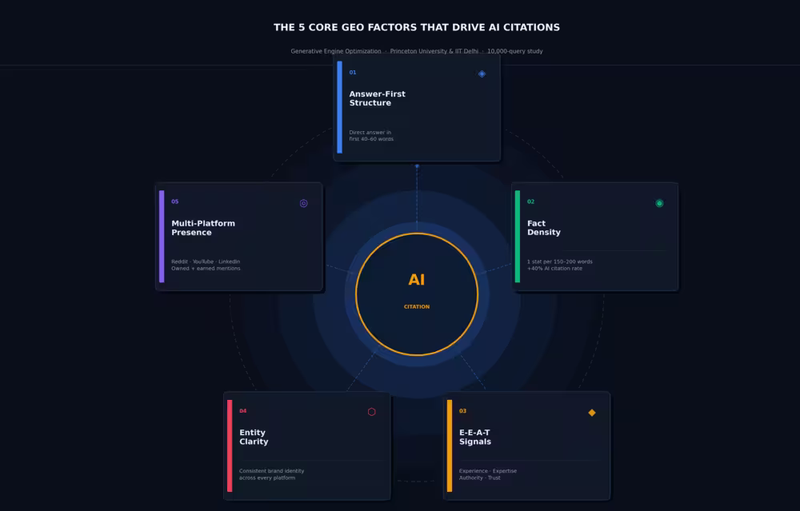
1. Answer-First Content Structure
AI engines retrieve specific passages — a paragraph here, a definition there — and assemble them into a response.
The passage either makes sense on its own when pulled out of context, or it doesn't get used at all.
So, put your direct answer in the first 40–60 words of every major section. Lead with the point, then build the supporting detail underneath it.
Headings phrased as questions help too — they map directly to how people type queries into AI tools.
There's a quick test you can run on any section of your content right now.
Read one H2 section completely in isolation — without reading anything before or after it. Does it make sense? Does it answer a complete thought?
If yes, AI can extract it. If the paragraph leans on phrases like "as we mentioned earlier" or "this is why the previous point matters" — it loses meaning the moment it gets pulled out.
Here's what the difference looks like in practice:
Hard to extract: "There are several reasons this works well. Most people find their results improve after applying it, which is exactly why it's become so popular."
Easy to extract: "Salting eggplant for 15 minutes before cooking draws out excess moisture and removes bitterness. The result is a firmer texture that holds up better during frying or roasting."
Same topic. One can stand alone. The other can't.
2. Fact Density — One Statistic Every 150–200 Words
People turn to AI search tools because they want specific, reliable answers fast.
"Content marketing generates more leads than paid advertising" is easy to ignore.
"Content marketing generates 3x more leads than paid search while costing 62% less, according to the Content Marketing Institute's 2024 B2B report" is citation-worthy.
The Princeton/IIT Delhi research found that content containing statistics and expert quotes had 30–40% higher visibility in AI responses compared to content without them. AI engines favor content that gives users numbers they can trust and verify.
The practical target: one data point every 150–200 words throughout your content.
For a 3,000-word article, that's roughly 15–20 statistics — each one linked back to its original primary source.
Always the original study or report, not a blog post that summarized it. AI systems cross-reference sources, and a citation chain that leads to authoritative data carries more weight than one that stops at a roundup post.
Mix up your stat types too. Percentages, absolute numbers, year-over-year comparisons, and benchmark figures each signal a different kind of credibility. Content that uses all of them reads like research. Content that uses only vague percentages reads like filler.
3. E-E-A-T Signals
Google introduced E-E-A-T — Experience, Expertise, Authoritativeness, and Trustworthiness — as a quality framework for human raters assessing search results.
AI systems use the same signals when deciding what to cite.
Experience means your content reflects firsthand knowledge. Real outcomes, original data, observations from doing the thing — not just summarizing what others said about it. When you share your own test results or client data, you're giving AI something genuinely unique to reference.
Expertise shows up in accuracy and depth. Factual claims backed by research. Named authors with verifiable credentials. Content that goes beyond surface-level and handles edge cases or nuance.
Authoritativeness comes from external validation — other credible sources citing you, your content showing up in industry discussions, your brand referenced across multiple platforms.
A Wikipedia entry for your brand significantly increases the likelihood of being mentioned in AI responses, given that Wikipedia makes up a substantial portion of AI training data.
Trustworthiness is the most practical layer. Visible author bios with real credentials. Publication dates and last-updated dates showing prominently. External citations linking to primary research rather than secondary summaries. A clean, transparent About page.
The SEOs who've been building E-E-A-T properly for traditional Google rankings are already ahead here — the same signals transfer almost directly.
4. Entity Clarity
Before an AI platform cites you, it has to understand what you are.
AI systems don't just process text — they build a map of entities: brands, products, people, concepts, and the relationships between them. When your brand description is clear and consistent across every place it appears, you become easy to categorize. When it's inconsistent, the model gets uncertain — and uncertain sources get deprioritized.
Take monday.com as an example. The word "monday" appears in an enormous range of online contexts.
The reason AI reliably categorizes monday.com as project management software is because every profile, every description, every page on their own site — they all say the same thing about what the product is and who it's for.
The consistency across surfaces is what creates the entity signal.
Your brand description on LinkedIn should match your Crunchbase entry, which should match your homepage headline, which should match your schema markup. Every external profile — G2, Capterra, Trustpilot, industry directories — reinforces or weakens that signal.
Schema markup specifically (written in JSON-LD format) gives AI systems a structured, machine-readable version of your entity data. Product pages should clearly declare the product name, category, description, attributes, and pricing in ways that leave no ambiguity.
The goal with schema isn't to "add markup" as a technical checkbox — it's to make sure the structured version of your content matches exactly what the visible page says.
When all of that lines up consistently, AI has high confidence citing you. When things conflict, that confidence drops.
5. Multi-Platform Brand Presence
AI engines pull their source material from far beyond your website.
According to the Semrush AI Visibility Index, Reddit, LinkedIn, and YouTube were among the top cited domains across major LLMs in October 2025.
Perplexity alone draws nearly 46.7% of its top citations from Reddit. Wikipedia accounts for 47.9% of ChatGPT's top cited sources for factual questions.
The platforms where your brand appears — and how it appears there — matter as much as your website.
Owned presence is content your team creates outside your domain. A YouTube channel that explains your product category in depth. Participation in relevant subreddits where your customers actually ask questions.
Executive LinkedIn content that establishes a point of view. Podcast appearances, conference talks, and webinars all contribute source material AI can pull from.
Earned mentions are third-party references you didn't write yourself. Customer reviews on G2 or Trustpilot. Industry journalists citing your research. Reddit threads where someone recommends your tool unprompted.
Press coverage. Community discussions where your brand comes up organically.
These two types of presence work together.
Owned content demonstrates expertise and gives AI detailed material to reference. Earned mentions validate credibility from sources the AI hasn't heard from you directly.
When both exist across multiple platforms, AI systems have corroborating signals from independent sources — and that combination is exactly what builds citation authority over time.
GEO Content Optimization Checklist
Use this before you hit publish. It covers the three areas that actually move the needle: content, technical setup, and off-site presence.
Content
- [ ] Direct answer in the opening — primary question answered in the first 40–60 words of the page
- [ ] Self-contained sections — every H2 passes the extraction test: readable in isolation, no dangling references
- [ ] One data point every 150–200 words — percentage, number, benchmark, or statistic — all linked to their original source
- [ ] 5–8 authoritative external citations — prioritise .edu, .gov, peer-reviewed research, and major industry publications
- [ ] FAQ section included — minimum 5 questions, each answer kept to 40–60 words
- [ ] Named author with verifiable credentials — linked bio page, consistent presence across the web
- [ ] Publish date + last-updated date visible — especially important for Perplexity, which weights recency heavily
Technical
- [ ] Article schema (BlogPosting) — include
headline,datePublished,dateModified,author, andimage - [ ] FAQPage schema — add a Question + Answer pair for every FAQ item on the page
- [ ] Server-side rendering — core content should load without JavaScript execution; many AI crawlers still can't process client-side rendered text reliably
- [ ] AI crawlers allowed in robots.txt — confirm none of these are blocked:
GPTBot·ChatGPT-User·PerplexityBot·Claude-Web·Google-Extended - [ ] XML sitemap up to date — newly published or updated content should be included
Off-Page
- [ ] Consistent brand description — same positioning on your site, LinkedIn, Crunchbase, G2, Trustpilot, and any relevant directory
- [ ] Content referenced off-domain — shared in a relevant Reddit thread, newsletter, LinkedIn post, or industry community
One thing worth flagging: the off-page items are the ones most SEO teams skip entirely.
AI engines pull citation sources from across the web — Reddit, LinkedIn, YouTube, review platforms — not just your own domain.
A technically perfect article with zero off-site presence still has a smaller footprint than the same article that's being discussed, linked to, or referenced in communities where your audience actually hangs out.
Both matter.
How to Measure GEO Success
GEO has a measurement problem most guides skip over entirely.
When someone discovers your brand through a ChatGPT citation on Monday and signs up through direct search on Friday — your GA4 attributes that conversion to direct. The AI mention that started the whole chain is invisible. There's no click to track, no session to attribute.
Traditional analytics only see what happens after the click. GEO influence often happens before one ever occurs.
So you need two dashboards now. One for your website performance in traditional search. One for your brand's presence inside AI-generated responses.
The Metrics That Matter
AI citation frequency — how often your brand or content gets cited when target queries are asked across ChatGPT, Perplexity, and Google AI Overviews. This is your primary GEO signal.
Share of voice — your citation rate compared to competitors for the same question set. If an AI answers 100 questions about your product category and you appear in 22 of them while your top competitor appears in 47, that gap is your benchmark to close.
Sentiment — whether AI responses frame your brand positively, neutrally, or negatively. High citation frequency means less if the AI is also mentioning a common complaint about your product in the same breath.
Branded search lift — as AI mentions build awareness, branded search volume tends to rise. Users hear about you through AI, then search your name directly later. An upward trend in branded queries is an indirect signal that AI visibility is working.
AI bot traffic in GA4 — partial, but trackable. More on the setup below.
Setting Up AI Bot Tracking in GA4
This won't capture everything — many AI platforms don't consistently identify themselves in user agent strings. But it gives you a real directional read.
In GA4, go to Explore → New exploration → Segment → Custom segment, then set the condition to:
User agent contains any of: ChatGPT-User · PerplexityBot · Claude-Web · GPTBot
Track it weekly. Look for trend direction, not exact numbers. A consistent upward curve over 60 days is meaningful even if the absolute volume is small.
Your Monthly Citation Audit
This is the most honest measure of GEO progress — and it takes about 30 minutes a month.
Pick 10–15 questions your content is built to answer. Specific ones, not broad ones. "How does RAG work in AI search?" rather than "what is AI search?"
Every month, run each question through ChatGPT, Perplexity, and Google. Log three things: whether you were cited, where in the response, and which competitors appeared alongside you.
Track the citation rate over time. For a small team working on GEO seriously, moving from 0% to 30% citation rate across your query set over six months is a meaningful result worth building on.
The monthly audit also catches displacement early — if a competitor publishes strong content and starts taking your citation slots, you'll see it before it affects anything else.
Conclusion
GEO isn't a replacement for SEO. It's the next layer on top of it.
The brands showing up consistently in AI-generated answers right now share one thing: they started before the competition got crowded.
Pick your 10 core queries. Run the citation audit. Update your oldest stats. Add FAQ schema to your top three pages.
That's a week of work. And it compounds.
Search is changing faster than most teams are adapting. The gap between brands that show up in AI answers and those that don't is widening — quietly, every month.
Frequently Asked Questions
Everything you need to know about this topic.
No. GEO builds on top of SEO. Traditional rankings still matter — GEO adds a second layer focused on getting cited inside AI-generated responses, not just ranked in results.
They describe the same discipline. AEO (Answer Engine Optimization), LLMO, GSO, and GEO are all different names for optimizing content to appear in AI-generated answers.
Perplexity can cite new content within 1–2 weeks. ChatGPT may take 6–12 weeks. Meaningful citation authority across platforms typically builds over 6–12 months.
Start with the platform your audience uses most. ChatGPT for B2B and professionals. Perplexity for research-heavy audiences. Google AI Overviews if you already rank well organically.
Yes — and smaller brands often have an advantage. Tight topical focus makes it easier for AI to categorize you accurately. Niche specificity beats broad authority in citation selection.
Definitions, statistics, comparisons, how-to explanations, and FAQ answers. Structured, self-contained paragraphs that answer one clear question get extracted and cited most reliably.
Run a monthly manual audit: query 10–15 target questions on ChatGPT, Perplexity, and Google. Log whether you appear, where, and which competitors are cited alongside you.
Partially. In GA4, create a custom segment filtering for user agents: ChatGPT-User, PerplexityBot, Claude-Web, and GPTBot. It's directional data — not a complete picture.
Every 90 days for pillar content. AI citation decay happens roughly every 13 weeks — outdated statistics are the fastest way to lose citation slots you've already earned.
Written By
Want help getting your brand ranked on Google and cited by AI?
We help businesses build AI visibility through SEO, content, and authority with clear revenue impact.
Book a Strategy Call