
AthenaHQ helps brands track where they appear inside AI-generated answers, while AirOps helps teams create and scale the content that improves those mentions. Both operate in the Generative Engine Optimization space, but they solve different parts of the workflow.
AthenaHQ focuses on AI visibility intelligence, and AirOps focuses on AI-assisted content operations.
So, in this guide, I break down where each platform fits, who should use it, and how to choose the right one based on your organic marketing goals.
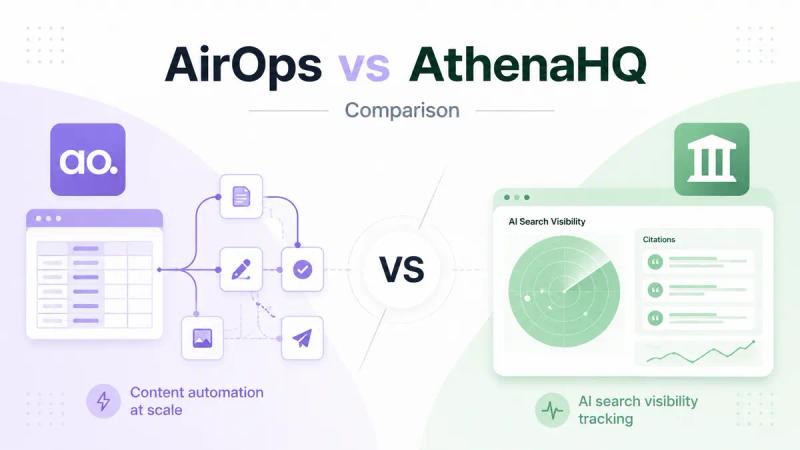
- AthenaHQ tracks AI search visibility across 8+ engines including ChatGPT, Gemini, Perplexity, Claude, and Grok, while AirOps focuses on automating content production and publishing to seven CMS platforms.
- AthenaHQ's Self-Serve plan starts at $295 per month with 3,600 credits and unlimited seats, while AirOps runs from a Free tier up to Solo at $199 per month and Pro at $1,999 per month.
- AthenaHQ wins on citation depth, prompt volume estimation, and Shopify revenue attribution, which makes it a strong fit for ecommerce and analytics-led teams.
- But AirOps wins on bulk content operations, workflow flexibility, and CMS write integrations, which makes it the better choice for high-volume content teams.
- Both platforms carry a learning curve, but AirOps demands more upfront because you're configuring the workflow logic yourself.
What AthenaHQ and AirOps Actually Are
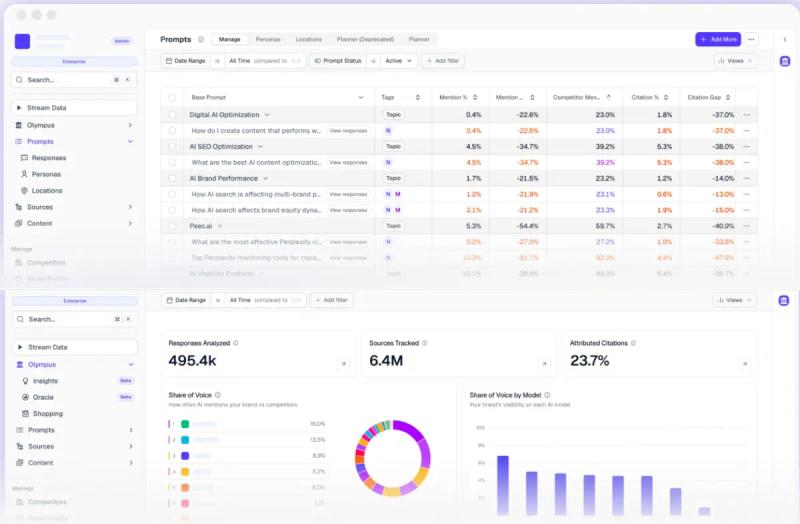
AthenaHQ is a GEO-native visibility platform. It tracks how often your brand appears in answers across ChatGPT, Gemini, Perplexity, Claude, Copilot, Grok, Google AI Overviews, and AI Mode.
The Self-Serve plan covers 8 major LLMs out of the box, which is broader than most platforms in this space. Underneath the tracking sits a Prompt Volume engine that estimates how many people are actually asking each prompt across AI platforms, plus competitor monitoring, brand impersonation detection, and citation intelligence.
The Action Center then translates those signals into recommendations you can work through. The Self-Serve plan starts at $295/mo (67% off for first month), includes 3,600 credits (one credit equals one AI response), and ships with unlimited seats so the whole team can log in without per-user fees.
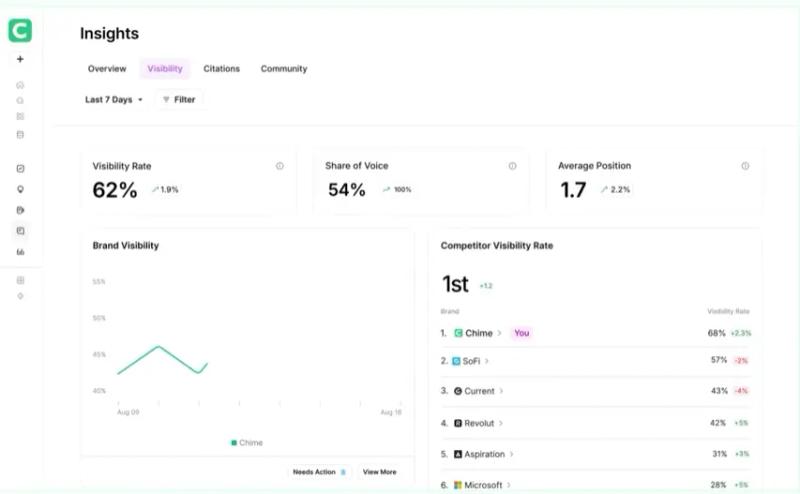
AirOps is a content operations platform that happens to include AI search tracking. The core of the product is the Grid, which works like a spreadsheet for content. You import a few hundred URLs, map them to a workflow, run AI-driven refresh or creation tasks across all of them at once, and push the output directly to your CMS.
There are 7 CMS integrations with write access, including Webflow, WordPress, Contentful, ContentStack, Ghost, Sanity, and Strapi. Page360 sits on top and unifies AI citations with Google Search Console rankings and GA4 engagement, so you're looking at one dashboard instead of three.
Pricing runs from a Free plan to Solo at $199/month, Pro at $1,999/month, and custom Enterprise contracts, with overages at $9 per 1,000 tasks on Solo and $6 per 1,000 tasks on Pro.
The way I'd put it to someone deciding between the two: AthenaHQ answers the question of where you stand in AI search, and AirOps answers the question of how you build the content engine to improve that standing.
AirOps vs AthenaHQ: Comparison Table
So, now before going deep, here's a side-by-side look at how AirOps and AthenaHQ compare on the dimensions that actually move buying decisions. I've pulled these numbers directly from both platforms' pricing pages so you're working with current 2026 data.
| Dimension | AirOps | AthenaHQ |
|---|---|---|
| Core focus | Content workflows and CMS publishing. | AI search visibility and citation tracking. |
| Entry plan | Free, then Solo at $199 per month. | Self-Serve at $295 per month. |
| Top self-serve plan | Pro at $1,999 per month. | Self-Serve at $295 per month (Enterprise sits above). |
| Pricing model | Task-based with overages at $9 per 1,000 on Solo and $6 per 1,000 on Pro. | Credit-based, where one credit equals one AI response. |
| Monthly volume on top self-serve plan | 75,000 tasks on Pro. | 3,600 credits on Self-Serve. |
| AI engines tracked | Around 4 to 5 majors including ChatGPT, Gemini, AI Mode, and Perplexity. | 8 plus, covering ChatGPT, Gemini, Perplexity, Claude, Copilot, Grok, AI Overviews, and AI Mode. |
| CMS write integrations | Seven platforms (Webflow, WordPress, Contentful, ContentStack, Ghost, Sanity, Strapi). | Two platforms (Shopify and Webflow), with Shopify being the deeper integration. |
| Multi-region tracking | Limited. | Single region on Self-Serve, multi-region on Enterprise. |
| User seats | Tier-dependent. | Unlimited on both plans. |
| API access | Available across tiers. | Enterprise only. |
| Time to first value | Roughly one to two weeks while you build workflows. | Same day for visibility tracking. |
| G2 rating | 4.6 out of 5. | 4.9 out of 5 as of Spring 2026. |
A few patterns are worth flagging before moving on. AthenaHQ wins on engine breadth, citation depth, and time to first value, which is why analytics-led teams gravitate toward it.
AirOps wins on CMS reach, workflow flexibility, and content production scale, which is what pulls in B2B SaaS and agency teams managing high page volume.
The pricing gap between AirOps Pro and AthenaHQ Self-Serve is wide on paper, but the two plans aren't doing the same job, so the comparison isn't quite apples to apples. I'll get into where that gap actually matters in the next section.
One last thing worth noting from the table: AirOps' Solo plan at $199 per month looks attractive on the surface, but it's heavily restricted on engine coverage and is really designed for individual exploration rather than production GEO work.
Most teams I've talked to end up on Pro or move on, which makes the realistic AirOps entry point closer to $1,999 per month if you actually plan to use it.
AthenaHQ vs AirOps: How & Where It Matters
The headline difference between AirOps and AthenaHQ is philosophical, not just functional. AthenaHQ treats AI search as a measurement problem you solve with better data. And AirOps treats it as a production problem you solve with better workflows.
Once you internalize that, every feature decision on both platforms starts to make sense. Here's how that plays out across the four areas that actually matter when you're picking between them.
Visibility Tracking and Engine Coverage
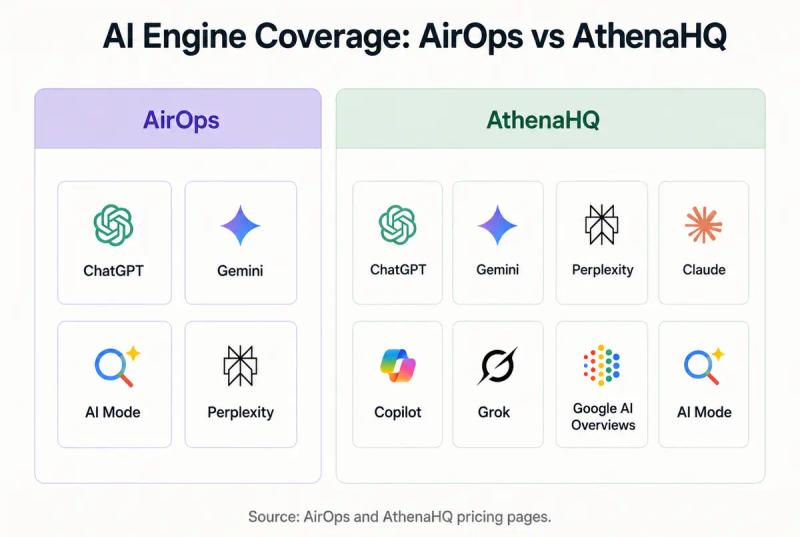
AthenaHQ has the clear edge on visibility depth. The Self-Serve plan tracks brand mentions across eight major LLMs out of the box, including ChatGPT, Gemini, Perplexity, Claude, Copilot, Grok, Google AI Overviews, and AI Mode.
The platform also runs a Prompt Volume engine that estimates how many people are actually asking each prompt across AI platforms, which is genuinely useful when you're prioritizing what to optimize for.
Add competitor monitoring, brand impersonation detection, and real-time sentiment tracking, and you get a picture of where you stand that's hard to replicate elsewhere.
AirOps covers the major engines well through Page360, which is its unified dashboard for AI citations, Google Search Console rankings, and GA4 engagement. The platform tracks ChatGPT, Gemini, AI Mode, and Perplexity, which together account for the bulk of relevant AI traffic for most B2B audiences.
What you don't get is the long tail. If you're a consumer brand that needs to know how Claude or Grok is talking about you, AirOps will leave you blind to that.
My Take: For B2B SaaS teams where 90% of relevant AI traffic flows through the big 4 engines, AirOps' coverage is fine. For consumer brands, global businesses, or anyone where citation depth is the actual KPI, AthenaHQ's 8 engine breadth pays for itself within the first month.
Content Execution and Workflow Scale
This is where AirOps pulls ahead, and it's not close. The Grid is the centerpiece, and it works like a spreadsheet for content operations. You can import 200 to 500 URLs from Search Console, map them to a workflow, and run AI-driven refresh or creation tasks across all of them simultaneously.
You then review the changes in side-by-side diffs and publish directly to your CMS without leaving the platform. For teams managing high page volume, the time savings compound quickly.
The workflow engine sits underneath the Grid and supports multi-step logic. You can chain steps together (pull SERP data, summarize top results, draft a section, run an SEO check, route to a human reviewer, publish on approval), build them into reusable templates, and schedule runs daily, weekly, or based on performance signals.
Brand Kits enforce tone, style guides, product facts, and legal constraints automatically at every step. The setup investment is real (most teams need one to two weeks before they're productive), but once it's running, the leverage is hard to match.
AthenaHQ's Action Center provides guided workflows for fixing visibility gaps, but execution still happens one page at a time. You review a recommendation, draft content in the platform's editor, then push it to your CMS manually.
The Content Optimization Agent and Athena Citation Engine (ACE) close some of that gap on Enterprise, but both features are locked behind a custom contract. For a team with five aging blog posts to refresh, this is fine. But for a team with 300, it becomes the bottleneck.
Pricing and What You Actually Get
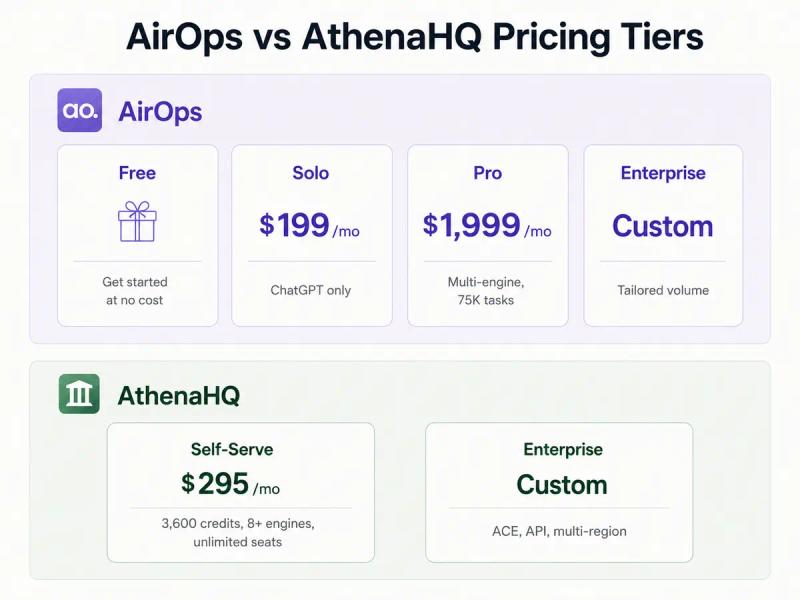
AthenaHQ Self-Serve at $295 per month includes 3,600 credits (one credit equals one AI response), all eight engines, unlimited seats, competitor monitoring, citation intelligence, AI crawling, and basic content optimization.
The Athena Citation Engine, multi-region tracking, the advanced Content Optimization Agent, and API access are all Enterprise-only.
AirOps runs four tiers: a Free plan for exploration, Solo at $199 per month for individuals (with ChatGPT-only tracking), Pro at $1,999 per month for teams scaling AI content and visibility, and custom Enterprise pricing.
Overages run $9 per 1,000 tasks on Solo and $6 per 1,000 tasks on Pro. The realistic entry point for production GEO work on AirOps is Pro, because Solo's engine restriction makes it more of a sandbox than a tool.
That puts the real comparison at $295 per month for AthenaHQ Self-Serve versus $1,999 per month for AirOps Pro, which is roughly a 6.8x premium.
But you're paying for fundamentally different things. AthenaHQ gives you visibility intelligence at scale. AirOps gives you production capability at scale. Neither replaces the other.
This is also where I've seen smaller teams get creative. A few have split the problem by running a lighter visibility tracker for the monitoring layer and saving budget for the workflow tool.
Platforms like RankSaver handle prompt and citation monitoring at a flat monthly rate, which sidesteps the credit math entirely.
It's not a one-to-one replacement for AthenaHQ's depth, but for teams that mostly need to know "are we showing up in AI answers across the engines our buyers use," it covers the core question at a fraction of the cost.
Worth knowing about if your budget can't stretch to both platforms simultaneously.
Integrations and Ecosystem Fit
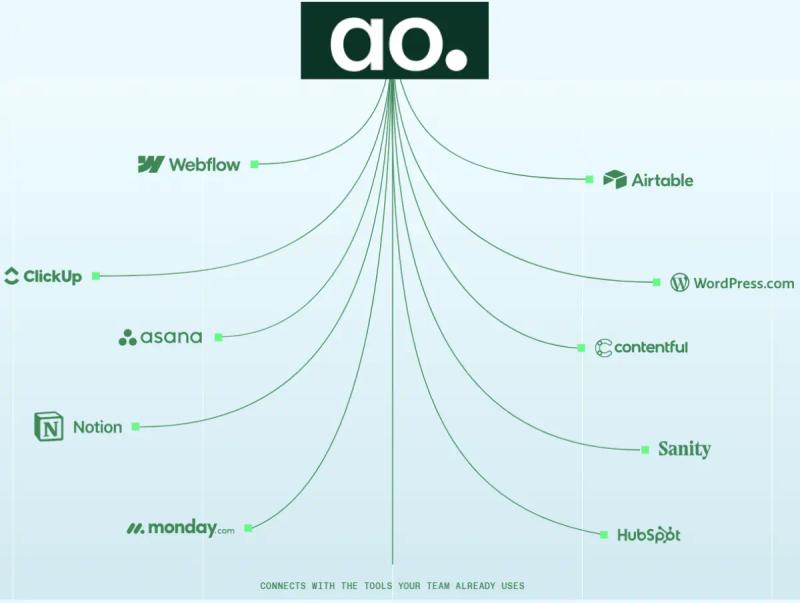
AirOps publishes directly to 7 CMS platforms with write access (Webflow, WordPress, Contentful, ContentStack, Ghost, Sanity, and Strapi), which is the broadest reach in the category.
The SEO tool stack covers Semrush, Ahrefs, Moz, DataForSEO, and Google Search Console with native workflow steps, so you can build automated competitive research and ranking monitoring pipelines without leaving the platform.
GA4, Slack, Notion, Asana, Gmail, and an MCP server for coding assistants round out the ecosystem. There's also a public API and bring-your-own-keys support across all tiers, which matters if you're building custom integrations.
AthenaHQ goes deep on Shopify and supports Webflow as a secondary integration. The Shopify integration is genuinely best-in-class for ecommerce teams, with revenue attribution that ties AI search sessions back to checkout events through the GA4 connection.
BI tool support for Tableau, Power BI, and Looker is available on Enterprise. The API is also Enterprise-only, which is a real limitation for mid-market teams that want to programmatically pull data into their own dashboards.
The pattern here mirrors everything else. AirOps gives you ecosystem breadth designed for content operations across diverse stacks. And AthenaHQ gives you ecosystem depth optimized for Shopify and AI visibility reporting.
So, if you're running an ecommerce brand, AthenaHQ's Shopify integration is the killer feature that justifies the platform on its own. But if you're managing content across multiple CMS targets, AirOps' integration breadth is the killer.
AirOps vs AthenaHQ Use Cases
The way I actually decide which tool fits a team is by mapping the work onto each platform's strengths.
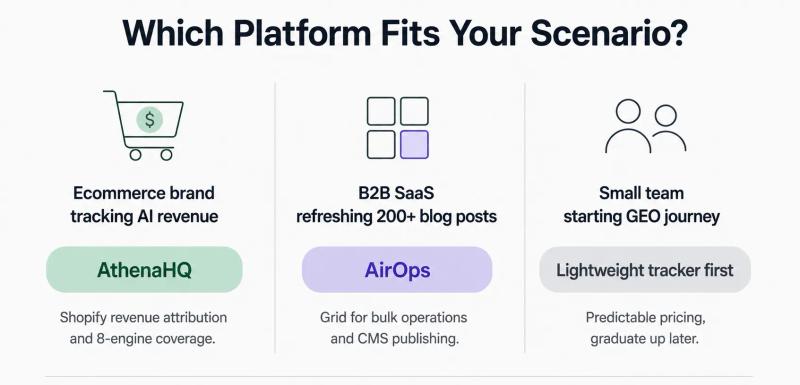
Scenario 1: An Ecommerce Brand Justifying GEO to a CFO
A team runs a mid-sized Shopify store doing around $40M in annual revenue, and the marketing lead needed to put a dollar figure on AI search before the next planning cycle.
AthenaHQ is the clear fit. The Shopify integration pulled session data through GA4 and tied AI-influenced traffic back to actual checkout events. Within six weeks, the team will have a defensible number for AI-attributed revenue, broken down by engine.
The Prompt Volume engine also surfaced product categories getting AI search demand the team wasn't capturing, which fed straight into the content roadmap.
AirOps couldn't have answered this brief. It tracks AI citations and engagement but doesn't natively connect that data to a Shopify order, which was the entire question.
Scenario 2: A B2B SaaS Team Refreshing 200 Aging Blog Posts
The team has a content library losing organic traffic for two quarters. The SEO lead suspected the decay is tied to outdated information and weak AI citation signals, and the plan is to refresh 200 posts in a single quarter.
AirOps earns its budget here. Underperforming URLs got pulled from Search Console into the Grid, mapped to a refresh workflow that combined Semrush research with content generation from Claude Opus, and routed through a Brand Kit that enforced the company's voice.
Approved drafts published directly to Webflow with original URLs preserved. The project runs in about three weeks of active work, against an internal estimate of two to three months if they had tried it manually.
AthenaHQ's Action Center would have flagged most of the same gaps, but the team would have ended up drafting in AthenaHQ and managing the publishing queue by hand.
Scenario 3: A Two-Person Marketing Team Starting Out
A team has a $150 monthly tooling budget, a 70-page website, and one part-time content contractor. They want to know if they are showing up in AI answers and what to do about it.
Neither platform fit cleanly. AthenaHQ Self-Serve at $295 was technically affordable but oversized for a 70-page site. AirOps Solo at $199 covered only ChatGPT, which didn't answer the actual question, and Pro at $1,999 is off the table.
What worked is a lightweight visibility tracker at a flat rate, which freed up budget to invest in creating the content the audit said is missing. RankSaver is the option you can land on, mostly because the pricing is predictable and the platform don't require learning a workflow builder before getting value.
The lesson I take from this scenario is that AirOps and AthenaHQ are both legitimate platforms, but they're not the right starting point for every team.
What the Pricing Actually Costs in Practice
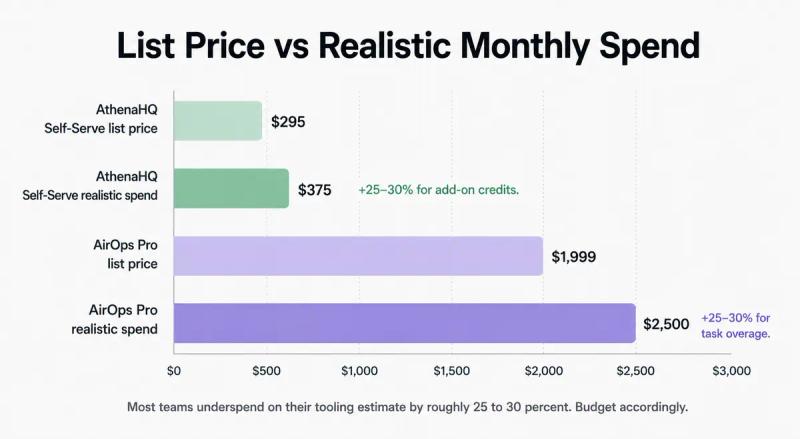
The sticker prices on both platforms understate what most teams end up paying once they're running production work. Here's the math I've watched play out across both tools so you can budget realistically before signing a contract.
How AthenaHQ Credits Drain Faster Than You'd Expect
The Self-Serve plan ships with 3,600 credits, and the math sounds generous until you actually use it. One credit equals one AI response, which means every prompt you track across every engine counts as a separate response.
A team tracking 50 prompts across five engines on a daily refresh cadence burns 250 responses per day. That allowance lasts about 14 days before you're buying add-on credits.
Push it to 100 prompts across all eight engines and you're out before the second week of the month. Add-on credit pricing isn't published — you talk to sales — which makes overage forecasting harder than it should be.
The features that would help you manage credit spend more strategically (the Athena Citation Engine, the advanced Content Optimization Agent, multi-region tracking) all sit behind the Enterprise paywall.
So, for Self-Serve teams, the practical move is to be selective about prompts and engines from day one rather than tracking everything and watching the credit balance tick down.
How AirOps Tasks Burn Differently
AirOps counts every step inside a workflow as a separate task. A content refresh workflow with 15 to 20 steps, run across 100 pages, lands at 1,500 to 2,000 tasks in a single execution.
Pro's 75,000 task allowance looks roomy on paper, but a team running heavy content operations can chew through it inside a week. Overage runs $6 per 1,000 tasks on Pro and $9 per 1,000 on Solo, which keeps the unit economics predictable but means a single misconfigured workflow can spike your bill quickly.
The fix is to design workflows with task efficiency in mind, but that's another reason the AirOps learning curve is real.
The Hidden Cost Most Teams Underestimate
Beyond credits and tasks, both platforms carry a setup tax that doesn't show up on the pricing page.
For AthenaHQ, the time investment is mostly in prompt curation: deciding which queries actually represent buyer intent, which competitors to track, and which engines to prioritize. Most teams need two to three weeks to dial this in before the dashboard starts producing decisions instead of noise.
For AirOps, the time investment is heavier and more technical. Building a production-ready content workflow library takes one to two weeks of focused work, and another four to six weeks of iteration before the workflows are mature enough to run without supervision.
Brand Kit setup adds another week if you're doing it properly. The platform pays back the investment many times over, but the calendar reality is that you're not getting full value in month one.
My rough rule when budgeting: take the published price, add 25 to 30% for realistic overage and add-on costs, and add another month of internal time for setup. If the number still works against your expected return, the platform is a fit. If it doesn't, look harder at lighter alternatives before committing.
What Real Users Say on G2
Both platforms have strong G2 ratings, but the review patterns tell you more than the star count.
AthenaHQ on G2 (4.9 out of 5)
The praise clusters around three themes: how quickly teams get a useful visibility baseline after onboarding, the clarity of agency-facing reports through the Pitch Workspace, and the actionability of the Action Center recommendations.
Reviewers consistently describe the platform as "easy to demonstrate value to executives," which lines up with the same-day time to first value I noticed in my own testing.
The criticism is narrower but worth noting. A handful of reviewers flagged that prompt volume data sometimes feels opaque, especially for niche or emerging queries where the estimation model has thinner training data.
A few mentioned occasional bugs, which is typical for a platform shipping features quickly. The most common structural complaint is that the Athena Citation Engine and API access are locked behind Enterprise, which leaves Self-Serve customers without two of the features they tend to want most after a few months of use.
AirOps on G2 (4.6 out of 5)
Reviewers highlight workflow scale, time savings on bulk content operations, and the depth of integrations with the SEO and CMS stack. Several reviews mention going from weeks of manual refresh work to a few days of supervised automation, which is consistent with the Scenario 2 outcome I described earlier.
The criticism is more pointed. The learning curve comes up repeatedly, with reviewers describing the platform as powerful but not friendly to non-technical operators.
Pricing complexity is the second most common theme: teams report burning through tasks faster than expected, and the jump from Solo to Pro feels steep without a middle tier to bridge it. A smaller cluster of reviews mentions post-sales support friction, which seems to vary depending on the account tier.
My short read: the rating patterns track what I observed in practice. AthenaHQ feels easier and more polished out of the box, while AirOps feels more powerful but more demanding. Neither rating should be the deciding factor on its own.
Strengths and Weaknesses
A balanced view matters more than a winner declaration. Here's where each platform is genuinely strong, and where the gaps are real.
Where AthenaHQ Wins
The breadth of engine coverage on the Self-Serve plan is unmatched in this price tier. The Prompt Volume engine and citation intelligence give analytics-led teams a level of insight that's hard to reproduce manually.
The Shopify integration is the deepest in the category for revenue attribution. Same-day time to value means stakeholders see results before they lose patience. Unlimited seats across both tiers removes the per-user friction that kills broad adoption.
Where AthenaHQ Falls Short
Several of the highest-value features (the Athena Citation Engine, the advanced Content Optimization Agent, multi-region tracking, API access, BI tool support) are gated to Enterprise, which leaves Self-Serve customers without natural growth paths inside the platform.
Execution remains one-page-at-a-time on Self-Serve. CMS reach outside Shopify is limited. The credit model creates ongoing usage anxiety for teams that want to track aggressively.
Where AirOps Wins
The Grid is genuinely category-defining for bulk content operations. CMS write integrations across seven platforms is broader than anything else in this space. Page360 unifies AI citations with SEO rankings and engagement metrics in a way that eliminates dashboard sprawl.
Workflow flexibility means you can build close to anything once you've learned the platform. API access across tiers and bring-your-own-keys support give technical teams real extensibility.
Where AirOps Falls Short
The Solo plan at $199 is too restricted to be a real production tool, which makes the practical entry point $1,999 per month on Pro. The learning curve is genuine and unavoidable. Engine coverage stops at four of the major LLMs, which leaves Claude, Grok, and Copilot uncovered.
Task accounting can burn faster than expected with complex workflows. The setup investment is real enough that month one rarely shows positive return.
How to Decide: AirOps vs AthenaHQ
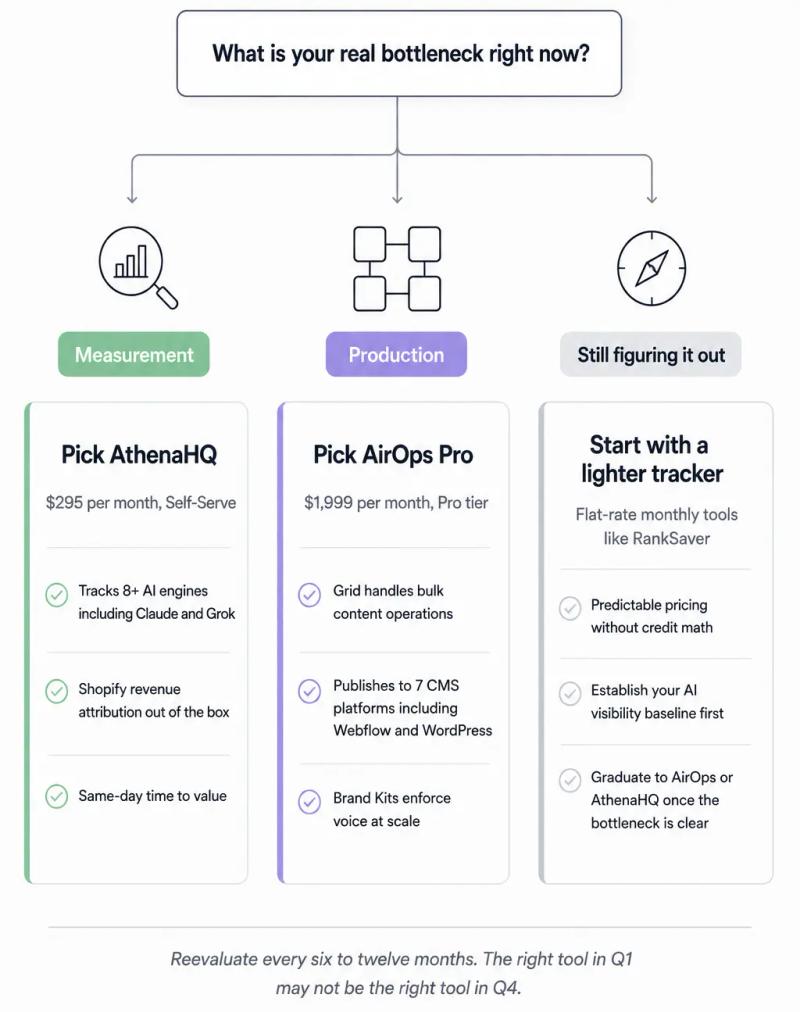
Pick AthenaHQ if your bottleneck is measurement. Your stakeholders are asking where you show up in AI answers, you need broad engine coverage including Claude or Grok, you're on Shopify and want revenue attribution, or you need a defensible reporting layer before you build the production engine.
The platform delivers visibility intelligence faster and at a lower entry price than any direct alternative.
Pick AirOps if your bottleneck is production. You're managing a content library at scale, you publish to multiple CMS targets, and your team has the patience for a one to two week setup investment before the workflows pay back.
The platform is built for high-volume operations, and the Grid plus Brand Kit combination doesn't have a real equivalent anywhere else.
Pick neither yet if you're still in the discovery phase. If your monthly tooling budget is under $300 and your site is under 50 pages, both platforms are oversized.
So, start with a lighter visibility tracker like RankSaver to establish a baseline at a flat monthly rate, identify which problem (measurement or production) actually matters for your business, then graduate to the platform that solves it. Both AirOps and AthenaHQ are easier to justify once you've earned the right to invest at that level.
Closing: The Honest Take
AirOps and AthenaHQ aren't really competing for the same job. AthenaHQ is the right answer when you need to know where you stand in AI search and what to fix next. AirOps is the right answer when you need to produce and publish content at a scale your team can't reach manually.
If you're not sure which bottleneck you have yet, the smart move is to start lighter, build the baseline, and graduate up when the data tells you which problem is the one slowing your growth.
The platform that fits your team in early 2026 may not be the platform that fits you in late 2026, and that's fine. So, reevaluate annually, ask whether the bottleneck has shifted, and resist the urge to buy the more impressive-sounding tool when the simpler one would have done the job.
Frequently Asked Questions
Everything you need to know about this topic.
AthenaHQ is better for visibility tracking and citation depth. AirOps is better for content execution at scale. They're not solving the same problem, so "better" depends on which problem you have.
Partially. AirOps covers four major AI engines through Page360 but lacks AthenaHQ's prompt volume modeling, eight-engine breadth, citation prediction, and Shopify revenue attribution.
No. Both sit on top of your traditional SEO stack rather than replacing it. AirOps integrates directly with Semrush, Ahrefs, Moz, and DataForSEO for research workflows.
Yes. RankSaver combines SEO and GEO with content creation. GetMint offers a content studio with predictable pricing. RankSaver also targets visibility tracking at a flat monthly rate without credit math. Which one fits depends on whether your real bottleneck is creation, monitoring, or governance.
Written By
Want help getting your brand ranked on Google and cited by AI?
We help businesses build AI visibility through SEO, content, and authority with clear revenue impact.
Book a Strategy Call