
Entity SEO is the practice of optimizing your content around specific "things" — people, brands, places, products, and concepts — instead of just keyword strings.
It helps search engines understand what your content is actually about, so they can rank it for the right queries.
So, in this guide, you'll learn what entities are in SEO, how to find entities for SEO optimization, and how to use them to rank higher in both traditional search and AI-powered results.
What is Entity SEO? (And what are entities in SEO?)
Entity SEO is a search engine optimization strategy that focuses on well-defined "things" — people, organizations, places, products, and concepts — rather than isolated keyword phrases.
Here's what that means in practice.
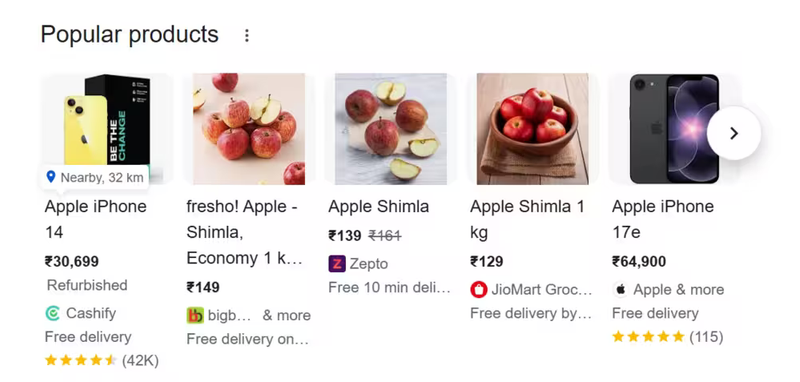
When you type "Apple" into Google, the search engine doesn't just scan the web for pages that contain those five letters. It tries to figure out which Apple you mean.
Are you looking for Apple Inc., the tech company?
Or apple, the fruit?
Google can tell the difference because it understands both as separate entities — distinct things with unique identities, attributes, and relationships to other things.
This is the core idea behind entity SEO.
You're optimizing your content so search engines understand the specific things your page is about. Not just the words on it.
Google made this shift official back in May 2012 when they launched the Knowledge Graph.
The announcement came with a phrase that changed how SEOs think about search:
"Things, not strings."
In other words: Google stopped being a keyword-matching machine.
It became a meaning-understanding machine.
And that's exactly what entity SEO helps you work with.
So what counts as an entity?
Google's own documentation describes it as "a thing or concept that is singular, unique, well-defined, and distinguishable."
That's a broad definition. And it's meant to be.
Entities include:
| Entity Type | Examples |
|---|---|
| People | Elon Musk, Marie Curie, your company's CEO |
| Organizations | Google, NASA, a local law firm |
| Places | Paris, Mount Everest, a neighborhood |
| Products | iPhone 16, ChatGPT, a SaaS platform |
| Concepts | Machine learning, climate change, SEO |
| Events | The Olympics, Black Friday, a product launch |
Each recognized entity gets a unique ID inside Google's system.
Apple Inc. has the Knowledge Graph Machine ID (KGMID) /m/0k8z.
Apple, the fruit, has /m/014j1m.
Two completely different entries in Google's database, even though they share the same word.
That distinction is what separates entity SEO from traditional keyword SEO.
What's the difference between an entity and a keyword?
A keyword is a text string a user types into a search bar. An entity is the real-world concept that Google maps that string to.
"Tesla" is a keyword. Tesla Inc. (the electric car company) and Nikola Tesla (the inventor) are two different entities.
Entity SEO makes sure Google connects your content to the right one.
Think of it this way:
Keywords are like dictionary entries. Entities are like encyclopedia entries.
A keyword tells you how a word is spelled. An entity tells you everything about the thing behind that word — what it is, what it's related to, and where it fits in the world.
Entity SEO Example: How Google Disambiguates Search Queries
Let's look at a real Entity SEO example to see how this works.
If you search for "Mercury" on Google. Google has to decide between at least five possible meanings:
- Mercury, the planet
- Mercury, the chemical element
- Mercury, the Roman god
- Mercury (the car brand, now discontinued)
- Freddie Mercury, the musician
How does it choose?
Through entity disambiguation.
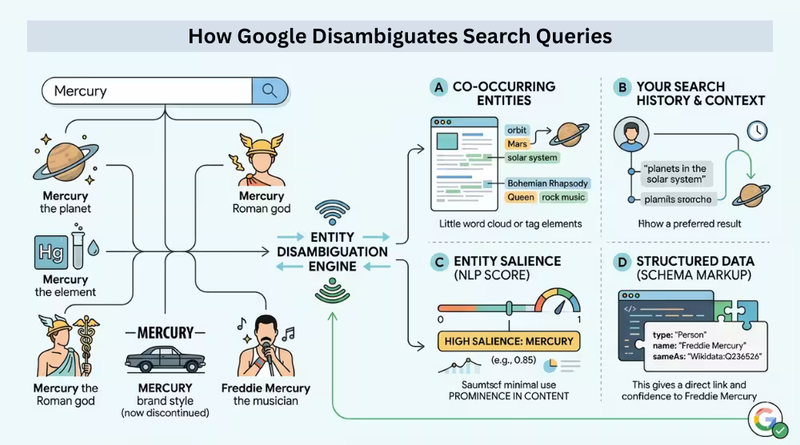
Google looks at several signals to determine which entity you likely mean:
A. Co-occurring entities on a page: If your content mentions "orbit," "Mars," and "solar system" alongside "Mercury," Google is confident you're writing about the planet.
But if it finds "Bohemian Rhapsody," "Queen," and "rock music," it knows you're talking about Freddie Mercury.
B. Your search history and context: If you just searched for "planets in the solar system," Google will lean toward showing you Mercury the planet.
C. Entity salience: This is how prominently an entity appears in a piece of content. Google's NLP algorithms assign a salience score (from 0 to 1) to every entity detected on a page.
The higher the score, the more confident Google is about what the page is actually about.
D. Structured data: If a page uses Schema markup that explicitly identifies the entity (for example, marking "Mercury" as a Person with a link to a Wikidata entry for Freddie Mercury), Google doesn't have to guess.
Here's another Entity SEO example.
Search for "Jaguar speed."
Google could interpret this as the top speed of a Jaguar car or how fast a jaguar (the animal) can run.
It makes the right call by analyzing the surrounding entities on each page. A page that mentions "acceleration," "horsepower," and "F-Type" connects to the car entity. A page with "habitat," "prey," and "big cats" connects to the animal entity.
This is entity disambiguation in action. And it happens billions of times per day.
Why Entity SEO Matters in 2026 & Beyond
Entity SEO has been important since 2012. But in 2026, it's become the mechanism behind almost every major search feature you interact with.
Here's why.
AI Overviews are everywhere. According to BrightEdge data, AI Overviews now appear on approximately 48% of all tracked queries — up 58% year over year. And 99.2% of the keywords that trigger AI Overviews have informational intent. These summaries are assembled from pages where Google clearly understands the entities and their relationships.
Zero-click searches are rising. Data from Semrush shows that AI Overviews reduce clicks to websites by 34.5%. When users do click, they click on the pages cited inside the AI Overview. Your content gets cited when Google trusts your entity data.
LLMs are changing how people find information. ChatGPT now has 883 million monthly users as of January 2026.
And according to Growth Memo's research, ChatGPT is more likely to cite content that has high entity density, uses definite language, and contains a balanced mix of facts and opinions.
In other words, entity-rich content gets cited. Vague content gets skipped.
Google's Knowledge Graph keeps expanding. As of mid-2024, Google's Knowledge Graph contained approximately 54 billion entities and 1.6 trillion facts — up from 5 billion entities in 2020.
In a June 2025 update, Google wiped out over 3 billion low-quality entities in a single week. The message is clear: Google is investing heavily in making its entity database leaner, more accurate, and more central to how search results work.
See the full picture:
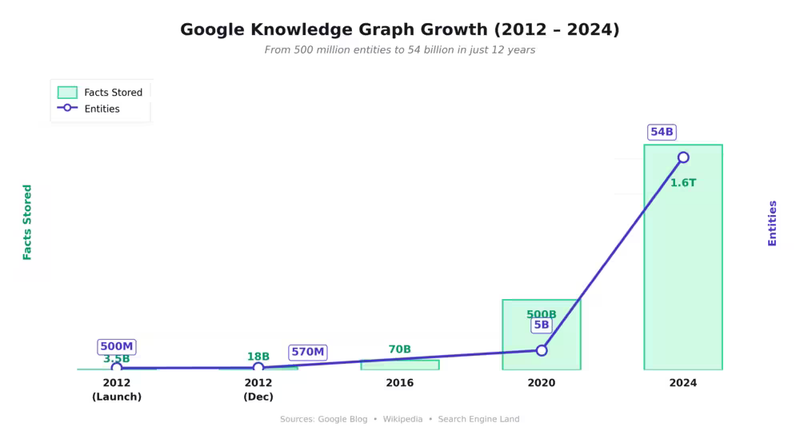
That growth — from 500 million entities to 54 billion in 12 years — tells you where Google is investing.
And here's the part most SEOs miss: Google's June 2025 Knowledge Graph update didn't just remove entities.
It specifically increased the proportion of person entities with E-E-A-T-friendly subtitles (writers, researchers, journalists) by 38%.
Google is connecting content to the people who create it — and treating those people as entities with measurable credibility.
This directly ties entity SEO to E-E-A-T (Experience, Expertise, Authoritativeness, Trustworthiness).
The better Google understands your brand and your authors as entities, the more trust it assigns to your content. So...
Is entity SEO replacing keyword SEO?
No. Keywords still tell you what people type into search bars. Entities tell Google what those searches actually mean.
Entity SEO works on top of keyword SEO. You still need to target the right keywords. But entities determine which pages ranking for those keywords get featured in Knowledge Panels, AI Overviews, People Also Ask, and LLM-generated answers.
Think of keywords as the question. Entities are the answer Google gives back.
How Does Google Use Entities?
Google doesn't just match words anymore. It understands things (Knowledge Graph and Semantic Search).
When you search for something, Google's algorithms identify the entities in your query, connect them to its massive Knowledge Graph database, and use those connections to serve the most relevant results.
Here's how that system works under the hood.
The Knowledge Graph: Google's Entity Database
The Knowledge Graph is Google's structured database of entities and the relationships between them.
Think of it as Google's internal encyclopedia.
Every entry describes a specific thing — a person, company, place, concept, or product — along with facts about it and how it connects to other things.
As of early 2024, the Knowledge Graph contained approximately 54 billion entities and 1.6 trillion facts. That's up from 500 million entities when it launched in May 2012.
But where does all this data come from?
Google built the Knowledge Graph by combining information from multiple sources:
| Freebase | The original structured database that became the Knowledge Graph's foundation (acquired by Google in 2010) |
| Wikipedia | Summary text, biographical facts, and entity descriptions |
| Wikidata | Structured entity data with unique IDs, properties, and relationships (Freebase was merged into Wikidata in 2016) |
| CIA World Factbook | Country data, demographics, and geopolitical facts |
| Google's own crawling | Real-time entity extraction from billions of web pages |
| Licensed data | Sports scores, stock prices, weather data, and medical information from verified providers |
A quick timeline of how it all came together:
2007 → Freebase launches as an open, community-built database of structured information.
2010 → Google acquires Freebase.
May 2012 → Google launches the Knowledge Graph with 500 million entities and 3.5 billion facts.
2016 → Freebase is shut down and its data is merged into Wikidata.
2020 → The Knowledge Graph reaches 5 billion entities and 500 billion facts.
2024 → It grows to an estimated 54 billion entities and 1.6 trillion facts.
That's a 100x increase in entities over 12 years.
And Google is still expanding it — while simultaneously pruning low-quality entries to keep the data clean for AI features. So...
Where does Google store entity data?
Primarily in the Knowledge Graph itself. But Google also maintains a separate system called the Knowledge Vault, which automatically extracts facts from web pages (rather than relying on curated sources like Wikipedia).
The Knowledge Vault was reported to have collected over 1.6 billion facts as far back as 2014.
Together, these systems give Google a layered understanding of entities — from verified facts to real-time web signals.
How Google Detects Entities on a Page (NLP Pipeline)
So Google has a database of 54 billion entities. But how does it figure out which entities appear on your page?
Through a multi-step Natural Language Processing (NLP) pipeline.
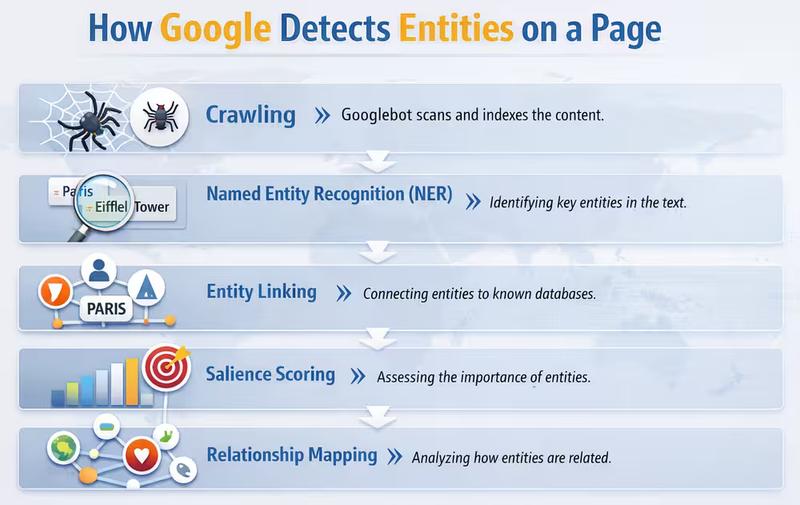
The Simplified version of what happens every time Google crawls a page is:
Step 1. Crawling: Googlebot visits your page and reads the content — text, headings, images, alt tags, Schema markup, and internal links.
Step 2. Named Entity Recognition (NER): Google's NLP algorithms scan the text and identify mentions of specific things — people, organizations, places, products, events, concepts.
Each mention gets classified into an entity type (PERSON, ORGANIZATION, LOCATION, EVENT, WORK_OF_ART, CONSUMER_GOOD, etc.).
Step 3. Entity Linking: Google matches each detected entity to an entry in its Knowledge Graph.
This is where "Apple" gets linked to either /m/0k8z (Apple Inc.) or /m/014j1m (apple the fruit) based on context.
Step 4. Salience Scoring: Google assigns a salience score (from 0 to 1) to each entity on the page. This score reflects how central that entity is to the page's overall content.
A score of 0.9 means the page is fundamentally about that entity. A score of 0.05 means it's a passing mention.
Step 5. Relationship Mapping: Google maps how the entities on your page relate to each other — and how they connect to the broader Knowledge Graph.
If your page mentions "Elon Musk," "Tesla," and "electric vehicles," Google understands those three entities are related and can serve your page for queries about any of them.
You can actually see this process in action using Google's Natural Language API. Paste any block of text into the demo, and it returns the exact entities Google detects — along with their type, salience score, and Knowledge Graph ID.
Here's an example. If you run this paragraph through the API:
"Tesla CEO Elon Musk announced that the company's new Gigafactory in Austin, Texas will begin producing the Cybertruck in 2024."
You'd get output like this:
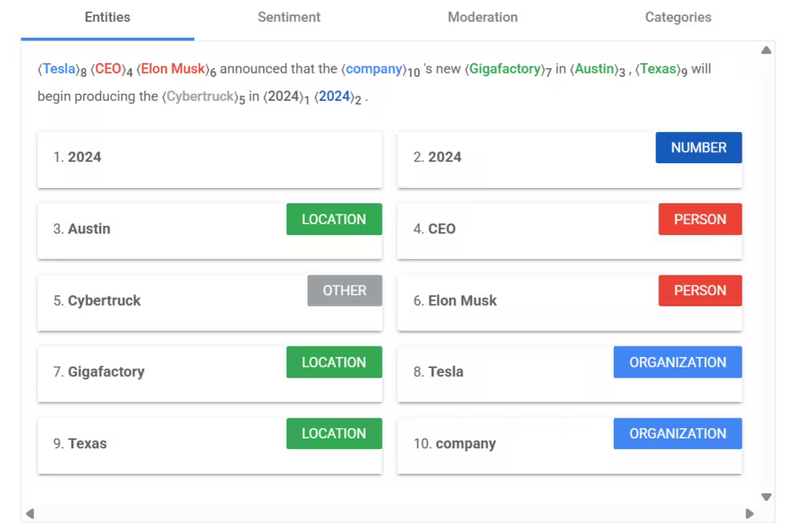
That's exactly how Google "reads" your content. It doesn't see a wall of text. It sees a structured network of things and relationships.
And this is powered by models like BERT and MUM.
BERT (launched in 2019) processes the context around each word bidirectionally — understanding how the words before and after a term shape its meaning.
MUM (announced in 2021) goes further: it understands and generates content across 75 languages simultaneously and can process text, images, and video. According to Google, MUM is 1,000 times more powerful than BERT.
So, for entity SEO, the practical takeaway is simple: Google's NLP can now identify entities on your page with high accuracy across dozens of languages. Your job is to make those entities clear, prominent, and well-connected.
Semantic SEO and Entities: How They Work Together
You've probably heard the term "semantic SEO" before.
And you might be wondering how it relates to entity SEO.
Here's the short version: they're different layers of the same approach.
Semantic SEO focuses on understanding search intent and covering topics comprehensively. Instead of targeting one keyword, you cover the full scope of what a searcher wants to know. You answer related questions, address subtopics, and build content depth.
Entity SEO adds a structured, machine-readable layer on top of that. It maps the specific "things" within your content and defines their relationships — using Schema markup, Knowledge Graph alignment, and entity salience.
So, let's see an analogy that makes this easy to remember:
Semantic SEO makes sure you cover the topic deeply.
Entity SEO makes sure Google knows exactly which things you're covering and how they connect to each other.
You need both.
A page that covers "entity SEO" comprehensively (semantic SEO) but doesn't use Schema markup or mention related entities like Knowledge Graph, Wikidata, and structured data (entity SEO) is leaving value on the table.
Google can understand the topic, but it can't precisely map the things within it.
On the flip side, a page with perfect Schema markup but thin content won't rank either. Google needs both depth and structure.
So...
What's the difference between semantic SEO and entity SEO?
Semantic SEO optimizes for meaning and search intent. Entity SEO optimizes for specific, identifiable things within that meaning — and makes them machine-readable. Semantic SEO gives Google context. Entity SEO gives Google precision. The best-performing content in 2026 uses both together.
Which Google Features are Powered by Entities?
Entities don't just help Google understand your content. They directly power the SERP features that drive the most visibility and clicks.
| Google Feature | How Entities Power It |
|---|---|
| Knowledge Panels | Triggered when Google recognizes a query as a specific entity (a person, brand, place, etc.) and pulls structured facts from the Knowledge Graph |
| AI Overviews & AI Mode | Google's AI assembles synthesized answers by mapping entity relationships across multiple sources — 48% of all tracked queries now trigger an AI Overview |
| People Also Ask | Generated from entity-relationship graphs — Google surfaces related questions based on how entities connect to each other |
| Featured Snippets | Entity salience determines which page gets extracted — the page where Google most confidently identifies the target entity tends to win the snippet |
| Google Discover | Matches content to users based on entity-based interest profiles — Google tracks which entities you've engaged with and serves more content about related entities |
| Google Shopping | Product entities with structured Schema data (price, availability, reviews) appear in product Knowledge Panels and shopping carousels |
| Voice Search / Google Assistant | Direct-answer queries ("Who is the CEO of Tesla?") are resolved through entity lookups in the Knowledge Graph |
These features collectively appear on the majority of page-one results for informational queries.
AI Overviews alone appear on 48% of tracked queries, Knowledge Panels show up for most branded and entity-specific searches, and People Also Ask boxes are present on roughly 65-70% of search results.
So, if your content doesn't have clear entity signals, you're invisible to most of these features.
How to Find Entities for SEO Optimization
As we know what entities are and how Google uses them.
Now comes the practical part: how to find entities for SEO optimization on your own pages and your competitors' pages.
Step 1: Identify Your Core Entities
Every website has a set of primary entities that define what it's about.
So, before you optimize anything, you need to know what yours are.
Start with four questions:
- What is your brand? Your company name is an entity. So is your founder, your CEO, and any public-facing team member.
- What do you sell or offer? Each product, service, or tool is a separate entity.
- Where are you located? Your city, region, or headquarters is a location entity.
- What topics do you cover? Each core subject area on your blog or resource center maps to a concept entity.
For example, if you run a project management SaaS tool, your core entities might include: your brand name, the product name, "project management" (the concept), "Gantt charts" (a feature entity), and your CEO (a person entity).
Once you have your list, check whether Google already recognizes them.
How do I know if my brand is already an entity in Google's Knowledge Graph?
Search your brand name on Google. If a Knowledge Panel appears on the right side of the results page, Google recognizes you as an entity.
If there's no panel, you need to build entity signals (more on that in Section 4).
You can also check programmatically using the Google Knowledge Graph Search API.
Enter your brand name, and the API returns whether a matching entity exists — along with its type, description, and Knowledge Graph ID.
Step 2: Use SEO Entity Tools to Extract and Analyze Entities
Once you know your own entities, you need tools to find entities on any page — yours or a competitor's.
Best SEO entity tools:
| Tool | What It Does | Cost |
|---|---|---|
| Google Natural Language API | Extracts entities from any text, assigns types, salience scores, and Knowledge Graph IDs | Free tier available (5,000 units/month) |
| InLinks | Automated entity extraction, topic modeling, internal linking based on entity relationships | Paid (starts at $39/month) |
| TextRazor | NLP API that identifies entities, topics, and relationships at scale — useful for auditing hundreds of pages | Free tier (500 requests/day) |
| Wikidata | Open-source entity database — search any concept and see all related entities, properties, and IDs | Free |
| Dandelion API | Entity extraction and semantic analysis API with multilingual support | Free tier available |
| SEMrush Topic Research | Surfaces semantically related subtopics and questions — useful for identifying related entities around a keyword | Paid (part of SEMrush subscription) |
The best way to find SEO entities on any page?
Google's Natural Language API.
- Go to the API demo page
- Paste a block of content (your page or a competitor's page)
- Click "Analyze"
- Review the output: entity name, entity type, salience score, and Wikipedia/Knowledge Graph link
The salience score is the number to pay attention to.
It tells you which entities Google considers most important on that page. If your target entity scores below 0.5, you have work to do.
Step 3: Find Related Entities for SEO
Finding your primary entity is the easy part. The real leverage comes from finding related entities — the connected concepts that build context around your main topic.
Why?
Because Google doesn't evaluate entities in isolation. It evaluates them as part of a network. A page about "Entity SEO" that also covers Knowledge Graph, Schema markup, NLP, and Wikidata sends stronger relevance signals than a page that only mentions the term by itself.
How to find related entities for SEO:
Use Wikidata's relationship properties: Go to Wikidata and search for your main topic. Look at the "instance of," "subclass of," "part of," and "related to" properties. These show you how your entity connects to other entities in the database.
Mine Google's "People Also Ask" and "Related Searches": These SERP features are generated from entity-relationship graphs. Every question and related term is a clue about which entities Google associates with your topic.
Use InLinks' topic graph: InLinks visualizes entity clusters for any topic — showing you which entities are most closely related and which ones your content should cover.
Analyze Wikipedia's internal links: Open the Wikipedia page for your topic. Every blue hyperlink is a related entity. Wikipedia's editors have already mapped the relationship network for you.
Now, let's see what a related entity map looks like:
| Relationship Level | Related Entities |
|---|---|
| Core (must mention) | Knowledge Graph, Schema markup, structured data, semantic search |
| Close (should mention) | Wikidata, BERT, Named Entity Recognition (NER), salience score, E-E-A-T |
| Supporting (adds depth) | Freebase, Knowledge Vault, Google Natural Language API, topic clusters, JSON-LD |
Now, the question is...
How many related entities should I cover in a single article?
There's no magic number, but a pattern emerges when you analyze top-ranking pages. The guides that rank in the top 3 for competitive informational queries typically mention 15-25 distinct entities with natural, contextual references. Not stuffed in. Woven into the explanation.
The goal is coverage, not keyword density. If an entity is relevant to your topic and helps the reader understand it better, include it.
Step 4: Run an Entity Gap Analysis Against Competitors
This is the step that gives you a competitive edge.
Here's the process:
- Pull the top 5 ranking pages for your target keyword
- Run each page through Google's Natural Language API or TextRazor
- Export the entity lists from all 5 pages
- Build a comparison spreadsheet with three columns:
| Column | What It Tells You |
|---|---|
| Entities all 5 pages mention | Table-stakes entities — you must cover these to compete |
| Entities only 2-3 pages mention | Differentiating entities — covering these helps you stand out |
| Entities no page mentions | Gap entities — covering these gives you unique depth no competitor has |
The third column is where the real opportunity lives.
For example, when we analyzed the top 5 pages ranking for "Entity SEO," we found that every page mentions Knowledge Graph, Schema markup, and semantic search. Most mention Wikidata and BERT.
But very few cover Knowledge Vault, MUM's multilingual entity processing, or entity salience scoring in any practical detail.
Those gaps are your advantage.
How to Use Entities for SEO Optimization
Finding entities is half the equation. Using them to actually improve rankings is the other half.
This section covers five specific tactics — from structuring your content for entity salience to implementing Schema markup and building your brand into a recognized entity.
1. Establish Entity Salience in Your Content
We covered what salience scoring is in Section 2. Now let's talk about how to control it.
Entity salience tells Google how important a specific entity is to your page. A score of 0.8 means the page is fundamentally about that entity. A score of 0.1 means it's a footnote.
If you want your primary entity to score 0.7 or higher.
Name the entity early and fully: Don't bury your main topic three paragraphs in. Mention it in your title, your H1, and your opening sentence.
Use the full, unambiguous name first ("Apple Inc." instead of "Apple"), then use shorter references after you've established context.
Front-load co-occurring entities: In the first 300 words, mention 3-5 closely related entities. For a page about "Entity SEO," you'd mention Knowledge Graph, structured data, and semantic search early.
This gives Google immediate context about what network of concepts your page belongs to.
Use headings that contain entity names: Your H2s and H3s are high-salience zones.
A heading like "How Google's Knowledge Graph Uses Entities" carries more entity weight than "How It Works."
Repeat with purpose, not with density: Mention your primary entity naturally 4-6 times across the full article.
Don't stuff it into every sentence. The NLP algorithms measure prominence and placement, not raw frequency.
Here's a before/after example:
| Before (Low Salience) | After (High Salience) |
|---|---|
| This approach to optimization focuses on things rather than keywords. It's been growing in importance since 2012. | Entity SEO focuses on optimizing content around specific things — people, brands, and concepts — rather than keyword strings. Google formalized this approach in 2012 when it launched the Knowledge Graph. |
The second version names the primary entity ("Entity SEO") and a supporting entity ("Knowledge Graph") in the same two sentences.
Google's NLP can immediately identify what the content is about and connect it to the right Knowledge Graph entries.
2. Implement Entity SEO Schema (Structured Data)
Schema markup is the most direct way to tell Google which entities are on your page.
Without it, Google relies entirely on its NLP to figure out what your content is about.
With it, you're giving Google an explicit, machine-readable map of your entities and their relationships.
The entity SEO Schema types that matter most:
| Schema Type | When to Use It | What It Tells Google |
|---|---|---|
| Organization | Your brand or company pages | "This is a specific business entity with a name, logo, and contact information" |
| Person | Author bios, founder pages, team pages | "This is a real person with credentials and a public identity" |
| SoftwareApplication / Product | Product or service pages | "This is a specific product with features, pricing, and reviews" |
| Article + about + mentions | Blog posts and content pages | "This article is about [entity X] and mentions [entities Y and Z]" |
| FAQPage | FAQ sections within content | "These are specific questions and answers about [entity]" |
| SameAs | Any page referencing your brand | "This entity is the same one found on Wikipedia, Wikidata, LinkedIn, and Crunchbase" |
The SameAs property deserves special attention. It's one of the most powerful signals you can send because it links your entity directly to authoritative external databases.
So, let's see a basic Organization Schema with entity-linking looks like in JSON-LD:
{
"@context": "https://schema.org",
"@type": "Organization",
"name": "Your Brand Name",
"url": "https://yourdomain.com",
"logo": "https://yourdomain.com/logo.png",
"sameAs": [
"https://www.wikidata.org/wiki/Q_YOUR_ID",
"https://en.wikipedia.org/wiki/Your_Brand",
"https://www.linkedin.com/company/your-brand",
"https://x.com/yourbrand",
"https://www.crunchbase.com/organization/your-brand"
],
"founder": {
"@type": "Person",
"name": "Founder Name",
"sameAs": "https://www.linkedin.com/in/founder-name"
}
}
And here's an Article Schema that maps content entities using about and mentions:
{
"@context": "https://schema.org",
"@type": "Article",
"headline": "Entity SEO: The Complete Guide",
"author": {
"@type": "Person",
"name": "Author Name"
},
"about": {
"@type": "Thing",
"name": "Entity SEO",
"sameAs": "https://www.wikidata.org/wiki/Q_ENTITY_SEO_ID"
},
"mentions": [
{
"@type": "Thing",
"name": "Knowledge Graph",
"sameAs": "https://en.wikipedia.org/wiki/Knowledge_Graph_(Google)"
},
{
"@type": "Thing",
"name": "Schema.org",
"sameAs": "https://en.wikipedia.org/wiki/Schema.org"
}
]
}
The combination of about (what this page is fundamentally about) and mentions (what other entities it references) gives Google a clean entity map of your entire article.
Does this move the needle?
According to a Tonic Worldwide analysis, rich results capture 58% of clicks versus 41% for non-rich results.
And SearchPilot's controlled testing found that adding Review Schema alone to product pages increased traffic by 20%.
Meanwhile, Marshfield Clinic Health System saw an 80% traffic increase after scaling Schema markup across 50+ sites.
Yet as of 2025, only about 45 million web domains have implemented Schema.org structured data — roughly 12.4% of all registered domains.
That gap is your opportunity.
3. Build Topical Authority Through Entity Clusters
Individual pages rank. But clusters of interconnected pages build authority.
The concept is straightforward: create a network of content where each page covers a specific related entity, and all pages link back to a central pillar.
Google sees this cluster and understands two things: (1) your site covers this topic comprehensively, and (2) the pillar page sits at the center of that expertise.
Here's what an entity cluster for "Entity SEO" looks like:
Pillar page: "Entity SEO: The Complete Guide" (the article you're reading)
Cluster pages (each covering a related entity):
- What Is the Google Knowledge Graph?
- Schema Markup for SEO: A Practical Guide
- Entity Salience: What It Is and How to Optimize for It
- Semantic SEO vs. Entity SEO: Key Differences
- How Google's NLP Processes Web Content
- Wikidata for SEO: How to Create and Use Entity Entries
Each cluster page links back to the pillar using entity-rich anchor text. Instead of "click here" or "read more," you'd use anchor text like "learn how Schema markup defines entities for search engines."
This does two things: it passes topical relevance between pages, and it gives Google's entity-linking algorithms clear signals about which concepts connect to each other.
According to HubSpot's research, sites with well-structured topic clusters see up to 3x more organic traffic growth than sites with isolated, unconnected pages.
How many cluster pages do I need to build topical authority?
For a competitive topic, aim for 8-15 supporting pages around your pillar. Each page should target a distinct related entity — not a keyword variation of the same topic. The goal is to cover the entity network, not to create thin content targeting every long-tail keyword.
4. Strengthen Your Brand Entity
Everything we've covered so far focuses on optimizing content for entities. But there's a higher-level play: making your brand itself a recognized entity in Google's Knowledge Graph.
When Google recognizes your brand as an entity, several things happen:
- You become eligible for a branded Knowledge Panel
- Your content gets associated with a trusted entity (which strengthens E-E-A-T signals)
- LLMs like ChatGPT and Gemini can reference your brand by name with confidence
Step-by-step process to build your brand entity:
1. Create a Wikidata entry: Wikidata doesn't require Wikipedia's notability standards. You can create an entry for your brand with basic properties: name, instance of (company/software/organization), official website, founding date, and founder.
This gives your brand a unique ID in the open-data ecosystem that Google actively pulls from.
2. Build a Wikipedia page (if notable): Wikipedia has strict notability guidelines, so this isn't possible for every brand. But if your company has been covered by independent reliable sources, a Wikipedia page significantly accelerates entity recognition.
3. Claim and complete your Google Business Profile: Fill out every field — name, address, phone number, hours, category, description, photos. This is one of Google's primary sources for local and organizational entities.
4. Ensure NAP consistency everywhere: Your Name, Address, and Phone number must be identical across your website, social profiles, directories (Crunchbase, LinkedIn, Clutch, G2), and any third-party mentions. Inconsistency confuses Google's entity reconciliation process.
5. Build SameAs links across platforms: Your website should link to your official profiles on LinkedIn, Twitter/X, Crunchbase, Wikidata, and Wikipedia (if applicable). And your Schema markup should list all of these in the sameAs property.
6. Get mentioned (not just linked to) by authoritative sources: Entity recognition isn't just about backlinks. Google also tracks unlinked brand mentions across the web. Being named in industry publications, podcasts, interviews, and research — even without a link — contributes to entity signals.
7. Publish author entities on every article: Each content creator on your site should have a bio page with their name, credentials, and SameAs links to their LinkedIn, Twitter/X, and any publications.
Use Person Schema on these pages. Google's June 2025 Knowledge Graph update increased person entities with E-E-A-T-friendly roles (writers, researchers, journalists) by 38% — a clear signal that author entities matter.
5. Optimize for AI Overviews and LLM Visibility
Entity SEO and AI visibility are deeply connected.
AI Overviews assemble their answers by identifying entities in a query, finding pages that cover those entities with high confidence, and synthesizing a response from the best-structured sources.
LLMs like ChatGPT and Gemini work similarly.
ChatGPT is more likely to cite content that has high entity density, uses definite language, and contains simple writing structures.
Lead every section with a direct answer: AI systems extract the opening sentence of a section as the "answer."
Don't start with a question or a teaser. Start with a clear, factual statement that answers the heading directly.
Structure content so each H2 stands alone: AI Overviews often pull from a single section of a single page.
If your H2 section fully answers a question on its own — without requiring the reader to scroll up or down for context — it's a strong candidate for AI citation.
Include specific numbers and facts: LLMs prefer citable specifics over vague claims. "Entity SEO improves rankings" is weak. "Google's Knowledge Graph contains 54 billion entities and 1.6 trillion facts as of 2024" is strong.
The specific claim gives the AI something concrete to reference.
Use Q&A formatting naturally: Bold the question. Answer it concisely in 2-3 sentences right below.
This mirrors how AI systems extract and present information — and it's the exact format that AI Overviews pull from most frequently.
Implement Article + about Schema: As covered in Section 4.2, telling Google explicitly what your article is about through structured data makes it easier for AI systems to identify your page as a relevant source for entity-specific queries.
Common Entity SEO Mistakes (And how to avoid them)
Entity SEO is straightforward in concept. But in practice, most sites get tripped up by the same set of mistakes.
Here are six we see repeatedly — and what to do instead.
Mistake 1: Mentioning entities without establishing context
Dropping the phrase "Knowledge Graph" into your content once doesn't make your page entity-optimized.
Google's NLP needs surrounding context to link that mention to the right Knowledge Graph entry.
The fix: When you reference an entity, give it context within the same sentence or paragraph.
Don't just write "Knowledge Graph." Write "Google's Knowledge Graph, a database of over 54 billion entities." The additional details help Google's entity-linking algorithms make a confident match.
Mistake 2: Skipping structured data entirely
This remains the single biggest missed opportunity. Most sites have zero Schema markup beyond a basic Organization tag — if they have anything at all. Only about 12.4% of registered domains use Schema.org structured data.
Without it, Google relies solely on its NLP to guess what entities your page contains. Sometimes it guesses right. Often it doesn't.
The fix: At minimum, implement Organization Schema with sameAs links on your homepage, Person Schema on author bio pages, and Article Schema with about and mentions on your content pages.
Mistake 3: Inconsistent brand information across the web
Your website says "TaskFlow Inc." LinkedIn says "Taskflow." Crunchbase says "Task Flow Software." Google Business Profile says "TaskFlow App."
Google's entity reconciliation process tries to merge these into a single entity. When the signals conflict, it either picks the wrong one or gives up and treats them as separate, weaker entries.
The fix: Audit every platform where your brand appears. Name, address, phone number, description, and category should be identical everywhere.
This includes your website footer, social profiles, directory listings, press mentions, and any third-party review sites.
Mistake 4: Writing about your topic without covering related entities
A page about "Entity SEO" that doesn't mention Knowledge Graph, Schema markup, structured data, or semantic search is missing the relationship signals that Google expects.
Google evaluates entity coverage as a network. If your page only covers the primary entity without connecting it to related concepts, it looks shallow compared to pages that map the full relationship web.
The fix: Use the entity gap analysis process from Section 3.4. Run competitor pages through an NLP tool, identify which related entities top-ranking pages consistently cover, and make sure your content addresses them naturally.
Mistake 5: Letting entity data go stale
Entities change. Companies rebrand. People change roles. Products add features or get discontinued.
If your Schema markup still lists a former CEO or an outdated product category, you're sending conflicting signals.
The fix: Set a quarterly audit. Review your Schema markup, Wikidata entries, Google Business Profile, and team bio pages.
Update anything that's changed. Google's Knowledge Graph runs major updates multiple times per year — your data needs to be accurate when those updates happen.
Mistake 6: Publishing content without checking salience scores
You spent weeks writing a comprehensive guide. But when you run it through Google's NLP API, your primary entity scores 0.3 — buried behind generic terms and tangential mentions.
This happens more than you'd expect. Long-form content tends to dilute primary entity salience because it covers so many subtopics.
The fix: Run every major piece of content through Google's Natural Language API before publishing. Check that your primary entity scores 0.5 or higher.
If it doesn't, restructure your intro and headings to give the primary entity more prominent placement.
Final Verdict
Entity SEO is how modern search works. Google's Knowledge Graph, AI Overviews, and LLMs all rely on structured entity data to understand content, serve answers, and cite sources.
The workflow is straightforward: identify your core entities, find related entities using tools like Google's NLP API and Wikidata, implement Schema markup to make them machine-readable, and build topical authority through entity clusters.
With WebMCP and agentic search emerging in 2026, entity data is becoming the foundation of both discoverability and actionability. The sites that structure their entities clearly today will be the ones getting featured, cited, and chosen by AI tomorrow.
Frequently Asked Questions
Everything you need to know about this topic.
Through a combination of four signals: entity salience (how prominently the entity appears on the page), co-occurring entities (what other things are mentioned alongside it), structured data (Schema markup that explicitly identifies the entity), and links to authoritative entity sources like Wikipedia and Wikidata.
There's no single published number, but the data paints a clear picture. Knowledge Panels, People Also Ask, AI Overviews, Featured Snippets, and Google Discover all rely on entity understanding. Combined, these features appear on the vast majority of page-one results for informational queries. The pages that show up in these features are the ones where Google clearly understands the entities and their relationships.
Run their pages through an NLP tool, compare entity lists side by side, and look for concepts they mention briefly or skip entirely. The entities that zero competitors cover in depth are your biggest opportunities — they let you add unique value that Google can't find anywhere else on the first page.
Run your published content through Google's Natural Language API. Your primary entity should score 0.7 or higher. Supporting entities should land between 0.1 and 0.4. If your primary entity scores below 0.5, restructure your intro and headings to give it more prominence.
Typically 3-6 months of consistent signals across your website, social profiles, directories, and third-party mentions. A Wikidata entry can accelerate the process, sometimes within weeks. The key factor is consistency — Google needs to see the same entity information confirmed across multiple independent sources before it adds your brand to the Knowledge Graph.
Not implementing structured data. It takes less than an hour to add basic Schema markup to your key pages, and it gives Google an explicit map of your entities that NLP alone can't replicate. Every other tactic in this guide works better when structured data is in place.
Entity SEO won't replace keywords. But it will increasingly determine which keyword-optimized pages get ranked, featured, and cited. As AI becomes a primary search interface, entities are the language machines understand best. The sites that speak that language clearly will win the visibility that matters most.
Written By
Want help getting your brand ranked on Google and cited by AI?
We help businesses build AI visibility through SEO, content, and authority with clear revenue impact.
Book a Strategy Call