
Microsoft added AI visibility insights to Bing Webmaster Tools, including citations, intent, sentiment, and share of voice across Bing and Copilot.
Google Search Console now reports visibility from AI features, including AI Overviews, AI Mode, and AI-powered Discover experiences.
And GA4 can already separate AI referral traffic if you set up the right channel grouping.
So why pay for another dashboard to tell you what your existing analytics stack already shows?
That was the question that stopped me before I even signed up for Peec AI. It turned out to be more interesting than I expected, and it's not really about traffic at all.
In this Peec AI review, I cover:
- What I found after using Peec AI,
- Where the tool provides value,
- Where its limitations start to show.
Peec AI at a glance:
| Category | Details |
|---|---|
| Best for | Brands with an in-house content or marketing team Starting price |
| $95 per month (Starter plan) Free trial | 7 days, no credit card required Standout feature |
| Sentiment and share of voice analysis that traffic tools cannot show One honest limitation | Zero content creation. You still have to act on what it shows you |
Peec AI review: what I think after testing it
Peec AI is worth it if you already have people who can act on what the dashboard shows. It gives you a clearer view of how AI models talk about your brand, how you compare to competitors in AI search, and how AI agents see your site, not just whether they're sending traffic.
You can skip it if you're hoping a subscription alone will close the gaps it finds. Peec AI shows you where you're winning and losing visibility, but it won't tell you how to improve or win it back.
What is Peec AI
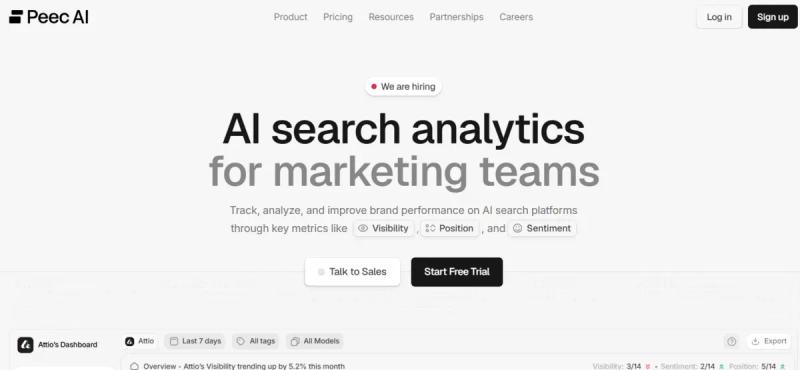
Peec AI is a Berlin-based AI search analytics platform built for marketing teams who need to know how their brand shows up across ChatGPT, Perplexity, Google AI Overviews, AI Mode, Gemini, and Microsoft Copilot.
Founders Marius Meiners, Tobias Siwonia, and Daniel Drabo launched the company in February 2025 after meeting in Antler's Berlin accelerator cohort.
The startup has raised $29 million across 3 rounds, with a $21 million Series A led by Singular closing on November 18, 2025, and Meiners has said the valuation tripled to above $100 million on the back of that round.
The revenue numbers move at a similar pace. Peec AI reported crossing $4 million in annual recurring revenue within 10 months of launch, then more than doubled that to over $10 million in the following months.
The platform now counts more than 2,000 marketing teams as customers, with enterprise names like Wix, Brevo, ElevenLabs, and Attio among them.
Peec AI features analysis
The core dashboard is built around four metrics: Visibility, Position, Sentiment, and Share of Voice. And most of the real value sits in the last two.
Visibility, Position, Sentiment, and Share of Voice
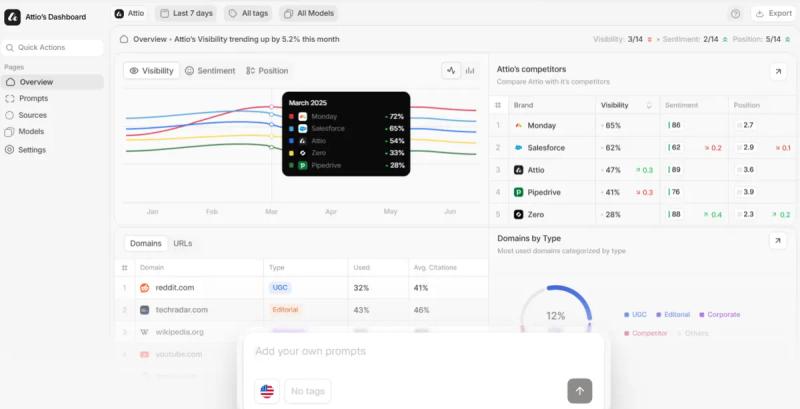
- Visibility tells you the percentage of tracked AI chats where your brand gets mentioned at all.
- Position tells you where you land in a list when a model names multiple brands for the same prompt.
- Share of Voice tells you what percentage of all brand mentions belong to you versus every tracked competitor combined, a sharper read on competitive standing than visibility alone.
- Sentiment is the metric that's genuinely hard to get anywhere else, scored 0 to 100 based on the language surrounding each mention: words like trusted or leading pushing the score up, critical framing pulling it down.
A brand can show up in plenty of AI answers and still come across badly. If ChatGPT consistently frames your pricing as expensive while Perplexity stays neutral, that's a different problem than simply not showing up enough, and it needs a different fix. Raw visibility numbers can't tell you that difference exists. This metric can.
One distinction worth pulling out on its own, because it reframes how you read every other number on the dashboard: Peec AI tracks brand visibility and source visibility separately.
Brand visibility means an AI answer names you directly. Source visibility means your website shaped the answer, even if your name never comes up. A brand cited often but rarely named likely has strong content but weak name recognition.
A brand named often but rarely cited might be a familiar name the model doesn't actually trust as a reference. Those are two different problems most visibility tools collapse into a single number.
Why this beats Google Search Console and GA4 for this specific job
This is the question I opened with, and it deserves a straight answer instead of a marketing one. GSC will show you that AI Overviews are driving impressions. GA4 will show you that ChatGPT and Perplexity are sending referral sessions, assuming your channel grouping catches them.
Both tools measure outcomes. They cannot tell you why a model chose to mention you, how it described you once it did, or whether a competitor got named first in the same answer.
A referral session from ChatGPT looks identical in GA4 whether the model called your product the best option in its category or mentioned it only as a cautionary footnote.
Peec AI sits upstream of that traffic. Instead of waiting for a visitor to click through, it queries the models directly and captures the framing before a single session lands in your analytics.
If your AI referral numbers in GA4 are trending up but you have no idea whether that growth is built on positive or lukewarm mentions, you're optimizing blind. That's the gap GSC and GA4 cannot close, by design, because neither was ever built to see inside the model's answer in the first place.
Citation and Source Tracking
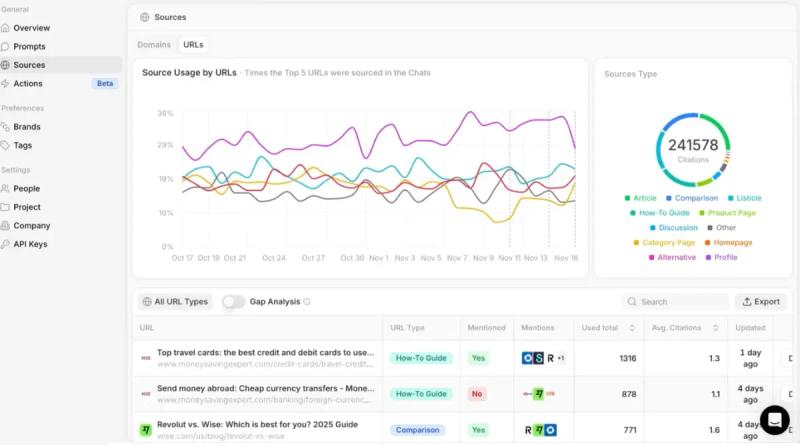
The Sources tab answers a question sentiment scoring can't touch: what is the model actually reading before it talks about you? It splits into two views, Domains and URLs, and both run on real numbers instead of vague categories.
My workspace was tracking over 200,000 citations, broken down by content type: Article, Comparison, Listicle, How-To Guide, Product Page, Discussion, Category Page, Homepage, Alternative, and Profile.
Corporate content made up the largest single slice in my data, which tells you AI models in this category are leaning on brand-owned pages more than third-party coverage to form their answers.
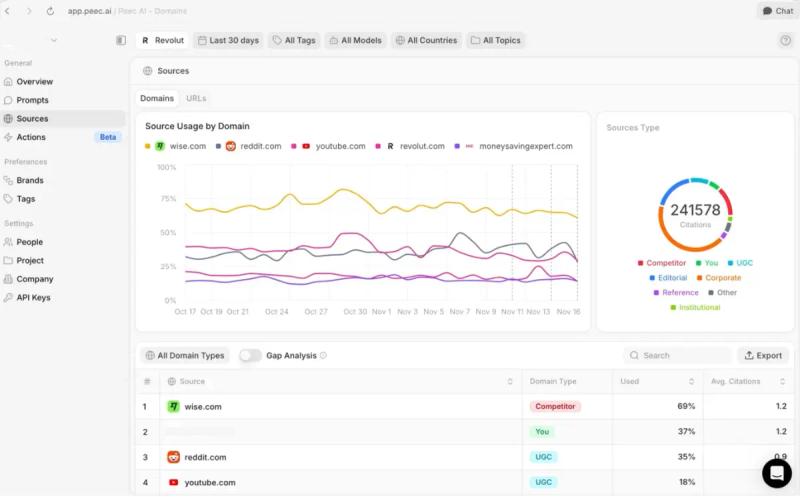
The Domains view goes further by classifying every source as Competitor, You, UGC, Corporate, Editorial, Referral, or Institutional, then tracks Used percentage and Average Citations for each one. Used is the percentage of chats where that domain showed up as a source at all.
Average Citations is how many times, on average, a URL from that domain got cited within a single chat once it appeared. A competitor domain sitting at 69% Used with a strong citation average is a domain actively shaping how models answer questions in your category, whether you like it or not.
There's also a Gap Analysis toggle on both views that filters down to sources you have no presence in at all, which turns the table from a scoreboard into an actual target list.
The URLs view drills down to individual pages, showing whether a specific URL was mentioned at all, which AI engines actually used it, a raw Used Total count, an Average Citations figure, and how recently the page was last pulled into an answer.
A how-to guide getting cited over a thousand times in a month while your own equivalent page sits at zero is a specific, fixable gap. So yes, knowing visibility is down five points tells you something is wrong and the exact URL models keep pulling from instead of yours tells you what to go fix.
AI Shopping
AI Shopping runs at both the brand level and the individual product level, and the brand-level view is more useful than I expected.
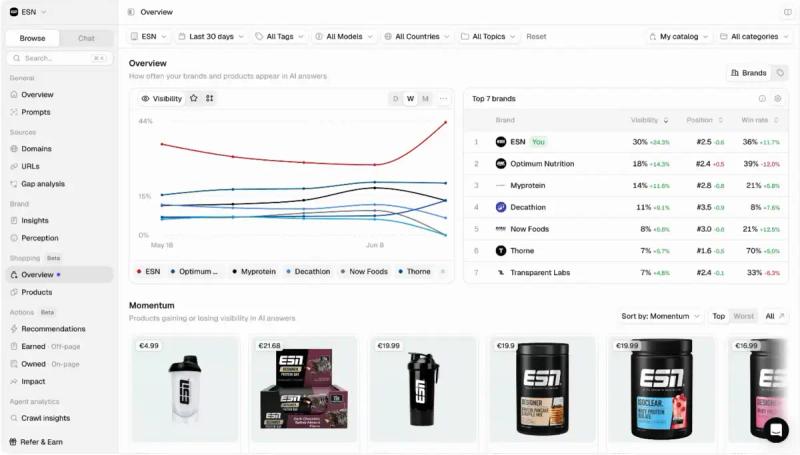
The Overview screen ranks your brand against named competitors on Visibility, Position, and Win rate, with week-over-week momentum on every number. Tracking a supplement brand, I could see it sitting at 30% visibility and #2.5 average position against six named competitors, with a 36% win rate that had climbed nearly 12 points in a month.
That's a direct, scoreboard-style read on whether you're gaining or losing ground in AI shopping recommendations, by name, against the competitors actually contesting your category.
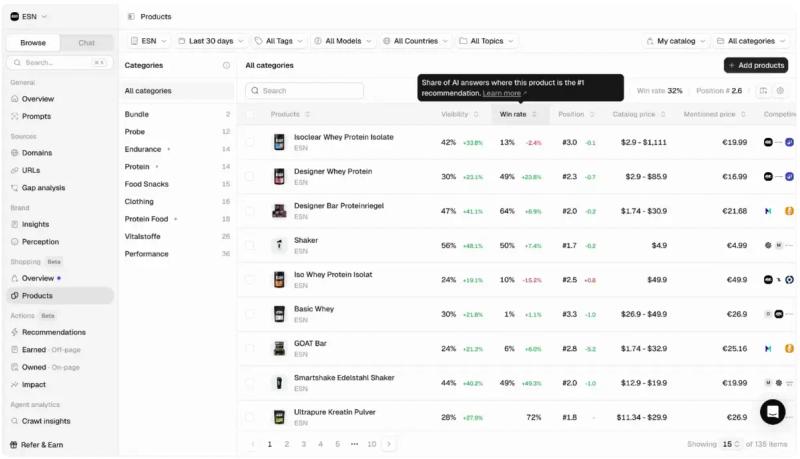
The Products view is where it gets genuinely tactical. Every SKU in your catalog gets its own Visibility, Win rate, Position, catalog price range, and the price AI models are actually quoting for it, plus a column showing which competitor logos keep showing up against it. Win rate has a precise definition here: the share of AI answers where that specific product is the number one recommendation, not just present.
A product sitting at 56% visibility but only a 1% win rate is showing up constantly and losing every time, which is a sharper, more actionable read than a single blended visibility score.
The honest caveat is scope: this currently runs on ChatGPT's shopping experience specifically, since that's where AI product recommendations are furthest along.
Agent Analytics
Agent Analytics is the bigger surprise of the two, and it does more than just log which bots showed up. Connect through Cloudflare, Vercel, or WordPress, and it tracks every AI crawler hitting your site, GPTBot, ClaudeBot, PerplexityBot among them, filtered by intent so you can separate bots training a model from the ones actually generating live answers.
It also audits your robots.txt directly, showing exactly which crawlers you're blocking, allowing, or simply never mentioned, which catches the accidental lockouts most teams never think to check.
On top of that, it flags every URL that returns an error when an AI bot tries to crawl it, and connects crawl activity back to citations, so you can see whether the pages bots visit most actually go on to show up in AI answers.
For a category still being defined in real time, that combination of crawl visibility, robots.txt auditing, and error detection puts Peec AI ahead of most others still treating bot traffic as someone else's problem.
Usability and Onboarding
Setup runs in minutes; you name your workspace, point it at your domain, and Peec AI crawls your own site to generate a starting set of suggested prompts based on what you actually sell or do, rather than handing you a blank box and asking you to guess what your customers ask ChatGPT.
Most of the suggested prompts I reviewed were usable as written, and the ones that weren't took a sentence of editing rather than a rewrite.
The first batch of data takes a day to populate, since prompts run on a 24-hour cadence rather than refreshing every few minutes. Filters for model, country, and tag sit at the top of every view, and clicking into any competitor or chat drills down without losing your place.
Plenty of AI visibility tools try to cram every metric onto one screen. Peec AI didn't do that here.
Pricing and Value for Money
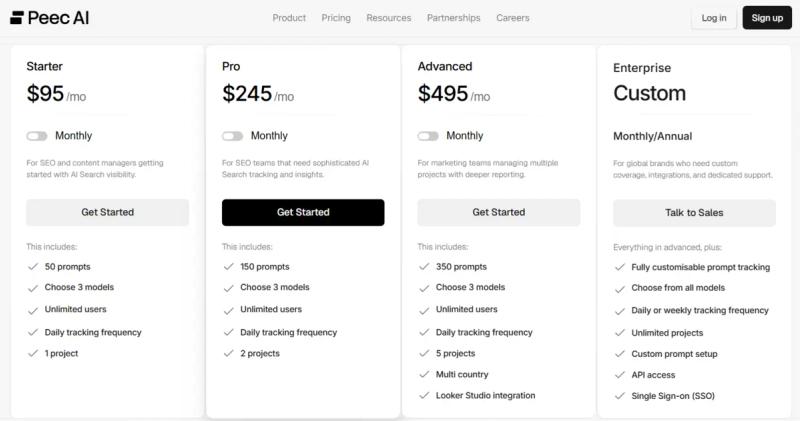
Peec AI's brand plans scale by tracked prompts and project count rather than by feature gates, which keeps the pricing model straightforward even as the dollar figures climb. As of this writing, Starter runs $95 per month for 50 prompts, your choice of 3 AI models, unlimited users, daily tracking, and 1 project.
Pro runs $245 per month for 150 prompts and 2 projects, same model and tracking allowances. And advanced runs $495 per month for 350 prompts, 5 projects, multi-country tracking, and the Looker Studio integration.
Enterprise drops the prompt cap entirely, opens up every model instead of 3, and adds API access plus SSO, priced custom through a sales conversation.
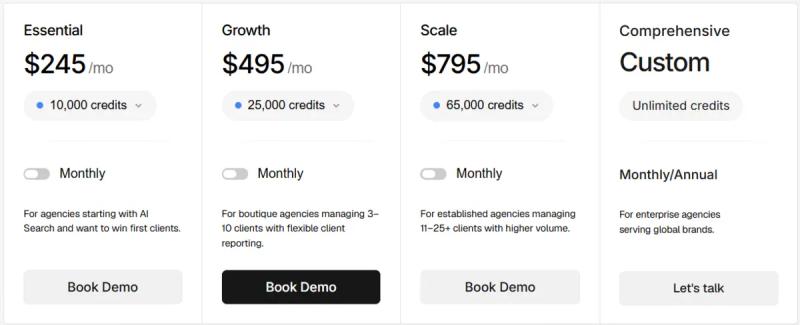
Agencies get their own credit-based structure instead of a flat prompt count. Essential starts at $245 per month for 10,000 credits, aimed at agencies just starting to win their first AI search clients.
Growth runs $495 per month for 25,000 credits, built for boutique agencies managing 3 to 10 client accounts. And scale runs $795 per month for 65,000 credits, sized for established agencies running 11 to 25-plus clients.
Comprehensive offers unlimited credits at custom pricing for enterprise agencies serving global brands.
Unlimited seats on every brand tier is the detail that actually changes the math for a lot of teams. Most analytics tools charge per seat, which means a 5-person marketing team pays a multiple of the sticker price before adding a single extra feature. Peec AI doesn't do that.
A 5-person team and a 50-person team pay the same $95 for Starter, assuming the prompt and project caps fit. With more than 2,500 marketing teams already on the platform, including enterprise names like Wix, Brevo, and ElevenLabs, the value case looks stronger than the entry price alone suggests. So you're not just buying 50 prompts. You're buying 50 prompts with no seat tax attached.
Customer Support and Integrations
Support runs through chat for every plan, with email added on Pro and above. There's no phone line, and SOC 2 certification and SSO are missing below the Enterprise tier, a real gap if your procurement team has a compliance checklist that gates vendor approvals. For a mid-market brand without that constraint, the in-app chat has been responsive enough that the missing phone option hasn't mattered.
The Looker Studio connector on Advanced and above pulls live visibility and source data straight into whatever dashboard your team or client already checks. The MCP server is the more interesting addition.
It connects Peec AI's data directly to tools like Claude, Cursor, and n8n, so instead of exporting a CSV to answer a quick question, you can ask in plain language and get an answer pulled straight from the same data the dashboard shows.
Pros and Cons
Pros
Sentiment and Share of Voice metrics show how AI models actually talk about your brand, a layer GA4 and Search Console were never built to capture. Brand visibility versus source visibility tracking separates two genuinely different problems most competing tools collapse into one number.
Citation and source data down to the domain and URL level turns a vague visibility score into a specific list of pages worth pursuing for PR or content. Agent Analytics ships as a working feature today, built on your own server logs, not a roadmap promise. Unlimited seats on every brand tier means a growing team never pays a seat tax on top of prompt-based pricing.
Cons
There is no content creation or optimization layer anywhere in the product. Every insight still needs a human to act on it elsewhere. Base plans cap you at 3 AI models, and tracking additional engines like Claude or Gemini at scale means a paid add-on.
SOC 2 certification and Single Sign-On are missing below the Enterprise tier, which rules the platform out for procurement-heavy organizations before pricing even enters the conversation. AI Shopping currently covers ChatGPT only, so ecommerce brands hoping for Perplexity and Gemini product tracking will need to wait.
Who should use Peec AI (and Who shouldn't)
Use this if:
You already have an in-house content or marketing team capable of acting on what the dashboard finds, since Peec AI will hand you the gap but never the fix. You're an ecommerce brand specifically testing how your products show up in ChatGPT's shopping carousel, where the AI Shopping feature is already mature enough to act on.
You're running an agency that needs to manage AI visibility reporting across multiple clients without paying a per-seat penalty for a growing team. You want first-party data on which AI bots are actually crawling your site, not just a simulated estimate of model behavior.
Skip this if:
Your marketing function is a single generalist with no bandwidth to act on sentiment or citation gaps once they're identified, since the subscription cost won't translate into results on its own.
Your organization requires SOC 2 or SSO as a baseline procurement requirement, since neither exists below the Enterprise tier. You need broad multi-model coverage, including Claude or Gemini, without paying extra, since the base plans cap you at 3 models by design.
The closing nuance most reviews skip is this: the gap between monitoring and execution that every reviewer flags as Peec AI's weakness is also the reason the category exists as two separate jobs in the first place. A platform that tried to do both well would likely do neither as cleanly as Peec AI does the one job it picked.
Final Verdict
Peec AI does exactly what it sets out to do, and it does the sentiment and citation layer better than the traffic-only view your existing analytics stack already gives you for free.
The 2,000-plus marketing teams and the enterprise logos on its customer list back up that the product has found genuine traction, not just funding momentum. What it won't do is close the gaps it finds for you.
If you've got the in-house team to act on what the dashboard surfaces, this earns its place in the stack quickly. If you're hoping a subscription alone will move the needle, it won't, and no amount of clean UI changes that math.
Frequently Asked Questions
Everything you need to know about this topic.
It can be, specifically through the AI Shopping feature, but the coverage is ChatGPT-only as of June 2026. If your shopping traffic leans heavily on a different model's product carousel, the value here is narrower than the brand-level tracking.
No. This is the most consistent gap across every independent review, including this one. Peec AI shows you where you're losing visibility, sentiment, or citation share. Closing that gap is on your content, SEO, or PR team.
It depends less on team size and more on whether someone can act on what the dashboard finds. A solo marketer who also handles content and outreach can still get value from the Starter plan, but a team with no one able to fix sentiment or citation gaps will be paying for visibility into a problem nobody on staff can solve.
Yes, and this is where the platform is strongest for agency use. Agency plans run on a credit system instead of per-client seats, and every brand tier includes unlimited users, so an agency can bring an entire client team into a shared workspace without paying extra per login.
Written By
Want help getting your brand ranked on Google and cited by AI?
We help businesses build AI visibility through SEO, content, and authority with clear revenue impact.
Book a Strategy Call