
AI search traffic converts at 14.2% vs. 2.8% for Google — yet 73% of websites have technical barriers that block AI crawlers. Your content may be strong, but if it cannot be discovered, it will not be cited.
So, in this guide, I explain what drives AI citations in 2026 and outline practical steps you can apply.
- AI search engines use Retrieval-Augmented Generation (RAG) to pull answers from external sources in real time — so your content needs to be retrievable.
- Each AI platform cites different sources: only 12% of cited domains overlap across ChatGPT, Perplexity, and Google AI Overviews.
- 91% of AI citations come from third-party sources like Reddit, review platforms, and news sites — not your own website.
- Content updated within 3 months is 2x more likely to be cited by ChatGPT than older pages.
- Pages with fast load times (FCP under 0.4s) earn 3x more citations than slow pages.
- Reddit's citation share across AI platforms grew 73% between October 2025 and January 2026.
- A structured first-week action plan at the end of this guide gives you seven concrete moves to start improving visibility today.
How AI Search Engines Actually Choose Which Brands to Cite
Most people think AI search works like Google with a chatbot skin. Type a query, get a ranked list, done.
That's wrong. And the gap between how you think AI selects sources and how it actually selects sources is where most brands lose visibility.
The Open-Book Exam: How RAG Works
AI search engines like ChatGPT, Perplexity, and Google's AI Mode use a process called Retrieval-Augmented Generation (RAG).
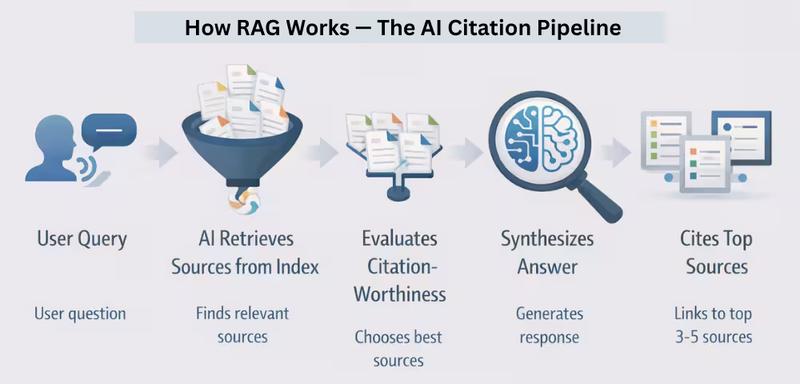
In simple words: When you ask an AI a question, the model doesn't just answer from memory. It runs a real-time search across its index, pulls the most relevant content, and synthesizes an answer from those sources.
Think of it like a journalist writing a sourced story. The journalist doesn't cite press releases. They cite independent analysts, published research, and credible reviews. AI works the same way.
That means two things for your brand:
- Your content needs to be in the index — which requires AI crawlers to access your site.
- Your content needs to look citation-worthy when the AI evaluates it against dozens of competing sources.
Does Ranking #1 on Google Guarantee AI Visibility?
No. And this is the part that surprises most SEOs.
Ahrefs' research found that only 10% of ChatGPT's short-tail query results overlap with Google's top rankings. SE Ranking's data tells a similar story: just 14% of URLs cited by AI Mode rank in Google's top 10.
Google AI Overviews are the exception — 76.1% of their citations come from pages already ranking in the top 10. But even there, that leaves almost a quarter of cited pages coming from outside the traditional winners.
In short, a strong Google ranking helps, but each AI platform has its own criteria for what counts as citable. You can rank #1 on Google and still be completely invisible on ChatGPT.
What Signals Actually Drive AI Citations?
SE Ranking analyzed 129,000 domains and 2.3 million pages to identify the factors that matter most. Four signals consistently predicted whether a page got cited:
1. Domain authority and backlink profile: Sites with over 32,000 referring domains are 3.5x more likely to be cited by ChatGPT than those with 200 or fewer. For AI Mode, sites with 24,000+ referring domains see nearly 3x the citation rate.
2. Third-party brand mentions. Brands with profiles on Trustpilot, G2, Capterra, and similar review platforms have 3x higher chances of being selected as a ChatGPT source. This signal is about credibility validation — the AI checks whether other people vouch for you.
3. Content depth and freshness. Long-form content above 2,900 words performs best for ChatGPT citations. Pages structured into 120–180 word sections earn 70% more citations than those with very short sections. And content updated within the past three months doubles its citation likelihood.
4. Page performance. Pages with a First Contentful Paint (FCP) under 0.4 seconds average 6.7 citations, while pages over 1.13 seconds drop to 2.1. Speed is a citation signal most brands overlook entirely.
The Citation Flywheel Most Brands Miss
Here's what the data points to, but rarely gets said plainly: AI citation authority compounds.
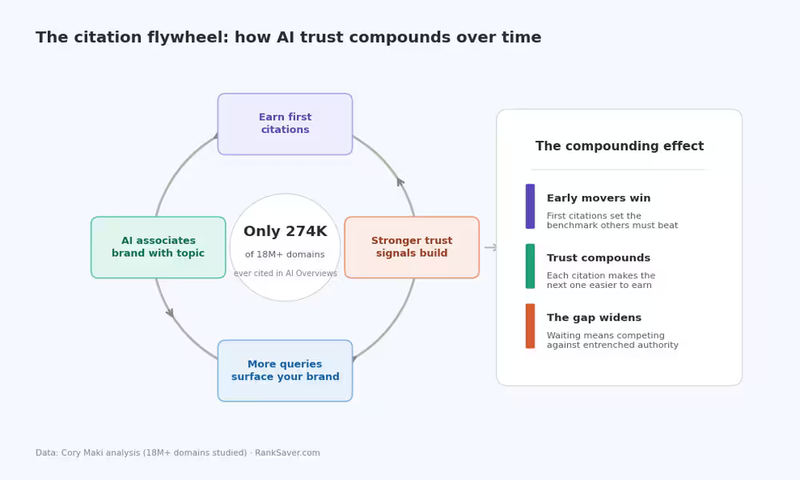
Once an AI system identifies your brand as a reliable source on a topic, it starts pulling from you more frequently across related queries. The brands that earn early citations set a benchmark competitors have to outperform — not just match.
Out of more than 18 million domains in Google's index, only about 274,000 have ever appeared in an AI Overview. That's a small club — and the members are pulling further ahead every month.
The practical takeaway: the cost of waiting isn't just missed traffic today. It's a compounding gap in AI trust signals that gets harder to close with every model update. So…
Build a "Citation-Worthy" Content Architecture
Most brands produce content that reads well for humans but is structurally invisible to AI retrieval systems.
The fix has less to do with what you write and more with how you arrange it on the page. AI crawlers evaluate your content in chunks — and the position, density, and self-containment of those chunks determine whether you get cited or skipped.
Why Your First 300 Words Matter More than Everything Else
Zyppy's analysis of 1.2 million ChatGPT answers found a clear positional bias: 44.2% of all LLM citations come from the first 30% of a page's text. The middle section contributes 31.1%. The final third accounts for 24.7%.
Your introduction carries nearly twice the citation weight of your conclusion.
That means the worst thing you can do is start a page with a company overview, a "welcome to our guide" paragraph, or three sentences of context-setting.
AI retrieval systems scan top-down. If your answer is buried in paragraph 6, the AI has already moved on to a competitor whose answer sits in paragraph one.
The practical move: Place your clearest, most direct answer within the first 40–60 words of every major section. Front-load the claim, then support it with evidence. This mirrors how journalists write — lead with the headline, explain below.
The Ideal Section Structure for AI Citations
| Content Element | Optimal Range | Citation Impact |
|---|---|---|
| Section length between headings | 120–180 words | 70% more citations than sections under 50 words |
| Total article length (ChatGPT) | 2,900+ words | 5.1 citations average |
| Total article length (AI Mode) | 2,300+ words | 5.1 citations average |
| Heading structure | H2 for themes, H3 for specifics | Helps AI parse topic boundaries |
| Content freshness | Updated within 2–3 months | 2x citation likelihood |
The pattern is clear: medium-length sections with distinct headings outperform both walls of text and overly fragmented content.
AI needs enough context within each section to extract a self-contained answer — but not so much that the core point gets diluted.
How to Write "Extractable Snippets" AI Can Cite
AI systems look for what you might call "quotable blocks" — self-contained paragraphs that answer a specific question without needing the surrounding text for context.
If you pull a paragraph out of the page and it still makes complete sense on its own, it's extractable.
If it starts with "as mentioned above" or requires three previous paragraphs for context, the AI will skip it.
Three structural techniques that help:
- Lead each section with a standalone answer paragraph. The first two sentences under each H2 or H3 should directly answer the implied question of that heading. A reader — or an AI — should be able to read just that heading and first paragraph and walk away with a useful takeaway.
- Embed specific data points within sentences. "Content updated within two months earns 28% more citations" is extractable. "Content freshness matters a lot" is not. The Princeton GEO framework found that adding statistics to content boosts AI visibility by up to 40%.
- Use comparison tables and bullet summaries after dense explanations. These function as pre-chunked summaries the AI can lift directly. Listicles account for 21.9% of all AI citations — the highest share of any format — precisely because their structure is inherently extractable.
What Content Format Gets Cited Most?
The answer depends on intent.
Wix and Search Engine Land's March 2026 analysis broke down citation rates by query type:
| Query Intent | Most-Cited Format | Citation Share |
|---|---|---|
| Informational ("how to", "what is") | Articles | 45.48% |
| Commercial ("best", "top", "vs") | Listicles | 40.86% |
| Transactional ("buy", "pricing") | Product pages | 13.7% |
A single format won't cover all your visibility needs. Your content strategy should match the format to the intent of each target query — articles for educational topics, listicles for comparison queries, structured product pages for purchase-ready searches.
The structural work here creates a compounding advantage. Every page you restructure becomes a potential citation source across multiple AI platforms — and each citation reinforces your brand's authority for related queries.
Win the Platform-Specific Citation Game
"Optimize for AI search" is advice that sounds actionable until you realize each AI platform pulls from fundamentally different sources.
Pixelmojo's analysis found that only 12% of cited domains overlap across ChatGPT, Perplexity, and Google AI Overviews. Treat them as one channel and you'll optimize for none of them.
ChatGPT
Wikipedia is ChatGPT's top source, accounting for 7.8% of all citations. Reddit comes second at roughly 11%. The platform uses Bing's index — not Google's — which means a site with zero Bing Webmaster Tools verification might be completely invisible to ChatGPT regardless of its Google rankings.
Two details most guides miss: ChatGPT only cites 15% of the pages it retrieves during a search. And 8 of the top 10 most-cited URLs across AI platforms are "best of" listicles.
If your brand appears in high-authority roundup articles, ChatGPT mirrors those recommendations in over 80% of relevant queries. Read our article on ChatGPT citation factors for better clarity.
Your move: Submit your sitemap to Bing Webmaster Tools. Pursue placement in authoritative "best of" lists in your category.
Google AI Overviews
This is where traditional SEO still carries the most weight. 76.1% of AI Overview citations come from pages already ranking in Google's top 10.
But Google's AI doesn't just grab the top result. It uses a technique called query fan-out — generating sub-queries, searching across all of them, and synthesizing from multiple sources.
Pages that rank for these fan-out queries are 161% more likely to be cited. On average, each AI Overview cites about 7.7 sources.
Your move: Identify the sub-questions your target keyword generates in AI Overviews. Create content that answers those sub-questions directly.
Google AI Mode
AI Mode looks like AI Overviews but behaves very differently. It cites 143% more unique domains and only 13.7% of its citations overlap with AI Overviews.
Organic traffic volume is the strongest predictor here — sites with over 1.16 million visitors are 3x more likely to be cited.
Your move: Prioritize your highest-traffic pages for AI-friendly restructuring first. The traffic they already receive amplifies their citation potential in AI Mode.
Perplexity
Reddit dominates Perplexity. It accounts for 6.6% of total citations — and 24% of all citations in January 2026 came from Reddit alone. Perplexity also offers the most balanced mention-to-citation ratio, meaning when it cites you, users can actually find and click through to your site.
Your move: Authentic participation in relevant subreddits. Not self-promotion — genuine answers to real questions. Perplexity picks up individual threads, not brand profiles.
Read more: SEO vs GEO vs AEO
Quick-Reference: Platform Citation Profiles
| AI Platform | #1 Citation Source | Key Differentiator | Biggest Lever |
|---|---|---|---|
| ChatGPT | Wikipedia (7.8%) | Uses Bing's index, not Google's | "Best of" list placements |
| Google AI Overviews | Top-10 Google results | Query fan-out across sub-topics | Traditional SEO + structured data |
| Google AI Mode | High-traffic domains | 143% more unique domains than AI Overviews | Organic traffic volume |
| Perplexity | Reddit (6.6%) | Strongest Reddit dependency | Subreddit participation |
Each platform rewards a different behavior. A single "AI SEO strategy" that ignores these differences leaves visibility on the table for at least two or three of them.
Leverage Third-Party Platforms AI Systems Actually Trust
The number that changes how most brands think about AI visibility: 91% of AI citations come from third-party sources. Only 9% come from brand-owned websites.
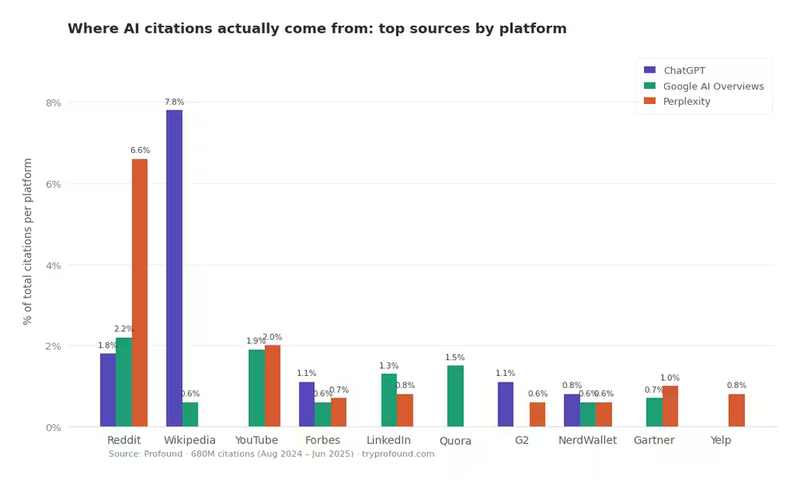
Your own site is one input in a multi-source retrieval system. The broader ecosystem — publications, forums, review platforms, partner content — carries the real weight. So…
Earned Media as a Citation Multiplier
Stacker's research found that distributing content to external publications can increase AI citations by up to 325% compared to publishing only on your own domain.
The reason is mechanical: AI systems cross-reference multiple sources before synthesizing an answer. A claim that appears on your site and in an independent publication looks far more trustworthy than one that exists only on your blog.
Ahrefs' data reinforces this — brands in the top 25% for web mentions get 10x more AI visibility than others.
The play here is digital PR with a citation lens. Guest articles, contributed expert quotes, original research picked up by trade publications — all of these create the third-party validation AI systems use to decide who gets named in an answer.
Reddit: The Most Underestimated Citation Channel
Reddit's citation share grew by at least 73% between October 2025 and January 2026. On Perplexity, 44% of all social media citations in Google AI Overviews came from Reddit in January.
But the mechanic matters: 99% of Reddit citations point to individual discussion threads, not subreddit pages or brand profiles. AI picks up conversations where real users share genuine experiences.
That means dropping a link to your product in a subreddit won't help. Writing a thoughtful, detailed answer to someone's actual question — where your expertise naturally comes through — will. The brands winning Reddit citations are the ones contributing to threads without a sales pitch.
Review Platforms as Trust Validators
Brands with active profiles on Trustpilot, G2, Capterra, Sitejabber, and Yelp have 3x higher chances of ChatGPT citation.
And there's a quality threshold: brands with aggregate review scores below 4.0 are significantly less likely to be cited regardless of content quality.
AI systems treat review platforms as an independent credibility check. Strong ratings reinforce the trust signals from your content. Weak or absent ratings undermine them.
LinkedIn for Professional and B2B Queries
Profound's March 2026 analysis found LinkedIn is the most-cited domain for professional queries across AI Overviews, AI Mode, ChatGPT, Copilot, and Perplexity.
For B2B brands, an active LinkedIn presence — company page, executive thought leadership posts, employee engagement — feeds directly into how AI systems evaluate your authority on industry topics.
Now, the question is…
Can Small Brands Compete?
The data suggests yes, through a focused approach. You won't outpace a Fortune 500 company's domain authority. But you can build niche authority through a combination of Reddit contributions in specific subreddit communities, review platform profiles with consistently high ratings, and original research or data that publications want to reference.
AI systems don't just count mentions — they evaluate relevance to the specific query. A 20-person SaaS company that's the most-mentioned brand in r/projectmanagement threads will outperform a global enterprise that has zero Reddit presence for that topic.
Engineer Your Brand's Entity Identity for AI Recognition
AI systems don't process your brand the way a human does. They build an internal representation — an entity — by collecting every data point about you from across the web.
Your website, LinkedIn profile, directory listings, review platforms, Wikidata entries. All of it feeds into a single picture.
When those data points conflict, the AI's confidence in your brand drops. And low confidence means fewer citations.
The Entity Consistency Audit
Start with the basics: your brand name, business description, core services, and founding details need to match everywhere they appear online.
If your LinkedIn says "AI-powered marketing platform" but your About page says "digital growth consultancy," you're sending mixed signals to the model.
Check these sources for consistency:
- Your website's About page and homepage meta description
- Google Business Profile
- LinkedIn company page
- Crunchbase, Wikidata, and any Wikipedia mentions
- Industry directories (G2, Capterra, Clutch, etc.)
- Social media bios across all platforms
AI models resolve ambiguity by defaulting to the most frequently repeated description. Make sure that description is the one you want.
Structured Data that actually Moves the Needle
FAQ schema markup has no measurable impact on AI citations. Structure beats metadata — the AI cares about how your content reads, not how it's tagged.
What does help: Organization schema and Product schema on your homepage and key service pages. These help AI systems map your brand to specific categories and queries.
When ChatGPT processes the question "best CRM for small teams," Organization schema helps it connect your brand to the "CRM" entity and the "small teams" qualifier.
Also worth implementing: Author schema with verifiable credentials. Pages with identifiable expert authors signal E-E-A-T to AI systems the same way they do to Google's quality raters.
What Doesn't Work
A few tactics that sound logical but have zero evidence behind them:
- LLMs.txt files — SE Ranking's research confirms they have no measurable influence on how ChatGPT or AI Mode selects sources. No major LLM provider is requesting these files.
- Keyword-stuffed URLs and titles — AI systems parse meaning, not keyword density.
- Relying on a .gov or .edu domain — Domain zone doesn't confer automatic trust. Authority comes from signals, not TLD extensions.
Focus your technical effort on entity clarity as well as entity SEO and content structure. Those are the levers that actually influence whether AI systems recognize and cite your brand.
Ensure AI Crawlers Can Actually Access Your Content
None of the strategies above matter if AI crawlers can't reach your pages in the first place.
Otterly.AI's 2026 report found that 73% of websites have at least one technical barrier preventing AI crawler access. Three issues account for nearly all of them.
Robots.txt Blocks
Many sites block AI crawlers by default — often without the site owner knowing. Open your robots.txt file and search for these user-agents: GPTBot, ChatGPT-User, OAI-SearchBot, ClaudeBot, and PerplexityBot.
If any of them show "Disallow: /", your content is invisible to that platform.
User-agent: GPTBot
Allow: /
User-agent: ChatGPT-User
Allow: /
User-agent: PerplexityBot
Allow: /
User-agent: ClaudeBot
Allow: /
User-agent: OAI-SearchBot
Allow: /
CDN and Security Rule Conflicts
Cloudflare, AWS, and Akamai security configurations often block non-browser user-agents automatically.
Your content could pass every SEO audit and still be unreachable by AI crawlers because your CDN treats them as bots to reject.
Check your CDN dashboard for user-agent blocking rules. Test access with: curl -A "GPTBot" https://yoursite.com/article
If it returns a 403 or a challenge page, add AI crawler user-agents to your allowlist.
JavaScript Rendering
Content that requires JavaScript execution may not render for AI crawlers. View your page source (Ctrl+U) — if the main content isn't visible in the raw HTML, AI crawlers likely can't see it either.
Server-side rendering or static HTML fallbacks for critical content sections solve this. Your key answers, data points, and definitions should all be accessible without JS.
Should You Block AI Crawlers to Protect Your Content?
Some publishers choose to block GPTBot and similar crawlers to prevent their content from being used in AI training. That's a valid decision — but it comes with a trade-off. Blocked content can't be cited with a source link, which means you lose the referral traffic advantage. AI might still reference your information from training data, but without attribution or a clickable link back to you.
Measure and Track Your AI Brand Visibility
You can't improve what you don't measure. And traditional SEO metrics — rankings, impressions, CTR — tell you nothing about whether AI platforms are citing your brand.
Only 22% of marketers actively track AI visibility right now. That gap is your competitive intelligence advantage.
The Four Metrics that Matter
Citation frequency. How often does your brand appear in AI-generated answers for your target queries? This is the foundational metric — your presence rate across platforms.
Share of voice. Of all the brands mentioned in AI answers for your category, what percentage of mentions belong to you versus competitors?
Sentiment. AI mentions aren't always positive. Track whether your brand is described favorably, neutrally, or negatively.
BrightEdge's March 2026 research found Google AI Overviews are 44% more likely to surface negative sentiment about brands than ChatGPT. A high citation rate paired with negative sentiment is worse than no citation at all.
Source attribution. Which of your pages get cited, and on which platforms? This tells you where your content architecture is working and where it needs restructuring.
How to Calculate Your Brand Visibility Score
Brand Visibility Score = (AI answers mentioning your brand ÷ Total AI answers for your category) × 100
Test 20–30 high-intent prompts that your buyers actually use. Run them across ChatGPT, Perplexity, Gemini, and Google AI Overviews. Use incognito windows to avoid personalization bias.
If your score is below 15%, you have a visibility gap. Above 30%, you're in a strong position relative to most industries.
How Often Should You Track?
Superlines' data showed a brand can lose a third of its AI visibility in just five weeks. Weekly tracking for your top 10 queries and monthly tracking for your full set of 30–50 gives you enough signal to catch declines before they compound.
Connect Visibility to Business Outcomes
AI citation increases tend to show up downstream in branded search volume, direct traffic, and higher click-through rates on comparison queries.
If your mention rate rises from 10% to 20% over a quarter, track whether demo requests or signups followed the same trajectory.
The connection won't always be one-to-one. But the trend line matters — and it gives you something concrete to show stakeholders beyond "we're optimizing for AI."
Your First-Week Action Plan
Everything above is strategy. Now the checklist.
These seven actions take less than a week and address the highest-leverage gaps most brands have right now:
- Audit your robots.txt: Open yoursite.com/robots.txt and confirm GPTBot, OAI-SearchBot, ChatGPT-User, PerplexityBot, and ClaudeBot aren't blocked. This single fix can unlock visibility across every AI platform.
- Submit your sitemap to Bing Webmaster Tools: ChatGPT uses Bing's index. If you've only verified with Google Search Console, you could be invisible to ChatGPT entirely. Takes five minutes.
- Rewrite the first 150 words of your top 5 pages: Lead with the direct answer. Cut the preamble. Make the opening paragraph extractable without any surrounding context.
- Add Organization and Product schema to your homepage and service pages: Use Google's Rich Results Test to validate your implementation.
- Claim or update profiles on G2, Trustpilot, and Capterra: Match your brand description exactly to what's on your website. Consistent descriptions across platforms strengthen entity recognition.
- Find 3 active Reddit threads in your niche and contribute a useful answer: No links to your product. Just genuine expertise. AI picks up the thread — your brand benefits from association.
- Build a monthly AI visibility tracker: Pick 20 prompts your buyers actually search. Run them across ChatGPT, Perplexity, Gemini, and Google AI Overviews in incognito mode. Record: cited yes/no, which page was cited, sentiment. That's your baseline.
The brands that move on this first will be the ones AI systems learn to trust earliest — and that trust carries forward into every future model update.
Final verdict: Make AI Work for Your Brand
The gap between brands that AI recommends and brands it ignores is growing. Every model update reinforces the trust signals that already exist — making it harder for latecomers to catch up.
You have the data, the framework, and a concrete seven-step starting point. The only variable left is execution.
Pick one section of this guide that addresses your biggest gap right now — whether that's crawlability, content structure, or third-party presence — and start there this week.
Frequently Asked Questions
Everything you need to know about this topic.
Content freshness matters more for ChatGPT — pages updated within three months earn double the citations of older content. AI Overviews also favor recently updated pages, though the correlation is slightly weaker. Perplexity performs real-time retrieval at query time, so fresh data has an even more direct path to citation.
Separate pages for each platform would be overkill. Instead, apply platform-aware tactics to your existing content: submit to Bing for ChatGPT reach, strengthen Google rankings for AI Overviews, and build Reddit presence for Perplexity. One strong page with the right distribution covers multiple platforms.
Run your brand name plus key product queries through ChatGPT, Perplexity, and Gemini in incognito mode. Compare the AI's description against your actual positioning. Inaccuracies often stem from inconsistent brand descriptions across the web — fixing entity consistency (covered earlier in this guide) is the most effective correction.
A mention is when the AI names your brand in its response. A citation is when it links to your content as a source. RankSaver research found that brands that earn both a mention and a citation are 40% more likely to reappear in consecutive AI answers. Citations are stickier than mentions alone.
LinkedIn is the most-cited social domain for professional queries across five major AI platforms. YouTube ranks among the top three citation sources for Google AI Overviews. Active, consistent profiles on these platforms feed into how AI models evaluate your brand authority.
Listicles lead commercial queries at 40.86% citation share. Articles dominate informational queries at 45.48%. Case studies and pricing pages drive the highest AI referral traffic for bottom-funnel conversions. Format should follow query intent, not a single template.
AI-referred visitors arrive further along the buying journey because the AI has already filtered and compared options for them. Ahrefs reported a 23x higher signup rate from AI-referred visitors compared to organic — though results vary by industry and funnel setup.
Paid placements inside AI-generated text don't exist as an ad format yet. However, ads now appear alongside 25.5% of AI Overview results, up 394% from early 2025. The organic citation itself remains earned, not bought.
The answer depends on your audience. ChatGPT has 883 million monthly users and dominates general queries. Google AI Overviews reach the broadest search audience. Perplexity over-indexes on senior leadership — 30% of its users hold leadership roles. Match your platform priority to where your buyers spend time.
Most brands see measurable citation movement within 6 to 8 weeks of consistent execution. Technical fixes like robots.txt and Bing sitemap submission can impact visibility within days. Content restructuring and third-party mention building take two to three months to compound.
Written By
Want help getting your brand ranked on Google and cited by AI?
We help businesses build AI visibility through SEO, content, and authority with clear revenue impact.
Book a Strategy Call