
People search on Google. They ask ChatGPT. They talk to Alexa. And each of these platforms finds and delivers answers differently.
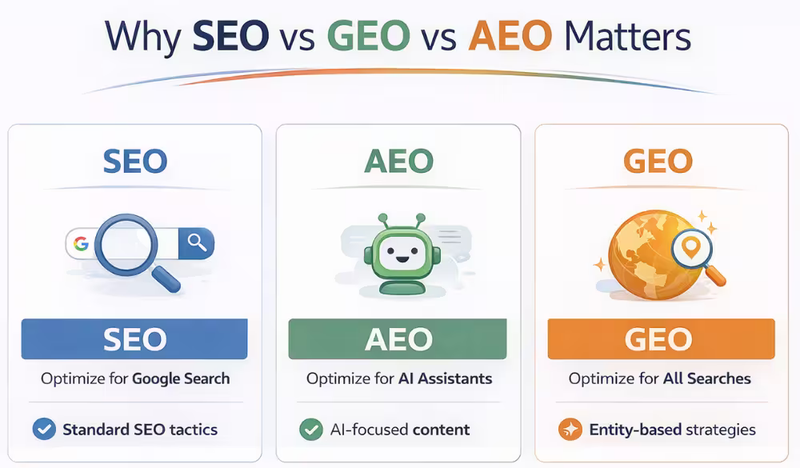
That's where SEO, AEO, and GEO come in — three approaches to make sure your content shows up no matter how someone searches.
So, in this guide, I break down what each one does, how they overlap, and how to use all three together.
- SEO (Search Engine Optimization) gets your pages ranked in Google and Bing. It still drives 53.3% of all website traffic, so it's the foundation everything else sits on.
- AEO (Answer Engine Optimization) makes your content the direct answer in featured snippets, People Also Ask boxes, and voice assistants like Siri and Alexa. It targets "Position Zero" — the spot above the #1 result.
- GEO (Generative Engine Optimization) gets your brand cited by AI platforms like ChatGPT, Perplexity, Google AI Mode, and Gemini. With ChatGPT alone handling 37.5 million queries per day, this is where search is heading fast.
Think of it this way: SEO helps you get found. AEO helps you get chosen. GEO helps you get trusted.
So, first let's understand...
Why this Comparison Matters
Ten years ago, "doing SEO" meant one thing: rank on Google.
That's not the full picture anymore.
Today, your potential customers are spread across multiple search surfaces. They Google things, sure.
But they also ask ChatGPT for recommendations.
They use Perplexity to research products.
They ask Alexa to answer quick questions while cooking dinner.
And each of these platforms pulls and presents information in completely different ways.
Google still processes 13.7 billion searches per day.
So, what makes this tricky:
60% of Google searches now end without a click, according to a SparkToro and Datos study. That means more than half the people searching on Google get their answer right on the results page — from featured snippets, AI Overviews, or People Also Ask boxes.
And AI Overviews now appear for roughly 48% of Google queries. So even on Google itself, the traditional "10 blue links" are shrinking.
The takeaway is simple. If your entire strategy is built around ranking in traditional search results, you're only visible in one lane. Meanwhile, your audience is searching in three.
That's why understanding the difference between SEO, AEO, and GEO matters.
But as three layers of one strategy that keeps your brand visible everywhere people look for answers.
Let's start with the one you probably already know.
What is SEO (Search Engine Optimization)?
SEO is the practice of optimizing your website so search engines like Google and Bing can crawl, index, and rank your pages for relevant queries.
The goal is straightforward: show up higher in organic search results, get more clicks, and drive more traffic to your site.
It's been around for over two decades. And despite all the talk about AI, it remains the single biggest driver of website traffic.
According to BrightEdge research, organic search drives 53% of all trackable website traffic. Paid search drives 15%. Social media drives 5%. Everything else fills in the gaps.
So SEO is still the foundation.
How SEO Works
SEO breaks down into four main areas.
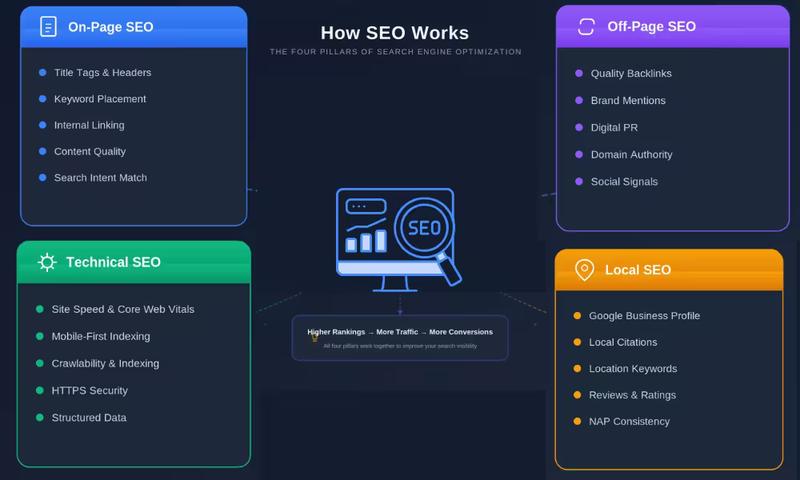
On-Page SEO is about the content on your pages. This includes your title tags, headings, keyword placement, internal links, and the quality of the content itself.
When Google crawls your page, it looks at these elements to understand what the page is about and how relevant it is to a given search query.
Off-Page SEO is about what happens outside your website. The biggest factor here is backlinks — links from other websites pointing to yours. Google treats these like votes of confidence.
The more high-quality, relevant sites that link to you, the more authority your site builds.
According to a Backlinko analysis of 11.8 million Google search results, the #1 result in Google has an average of 3.8x more backlinks than results in positions 2 through 10.
Technical SEO covers the behind-the-scenes stuff. Site speed, mobile-friendliness, crawlability, HTTPS security, Core Web Vitals.
If Google can't easily crawl and index your site, your content won't rank — no matter how good it is.
Local SEO helps businesses show up for location-based searches. This includes optimizing your Google Business Profile, building local citations, and targeting keywords with geographic intent (like "coffee shop in Austin").
SEO in 2026: What's Different
The core principles haven't changed. Quality content, strong backlinks, and solid technical health still matter.
But Google has raised the bar on what it considers quality.
Google's E-E-A-T framework — Experience, Expertise, Authoritativeness, and Trustworthiness — now plays a bigger role in how content gets evaluated.
Pages written by people with real expertise on a topic tend to rank higher than generic, surface-level content.
Google's Helpful Content System also means that content created primarily for search engines (instead of people) can drag down your entire site's rankings. Not just the individual page.
And here's one more thing worth noting:
The first organic result in Google still gets 27.6% of all clicks, according to Backlinko's CTR study. Position 2 drops to 15.8%. By position 10, you're down to 2.4%.
So ranking on page one still matters. A lot.
Who Should Prioritize SEO?
Every business. Full stop.
SEO is the foundation that AEO and GEO are built on. Without a technically healthy website, without content that matches search intent, and without some level of domain authority, the other two layers won't have much to work with.
So, whether you run an e-commerce store, a SaaS company, a local service business, or a media site — SEO is where you start.
AEO (Answer Engine Optimization) — The art of being the answer
AEO is the practice of structuring your content so search engines and AI assistants can pull it out and display it as a direct answer. Think featured snippets, People Also Ask boxes, knowledge panels, and voice search responses.
Where SEO gets you on the page, AEO gets you above the page — into what's called "Position Zero."
How AEO Works
AEO focuses on three core tactics.
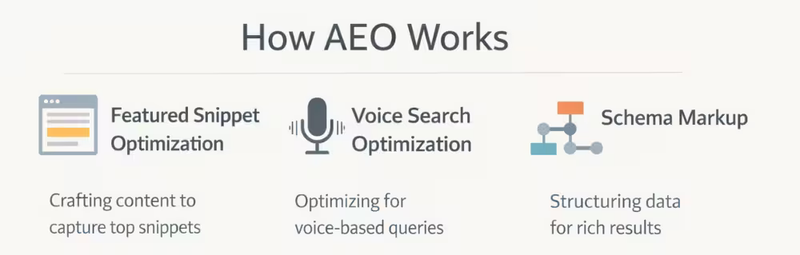
1. Featured Snippet Optimization:
When someone searches "what is domain authority," Google often pulls a short paragraph, list, or table from a webpage and displays it right at the top of the results.
That's a featured snippet. And it shows up above the #1 organic result.
To win this spot, your content needs to answer common questions in a clear, concise format.
Short paragraphs (40–60 words), numbered lists, and comparison tables all perform well here.
According to an Ahrefs study of 2 million featured snippets, when a featured snippet appears, it captures about 8.6% of clicks. Meanwhile, the first organic result below it drops from 26% to 19.6%.
That means the snippet is pulling clicks directly from the #1 spot.
2. Voice Search Optimization:
When someone asks Siri "what's the best way to clean a coffee maker?" — the answer Siri reads back comes from somewhere. Usually, it's from a featured snippet or a well-structured FAQ.
Voice queries are longer and more conversational than typed searches.
So your content needs to match that tone. Instead of targeting "coffee maker cleaning," you'd target "how do I clean my coffee maker at home."
Google's own data shows that 27% of the global online population uses voice search on mobile. That's a massive audience asking questions in full sentences.
3. Schema Markup:
This is structured data you add to your HTML that tells search engines exactly what your content contains.
FAQ schema, HowTo schema, and Q&A schema all help engines parse your content and display it in rich results.
You won't see schema on the page itself. But Google uses it behind the scenes to decide whether your content qualifies for enhanced SERP features.
AEO in 2026 — Why It Matters
Featured snippets used to be a nice bonus. Now, they're often the only result users see.
With 60% of Google searches ending in zero clicks, Position Zero is where a huge share of user attention goes. If your content doesn't show up there, someone else's will.
And it goes beyond just Google. Smart speakers like Alexa and Google Home don't show ten blue links.
They give one answer. One. AEO is how you become that answer.
The combination of voice search growth and zero-click behavior makes AEO a critical layer for any brand that answers questions their audience regularly asks.
Who Should Prioritize AEO?
AEO is especially valuable for local businesses that answer quick questions ("what time does the pharmacy close"), healthcare and legal sites with FAQ-heavy content, how-to publishers, and any brand where customers search with question-based queries.
If your audience is asking "what," "how," or "why" questions — AEO should be part of your strategy.
GEO (Generative Engine Optimization) — The strategy for being trusted by AI
GEO is the practice of optimizing your content so generative AI platforms — ChatGPT, Google Gemini, Perplexity, Claude, and Google AI Mode — can understand it, synthesize it, and cite it in their responses.
This is the newest layer of search optimization. And it works very differently from SEO and AEO.
Traditional search engines rank pages. AI platforms don't rank anything. They read content from across the web, synthesize it, and generate a new response.
So, if your content gets referenced in that response, your brand gets visibility. If it doesn't, you're invisible — even if you rank #1 on Google.
How GEO Works
GEO comes down to five things.
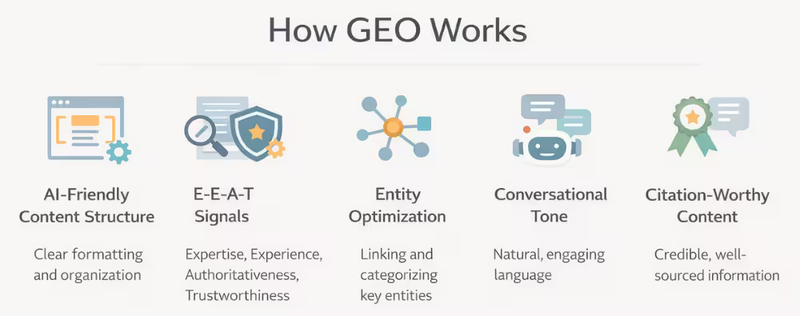
1. AI-Friendly Content Structure:
LLMs don't read your page the way a human does. They pull specific passages. So each section of your content needs to stand on its own.
Clear headings, self-contained paragraphs, and logical flow all make it easier for AI to extract and reference your content.
Think of each section as a potential "quote" that an AI might use in its answer.
2. E-E-A-T Signals:
Google uses E-E-A-T (Experience, Expertise, Authoritativeness, Trustworthiness) to evaluate content quality. AI platforms rely on similar trust signals.
Content from authors with real credentials, sites with strong reputations, and pages backed by original research tend to get cited more often.
If your blog post has no author bio, no sources, and no unique perspective — an AI model has little reason to trust or reference it.
3. Entity Optimization:
LLMs understand the web in terms of entities — people, brands, concepts, places — and the relationships between them.
If your brand's name, terminology, and descriptions are consistent across your website, Wikipedia, Crunchbase, LinkedIn, and other platforms, AI models can build a stronger "understanding" of who you are.
Inconsistent naming or fragmented brand signals make it harder for AI to confidently cite you.
4. Conversational Tone:
AI responses sound conversational. So the content they pull from tends to be conversational too. Stiff, overly formal writing is less likely to get synthesized into a natural-sounding AI answer.
So, write the way you'd explain something to a smart colleague. That's the tone AI platforms tend to favor.
5. Citation-Worthy Content:
This is the big one. AI models cite content that adds something original. Unique data, proprietary research, new frameworks, expert quotes — these are the things that get referenced.
If your page just restates what ten other pages already say, there's no reason for an AI to pick yours.
GEO in 2026 — The Numbers
The scale of AI-powered search is hard to overstate.
ChatGPT now has over 900 million weekly active users, up from 400 million in February 2025. That growth happened in under a year.
Perplexity serves over 100 million queries per month and growing.
According to NP Digital data, 93.7% of ChatGPT searches are informational. That means nearly all of them are questions about topics, products, comparisons, and how-to processes. The exact kind of content most brands create.
And on Google itself, AI Overviews now appear for roughly 47% of search queries. So even within traditional search, AI-generated answers are taking up more and more space.
This is what "Search Everywhere Optimization" looks like in practice.
Your content needs to perform across traditional search results, featured snippets, voice responses, and AI-generated answers. GEO covers that last piece.
Who Should Prioritize GEO?
GEO matters most for B2B companies, SaaS brands, thought leaders, publishers, and anyone competing for informational queries.
If your audience is researching solutions, comparing options, or exploring ideas — there's a strong chance they're doing it in ChatGPT or Perplexity.
If you create in-depth content and want it to reach people who never open a Google search tab, GEO is how you get there.
SEO vs AEO vs GEO: Head-to-head comparison
Now that you know what each approach does individually, let's put them side by side.
It covers the key differences across ten dimensions — from goals and platforms to content format and measurement.
| Feature | SEO | AEO | GEO |
|---|---|---|---|
| Primary Goal | Rank high in organic search results (Google, Bing) | Become the direct answer in Position Zero, voice responses, and PAA boxes | Get cited and referenced by generative AI platforms in their responses |
| Target Platforms | Google, Bing, Yahoo, DuckDuckGo | Voice assistants (Siri, Alexa, Google Assistant), Featured Snippets, Knowledge Panels | ChatGPT, Perplexity, Google Gemini, Google AI Mode, Claude |
| Content Format | Long-form blog posts, landing pages, product pages, guides | Concise Q&A sections, FAQ pages, short-answer paragraphs (40–60 words), comparison tables | In-depth, authoritative content with self-contained sections, original data, and expert citations |
| Key Metric | Organic traffic, keyword rankings, click-through rate | Featured snippet impressions, voice search appearances, zero-click visibility | AI share of voice |
| Optimization Focus | Keywords, backlinks, technical site health, internal linking | Schema markup | Entity clarity, E-E-A-T signals, original insights, consistent brand signals across the web |
| User Behavior | Types keywords, browses results, clicks a link | Asks a specific question, expects an instant answer without clicking | Has a conversation with AI, expects a synthesized response with trusted sources |
| Traffic Model | Click-based — user visits your site from search results | Zero-click — answer appears directly on the SERP or spoken by a voice assistant | Citation-based — AI references your brand, user may visit your site later or not at all |
| Content Length | Medium to long (1,500–5,000+ words) | Short and precise (40–60 word answer blocks within larger pages) | Deep and comprehensive (2,000+ words with quotable, standalone passages) |
| Authority Signals | Backlinks, domain authority, page authority, referring domains | Schema implementation, content clarity, source reliability, direct answer quality | Brand mentions across the web, expert credentials, original research, third-party citations |
| Measurement Tools | Google Search Console | schema validators | Semrush AI Toolkit |
How to Combine SEO, AEO, and GEO
You don't run three separate strategies. You build one strategy with three layers.
Think of it as a pyramid.
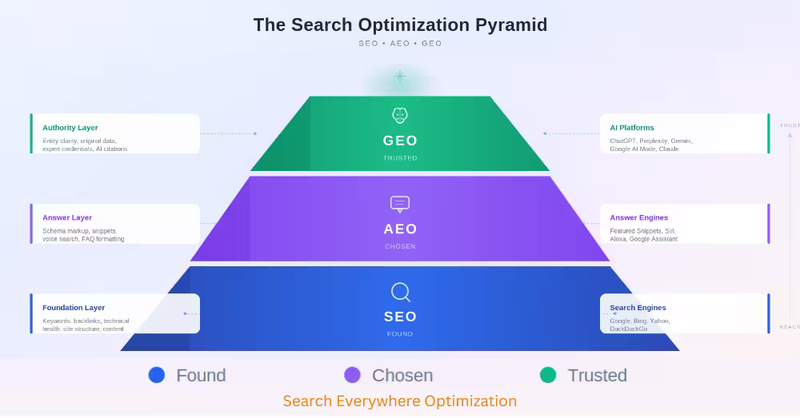
The Foundation Model
Layer 1 — SEO (Foundation):
This is the base. Your site needs to be technically healthy, fast, mobile-friendly, and easy to crawl.
Your content needs to target the right keywords. And you need backlinks from relevant, authoritative sites.
Without this layer, the other two have nothing to build on. A slow site with thin content won't win featured snippets. It won't get cited by ChatGPT either.
Layer 2 — AEO (Answer Layer):
Once your foundation is solid, you format your best content for direct answers. This means adding FAQ sections with schema markup, writing concise answer paragraphs right below your H2 headings, and structuring content with comparison tables and numbered lists.
This layer takes the content you already created for SEO and makes it extractable — ready for featured snippets, PAA boxes, and voice assistants.
Layer 3 — GEO (Authority Layer):
The top of the pyramid is about trust. You build entity clarity so AI platforms know exactly who you are.
You create original research, proprietary data, and unique frameworks that give LLMs a reason to cite you instead of ten other sites covering the same topic.
This layer also extends beyond your own website. Brand mentions in industry publications, expert quotes in third-party articles, consistent profiles across LinkedIn, Crunchbase, and Wikipedia — these all feed the signals AI models use to decide who to reference.
A Practical Example
Let's say you're writing an article targeting "best project management tools for startups."
Here's how all three layers apply to that single piece of content.
SEO layer. You research the keyword, check search volume and difficulty, and map the search intent (comparison/listicle).
You write a comprehensive post with a clear heading structure. You add internal links to related pages on your site. You build a few quality backlinks through outreach.
At this point, you have a page that can rank.
AEO layer. You add a short, direct answer (under 50 words) right below the H1: "The best project management tools for startups in 2026 include Asana, Monday.com, Notion, and Linear — based on ease of use, pricing, and integrations."
You include a comparison table breaking down features, pricing, and free tiers.
You add an FAQ section at the bottom with schema markup covering questions like "What is the cheapest project management tool?" and "Do startups need project management software?"
Now that same page is eligible for featured snippets and voice results.
GEO layer. You run a small survey of 200 startup founders about which tools they actually use and include the results as original data.
You add a quote from a product manager at a well-known startup.
Your author bio includes real credentials — "SaaS consultant with 8 years of experience advising early-stage companies." Each tool review section is self-contained, so ChatGPT can pull any one of them as a standalone recommendation.
Now that same page can get cited by AI platforms.
One piece of content. Three layers. Each one builds on the one before it.
The 80/20 Rule
If you're already doing solid SEO — writing helpful content, targeting the right keywords, building backlinks, keeping your site technically clean — you're already doing about 80% of what AEO and GEO require.
The remaining 20% is where you go further.
Adding schema markup to your FAQ sections. Writing those concise, extractable answer blocks under each heading. Including author bios with real expertise. Creating original data points that nobody else has.
Making sure your brand name and descriptions are consistent everywhere they appear online.
That 20% is what separates a page that ranks from a page that ranks, gets featured, and gets cited by AI.
How to Optimize for SEO, AEO, and GEO — A unified checklist
This checklist covers the specific things you can do across content, authority, technical setup, and measurement. Use it as a reference every time you create or update a piece of content.
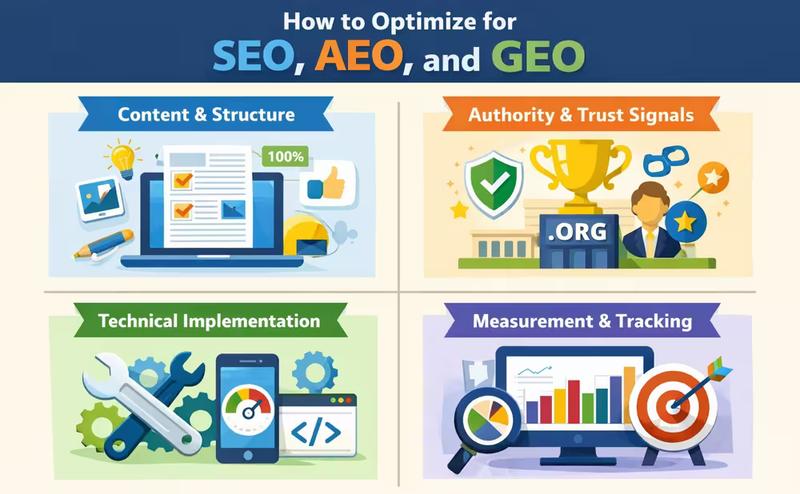
Content & Structure
Use question-based headings. Your H2s and H3s should mirror the way real people search. "What is generative engine optimization?" works better than "Generative Engine Optimization Overview." Tools like AlsoAsked and Google's People Also Ask boxes are great sources for these.
Lead with the answer. Right after each heading, put a direct 1–2 sentence answer before you expand on the topic.
Don't bury the takeaway three paragraphs deep. The first 40–60 words under a heading are what gets pulled into snippets and AI responses.
Make every section independent. Read each section on its own, without the rest of the article.
Does it still make sense? Does it deliver a complete thought? If not, rewrite it until it does.
AI platforms and featured snippets don't pull your full article. They grab individual passages.
Add comparison tables where relevant. Any time your content covers "vs" comparisons, "best of" lists, or feature breakdowns — put the key details into a table.
Tables are one of the most frequently extracted formats for featured snippets. They also make your page more scannable for readers.
Include a real FAQ section. Add 5–8 questions that your audience actually asks. Not variations of your target keyword stuffed into question form.
Real questions from forums, sales calls, customer support tickets, and PAA results. Answer each one in 2–3 sentences.
Authority & Trust Signals
Add author bios that mean something. "John is a passionate marketer" doesn't build trust with readers or AI models. "John has led SEO for three SaaS companies and managed $2M+ in organic pipeline" does.
Specific credentials, years of experience, and relevant accomplishments all strengthen E-E-A-T.
Link to primary sources. When you reference a stat, link to the original study — not a blog post that quoted it from another blog post.
First-party data from research firms, government sources, and platform-specific reports carries more weight with both search engines and LLMs.
Build your off-site presence. Get quoted in industry publications. Contribute expert commentary to roundup posts.
Make sure your brand's information is accurate on LinkedIn, Crunchbase, Wikipedia, and relevant directories.
These third-party mentions are signals that AI models use when deciding which brands to reference.
Keep your brand consistent. If your company is called "Acme Analytics" on your website but "Acme" on LinkedIn and "AcmeHQ" on Twitter — that's three different entities in the eyes of an LLM. Pick one name. Use it everywhere.
Technical Implementation
Implement schema markup. At minimum, add FAQ schema to your FAQ sections, Article schema to your blog posts, and Organization schema to your homepage.
If your content includes step-by-step instructions, add HowTo schema. These don't guarantee rich results, but they make your content machine-readable.
Hit your Core Web Vitals targets. Aim for an LCP (Largest Contentful Paint) under 2.5 seconds, an INP (Interaction to Next Paint) under 200ms, and a CLS (Cumulative Layout Shift) under 0.1.
Test your pages with PageSpeed Insights and fix what you can.
Use semantic HTML. Proper heading hierarchy (H1 → H2 → H3), descriptive alt text on images, and clean code structure all help search engines and AI crawlers understand your content.
Avoid nesting your content inside complex JavaScript frameworks that are harder to parse.
Consider an llms.txt file. This is a newer concept — a plain text file in your root directory that tells AI crawlers what your site is about and how to interpret it.
It's similar in spirit to robots.txt but designed for LLMs. It's still early, but Backlinko's guide to llms.txt covers how to set one up.
Measurement & Tracking
For SEO, track keyword rankings, organic traffic, and click-through rates in Google Search Console.
Use Ahrefs or Semrush to monitor your backlink profile and domain authority over time.
For AEO, monitor which of your pages own featured snippets using the SERP Features filter in Ahrefs or Semrush.
Track your appearances in People Also Ask. Test voice search results manually by asking Siri, Alexa, and Google Assistant questions related to your content.
For GEO, use tools like Semrush's AI Toolkit to monitor how often your brand gets cited in ChatGPT, Perplexity, and Google AI Mode. Otterly and Peec AI also track brand mentions across AI platforms.
Beyond tools, do manual spot-checks — ask ChatGPT and Perplexity questions in your niche and see whether your brand comes up, how it's described, and whether the information is accurate.
If you're only measuring Google rankings, you're seeing one-third of the picture.
5 Mistakes that kill your SEO, AEO, and GEO strategy
Most businesses fail because they're doing the right things in the wrong way.
Here are five mistakes that come up over and over.
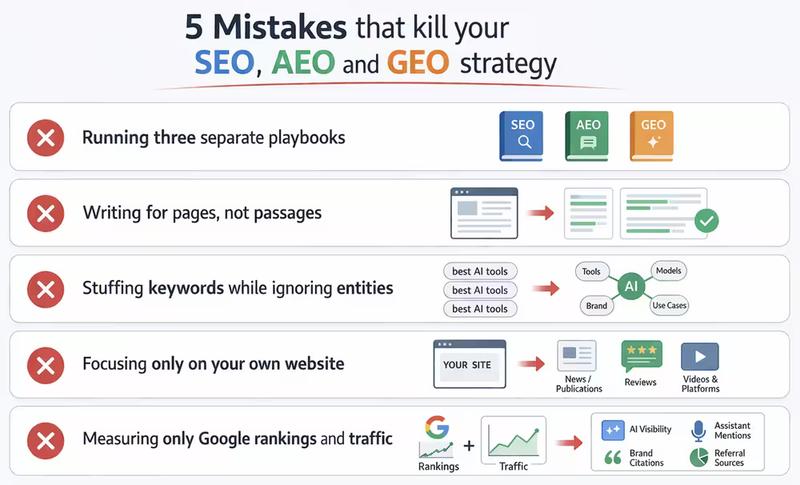
1. Running three separate playbooks. Some marketing teams assign SEO to one person, AEO to another, and GEO to a third.
Or worse — they treat GEO as a completely new initiative disconnected from their existing content.
This creates duplicated work and fragmented messaging. A single blog post should be optimized for all three.
A single content brief should include snippet formatting, entity signals, and passage-level structure. These aren't three campaigns. They're three lenses on one piece of content.
2. Writing for pages, not passages. Your article might be 3,000 words of solid information.
But if every section bleeds into the next without clear standalone value, neither a featured snippet nor an LLM will pull anything useful from it.
Every H2 section should work like a mini-article. A clear question, a direct answer, supporting detail.
If someone read only that section — stripped from the rest of the page — would they walk away with something useful? If not, restructure it.
3. Stuffing keywords while ignoring entities. Keyword optimization still matters for SEO. But LLMs don't care if "best CRM software" appears twelve times on your page.
They care whether your brand is consistently associated with the concept of CRM across multiple sources.
Entity optimization means making sure your brand name, product names, and key terminology appear consistently on your site, your social profiles, directory listings, and third-party mentions.
That's what gives AI platforms confidence to cite you.
4. Focusing only on your own website. Your site is one signal. AI models also pull from Reddit discussions, Quora answers, YouTube transcripts, news articles, industry directories, and review platforms.
If your brand has zero presence on any of those surfaces, you're invisible to a significant chunk of how LLMs build their understanding of your industry.
Contributing to relevant communities, earning press mentions, and maintaining accurate directory listings all feed into GEO performance.
5. Measuring only Google rankings and traffic. This is the biggest blind spot.
A brand could be getting mentioned in hundreds of ChatGPT responses per day and have no idea — because they're only looking at Google Search Console.
AI visibility requires its own measurement stack. Track how often AI platforms mention your brand, whether the information is accurate, and how your share of voice compares to competitors.
What's Next — the future of SEO, AEO, and GEO beyond 2026
The boundaries between these three approaches are already blurring.
Google's AI Mode merges traditional search with generative answers in a single interface.
You type a query and get a conversational AI response and organic results on the same screen. That means one query now touches SEO, AEO, and GEO simultaneously.
And the shift is happening faster than most forecasts predicted.
Gartner projected that traditional search engine volume would drop 25% by 2026, with AI chatbots and virtual agents absorbing that share.
Whether the exact number lands at 25% or something different, the direction is clear. More queries are moving to conversational AI platforms every quarter.
Gartner's follow-up prediction goes further: organic search traffic to websites could decrease by 50% or more by 2028 as consumers continue to embrace AI-powered search.
Meanwhile, the AI platforms themselves keep growing. ChatGPT went from 400 million weekly active users in February 2025 to 900 million by late 2025. That kind of adoption curve has no precedent in consumer technology.
So what does this mean for marketers?
The brands that will win aren't the ones chasing the latest acronym. They're the ones building genuine authority.
Original research. Real expertise. Consistent, trustworthy brand signals across every surface where their audience looks for information.
That's Search Everywhere Optimization in practice.
Not a single tactic.
Not a single platform.
A unified approach to being visible wherever people search — whether that's Google, ChatGPT, Perplexity, YouTube, Reddit, TikTok, or a voice assistant in someone's kitchen.
The tools and platforms will keep evolving.
But the principle stays the same: create something worth finding, structure it so machines can understand it, and build enough trust that both algorithms and AI models choose to surface it.
That's the strategy that works in 2026 — and whatever comes after.
Final Verdict — SEO vs GEO vs AEO
SEO gets you found. AEO gets you chosen. GEO gets you trusted.
They're not competing strategies. They're layers of one approach — and the strongest brands in 2026 are using all three together.
So, start with a solid SEO foundation. Format your best content for direct answers and snippets.
Then build the authority and entity signals that make AI platforms want to cite you.
Search is no longer one platform. Your audience is everywhere. Your strategy should be too.
That's Search Everywhere Optimization. And it starts with the next piece of content you publish.
Frequently Asked Questions
Everything you need to know about this topic.
No. GEO extends SEO into AI platforms. It doesn't replace the need for keyword research, backlinks, or technical health. It adds a new layer focused on AI citations and entity signals.
AEO stands for Answer Engine Optimization. It focuses on structuring content so search engines and voice assistants can extract and display it as a direct, immediate answer.
GEO stands for Generative Engine Optimization. It's the practice of optimizing content so AI platforms like ChatGPT, Gemini, and Perplexity cite it in their generated responses.
No. They work best as three layers of one unified strategy. About 80% of your SEO work already supports AEO and GEO. The remaining 20% is schema markup, entity optimization, and passage-level formatting.
It's a unified approach to being visible wherever people search — Google, ChatGPT, Perplexity, YouTube, voice assistants, and social platforms. SEO, AEO, and GEO are the three core layers of this approach.
Write self-contained sections with clear headings, include original data and expert credentials, maintain consistent brand signals across the web, and create citation-worthy insights AI models want to reference.
Position Zero is the featured snippet that appears above the first organic result on Google. It displays a direct answer pulled from a webpage. AEO is the strategy used to win this spot.
Schema markup (FAQ, HowTo, Q&A) helps search engines understand your content structure. It increases your chances of appearing in featured snippets, rich results, and voice search responses.
Entity optimization means keeping your brand name, product terms, and descriptions consistent across your website, social profiles, directories, and third-party mentions — so AI models can confidently identify and cite you.
Content with original data, unique frameworks, expert quotes, and clear structure. AI models favor content that adds something new over pages that restate what ten other sites already cover.
Voice search optimization is one part of AEO. AEO also covers featured snippets, People Also Ask boxes, and knowledge panels — any format where your content is displayed as a direct answer.
Written By
Want help getting your brand ranked on Google and cited by AI?
We help businesses build AI visibility through SEO, content, and authority with clear revenue impact.
Book a Strategy Call