
Scrunch AI and AirOps both appear in GEO tool searches, but they are built for different use cases. As a content marketer and co-founder of RankSaver, I tested both platforms over 30 days to understand where each fits.
In this post, I break down their core differences, pricing, and ideal workflows so you can choose based on how your team actually operates.
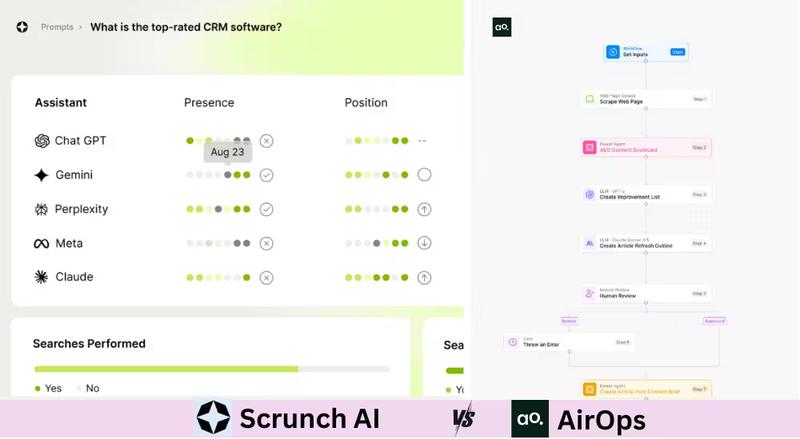
- Scrunch AI is a monitoring platform. It tracks how your brand appears in AI search. Core plan starts at $250/month with a 7-day free trial.
- AirOps is a content automation platform. It builds workflows that create, refresh, and publish content at scale. It has a free Solo plan and a Pro tier with task-based billing.
- LLM coverage: Scrunch Core tracks 4 engines & Enterprise tracks 9. AirOps Starter tracks only ChatGPT & Pro tracks 4.
- Setup: Scrunch gets you data in 15–30 minutes. AirOps takes 2–4 weeks to build useful workflows.
- Best pick: Scrunch for auditing AI visibility. AirOps for producing content at volume.
What is Scrunch AI?
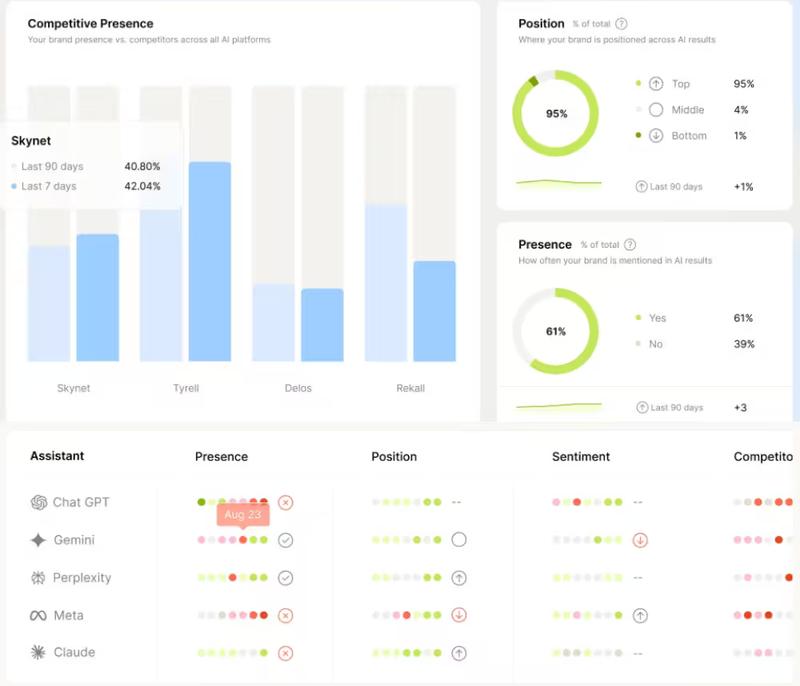
Scrunch AI is an AI search visibility platform. It tracks where and how your brand shows up in AI-generated answers.
That's the whole product in one sentence.
You plug in your brand, your competitors, and a list of prompts. Scrunch runs those prompts against major AI engines. Then it shows you who's getting cited, how often, and on which pages.
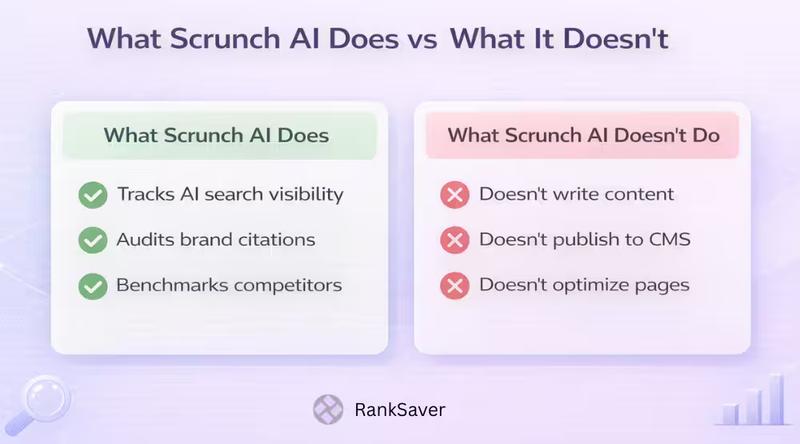
It doesn't write content.
It doesn't publish anywhere.
It's built for one job: tell you what's happening in AI search.
Who built Scrunch AI?
Scrunch was founded in 2023 by Chris Andrew and Robert MacCloy.
Both came from Hearsay Systems (acquired by Yext). Chris was the first employee and CPO there. Robert was CTO.
The company raised $4 million in seed funding led by Mayfield, then a $15 million Series A led by Decibel in 2025. Total funding sits at $19 million (source: PR Newswire).
Backers include Clara Shih (Meta AI), TJ Parker (PillPack), and Bryant Chou (Webflow).
Scrunch came out of stealth in November 2024. It now works with brands like Lenovo, BairesDev, Crunchbase, and Fictiv.
Who is Scrunch AI built for?
Scrunch splits its product into two tracks: one for brands, one for agencies.
For brands, the buyers are:
- Enterprise marketing teams tracking brand presence across AI engines.
- In-house SEO and AEO analysts auditing citation performance.
For agencies, Scrunch has a dedicated Agency Core plan with pitch workspaces — temporary environments you spin up to run audits for sales pitches without paying for a full seat.
If your main question is "where does my brand show up when people ask ChatGPT?" — this is the tool.
If your main question is "how do I produce 50 articles this month?" — it won't help you. Scrunch doesn't touch content creation.
Where does Scrunch AI track visibility?
This part matters because most comparison articles get it wrong. Scrunch's LLM coverage depends on which plan you buy.
Core and Agency Core plans track 4 engines:
- ChatGPT
- Perplexity
- Google AI Overviews
- Microsoft Copilot
Enterprise and Agency Enterprise plans track 9 engines:
- Everything in Core, plus Claude, Gemini, Meta AI, Google AI Mode, and Grok
So if you need to monitor Claude or Gemini specifically, you're looking at Enterprise pricing from day one. A lot of third-party reviews miss this detail.
Scrunch also has a product called AXP (Agent Experience Platform). AXP sits between your website and AI crawlers. It serves a structured, machine-readable version of your content to bots without changing what humans see. AXP is an Enterprise-only feature.
What does Scrunch AI actually do well?
Here's what I liked after testing it:
- Prompt-level citation tracking: You see which exact prompts surface your brand and which don't.
- Persona and region filters: Core gets you 3 personas, 2 languages, and 1 country. Enterprise unlocks unlimited.
- Competitor share of voice: Core tracks 5 competitors. Agency Core doubles the prompt ceiling to 250.
- Pitch workspaces for agencies: You can audit a prospect's AI visibility before they sign, without burning a paid seat.
- AI agent traffic tracking: You can see when Claude or GPTBot crawls your site.
- Clean dashboard: Scrunch holds a 4.6/5 rating on G2 across 68+ reviews (source: G2).
Scrunch AI pricing and plan breakdown
Scrunch has four plans split across two tracks:
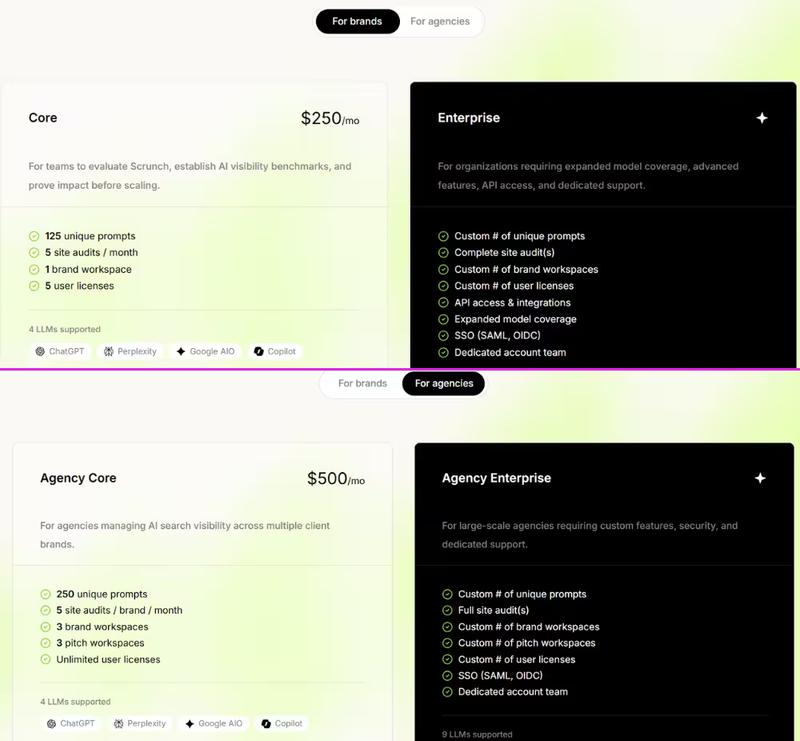
| Plan | Price | Prompts | LLMs | Workspaces | Built For |
|---|---|---|---|---|---|
| Core | $250/mo | 125 | 4 | 1 brand | Single-brand teams |
| Enterprise | Custom | Custom | 9 | Custom | Large brands needing full coverage |
| Agency Core | $500/mo | 250 | 4 | 3 brand + 3 pitch | Small-to-mid agencies |
| Agency Enterprise | Custom | Custom | 9 | Custom + custom pitch | Large-scale agencies |
Core includes a 7-day free trial (credit card required). Enterprise and Agency tiers require a sales call. Additional user seats past your plan's limit cost $25/month each, or $75/month for a 5-pack.
Scrunch AI feature snapshot
| Feature | Core ($250/mo) | Enterprise (Custom) |
|---|---|---|
| LLMs tracked | 4 | 9 |
| Unique prompts | 125 | Custom |
| Competitors tracked | 5 | Custom |
| Personas | 3 | Custom |
| Site audits | 5/month | Full site |
| User seats | 5 | Custom |
| AXP | Not included | Included |
| API access | Not included | Included |
| Free trial | 7 days (card required) | No |
What real users say about Scrunch AI
Here's a G2 review from Brittany T., a verified Scrunch user:
"Scrunch gives us one of the clearest views I have seen of how brands show up in AI Search. It actually helps guide our strategy and content planning. The Scrunch team is also fantastic." — Brittany T., verified G2 reviewer.
A different reviewer on G2 flagged a real limitation:
"There's no good way to generate reports using Scrunch. I'm not advanced enough to figure out how to use the API to feed data into reporting tools." — Tehra P., Owner/President (source).
That matches my experience. You get the data. You don't always get a clean way to pull it into a client-facing report.
What is AirOps?
AirOps is a content engineering platform. It helps teams create, refresh, and publish content at scale using AI workflows.
That's the core product.
You build a workflow once — research, draft, optimize, publish — and run it across hundreds of pages. AirOps also tracks where your brand shows up in AI search, so you know which content to prioritize.
Who built AirOps?
AirOps was founded in 2021 by Alex Halliday, Matt Hammel, and Berna Gonzalez (source: Crunchbase)
Alex is the CEO. He previously led product at Teespring and MasterClass. Matt is COO. Berna is CTO.
The company started before ChatGPT launched. Originally, it helped non-technical employees work with data. When LLMs became usable, AirOps pivoted toward marketing teams.
Total funding sits at $60 million. The Series B, announced in November 2025, raised $40 million at a $225 million valuation.
Greylock led the round, with Unusual Ventures, Wing VC, and Frontline participating (source: Fortune).
Customers include Webflow, Ramp, Chime, Monday.com, Carta, Klaviyo, and Kayak.
Who is AirOps built for?
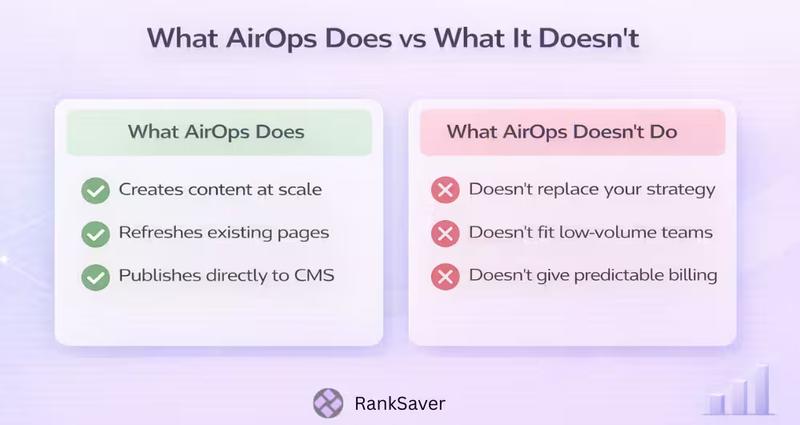
AirOps targets teams producing content at real volume. If you publish 5 posts a month, you won't get your money's worth.
The sweet spot:
- Content ops teams producing 50+ pieces per month.
- Marketing agencies managing content for multiple clients.
- Enterprise SEO teams running refresh and creation workflows across thousands of pages.
If you're a solo founder writing one blog post a week, this is overkill. The free Starter plan exists for exactly that reason — it lets you track AI visibility without paying for the heavy content engine.
What does AirOps actually do?
The platform has three main components:
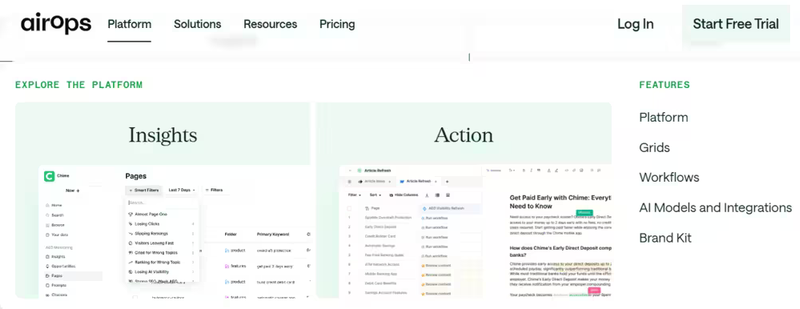
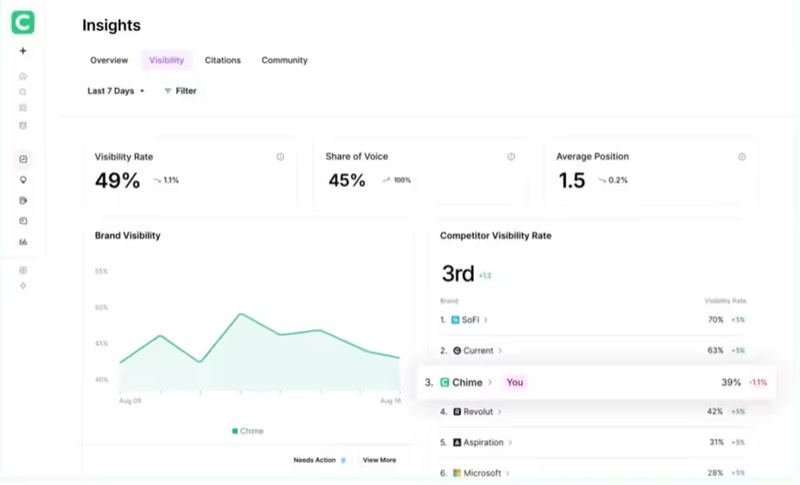
Insights — tracks your brand's visibility across AI search and traditional SEO. Shows which prompts surface your content and which competitors own the answer.
Workflows — the no-code builder. Drag-and-drop steps for research, generation, optimization, and publishing. You can chain 20+ steps together.
Grid — a spreadsheet-style interface that runs workflows across hundreds of pages at once. One reviewer called it "an editorial calendar on steroids".
AirOps also has Brand Kits (voice and tone rules) and Knowledge Bases (proprietary data sources) that feed into every workflow.
Where does AirOps publish content?
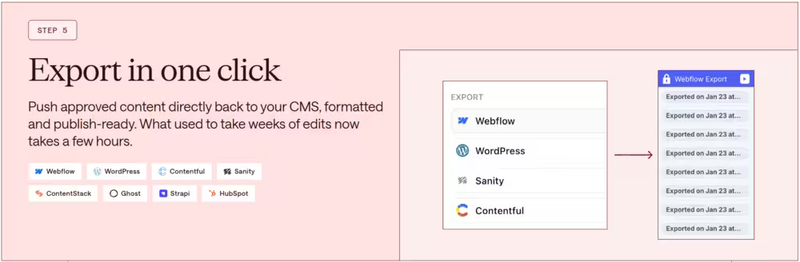
Direct CMS integrations include:
- WordPress
- Webflow
- Contentful
- contentStack
- Ghost
- Shopify
- Strapi
- Sanity
You can push optimized content from the platform to your CMS without copy-pasting. Approvals and version history live inside AirOps.
AirOps pricing and plan breakdown
AirOps has four tiers:
| Plan | Price | Built For |
|---|---|---|
| Starter (Free) | $0/mo | Testing the platform and basic AI visibility tracking |
| Starter (Paid) | $199/mo | Solo users and small teams running content workflows |
| Scale | Custom pricing | Mid-size teams scaling content operations |
| Agency | Custom pricing | Agencies managing multiple client brands |
The free Starter plan is how most teams get started. You can track a limited number of prompts and run basic workflows without a credit card.
The paid Starter at $199/month is where real content production begins. Scale and Agency tiers require a sales conversation.
AirOps uses task-based billing. Every time a workflow runs a step, it counts as a task. Your plan includes a monthly task budget, and overages are charged per task beyond that. A 14-day free trial gives you 50,000 credits to test workflows before committing.
What does AirOps do well?
Here's what worked in my testing:
- Grid for bulk operations. Run one workflow across 200 URLs at once. Saves hours on content audits and refreshes.
- Brand Kits. Load your voice guidelines once. Every workflow uses them automatically.
- Direct CMS publishing. Approved content ships to WordPress or Webflow without manual copy-paste.
- Power Agents. Pre-built workflow components for common SEO tasks (SERP analysis, gap identification, schema generation).
- 20+ AI models supported. You can mix GPT-4, Claude, and Gemini within a single workflow.
- BYO API keys. On Scale and above, you can use your own model keys for direct cost control.
AirOps holds a 4.6/5 rating on G2 across 116+ reviews.
AirOps feature snapshot
| Feature | Starter Free | Starter Paid ($199/mo) |
|---|---|---|
| Task budget | 1,000/month | Higher allotment with overages |
| Workflow builder | Basic templates | Full access |
| Brand Kits | 1 | 1 |
| Knowledge Bases | 5 sources | Expanded |
| AI models | Limited | 20+ models |
| CMS integrations | Not included | Included |
| User seats | 1 | 1 |
| Support | Community | Live chat + email |
What real users say about AirOps
Here's Stephanie M., a verified G2 reviewer, on the upside:
"AirOps has unlocked our ability to post custom content at scale across the site. Our team has some people who are not very tech savvy. AirOps made it simple and easy to use." — Stephanie M., verified G2 reviewer,
Another verified organic review highlighted the brand consistency angle:
"We uploaded our tone guidelines and key messaging, and the content that comes out actually feels on-brand." — Verified organic G2 reviewer
On the critical side, Lesley M., Director of Organic Growth, flagged the billing model:
"The downside is the pricing model. If you're not careful about monitoring team usage, it's easy to burn through your task budget faster than expected." — Lesley M., Director of Organic Growth
And Colby H., a President and Co-Founder at a small business, praised the flexibility but noted an integration gap:
"We've reduced our costs by 15%+ using their platform." — Colby H., President & Co-Founder
His critique: connecting workflows to third-party apps isn't as intuitive as it could be.
One more pattern I saw across multiple reviews: almost every critical review mentions the learning curve. G2's own review summary tags "Learning Curve" as the #1 dislike with 25 mentions, followed by "Learning Difficulty" at 17 and "Expensive" at 7.
That matches my experience. The tool rewards patience. But week one is rough.
Webflow used AirOps to grow AI-attributed signups from 2% to over 10% in under a year with zero new headcount. Results like that are real, but they come after the setup investment.
Scrunch AI vs AirOps: Quick Comparison Table
Before we get into the feature-by-feature breakdown, here's a side-by-side snapshot of both platforms.
Every number in this table comes from the official pricing pages and G2 listings.
| Dimension | Scrunch AI | AirOps |
|---|---|---|
| Primary function | AI visibility monitoring | Content automation + AI visibility |
| Founded | 2023 | 2021 |
| Founders | Chris Andrew, Robert MacCloy | Alex Halliday, Matt Hammel, Berna Gonzalez |
| Total funding | $19M | $62.5M |
| Valuation | Not disclosed | $225M |
| Entry price (brands) | $250/mo | $0/mo free, $199/mo paid |
| Entry price (agencies) | $500/mo | Custom |
| LLMs tracked (entry plan) | 4 (ChatGPT, Perplexity, Google AIO, Copilot) | 1 (ChatGPT only on Starter) |
| LLMs tracked (top plan) | 9 (adds Claude, Gemini, Meta AI, AI Mode, Grok) | 4 (ChatGPT, Google, Perplexity, Google AI Studio) |
| Content creation | No | Yes — workflow builder + Grid |
| CMS publishing | No | Yes — WordPress, Webflow, Shopify, Contentful, Ghost, Strapi, Sanity |
| Workflow automation | No | Yes — no-code builder with Power Agents |
| Brand Kit | No | Yes |
| Free trial | 7 days (card required) | 14 days (no card) + free Starter plan |
| G2 rating | 4.6/5 | 4.6/5 |
| Setup time | 15–30 minutes | 2–4 weeks for productive workflows |
| Best for | Auditing AI visibility, tracking competitors | Producing content at scale, automating SEO workflows |
Scrunch AI vs AirOps: Where Each Platform Wins
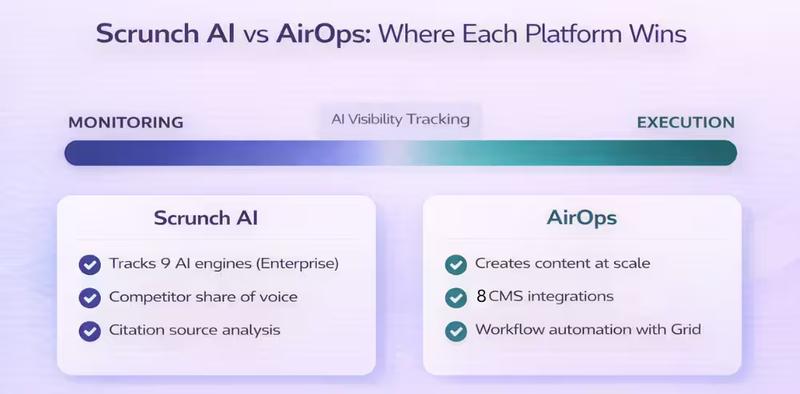
A few things jump out right away.
Scrunch goes deeper on visibility: 9 LLMs on the Enterprise plan versus AirOps' four. If you need Claude, Gemini, and Grok tracked alongside ChatGPT, Scrunch is the only option.
AirOps goes wider on execution: 8 CMS integrations, a workflow builder, Brand Kits, Knowledge Bases. Scrunch has none of these. It stops at the insight layer.
Pricing favors different buyers: If you want to start free and test before paying, AirOps wins — $0 Starter plan plus a 14-day trial with no card required.
Scrunch's free trial is only 7 days and needs a credit card upfront. But once you start paying, Scrunch's Core at $250/month gives you more AI engine coverage than AirOps' $199/month Starter (4 LLMs vs 1).
Funding tells a story too: AirOps has raised 3x more capital than Scrunch ($60M vs $19M). That shows up in the product breadth. AirOps tries to cover the full content lifecycle. Scrunch stays focused on one thing: monitoring.
Neither tool replaces the other. They solve different halves of the same problem.
Let me verify specific feature claims before writing the feature-by-feature breakdown. I need to confirm AirOps' Offsite product, Page360, and Scrunch's AXP details from primary sources.Good. Page360 is verified. Now let me check Scrunch's AXP and Offsite capability claims before writing.All verified. Writing Section 4 now — the feature-by-feature breakdown. Each sub-section opens with a Q&A header for AI Overview extraction.
Scrunch AI vs AirOps: Feature-by-Feature Breakdown
This is where the real differences show up. I'll walk through each capability, show what each tool actually does, and give you my verdict at the end of each one.
Which tool has better AI search visibility tracking?
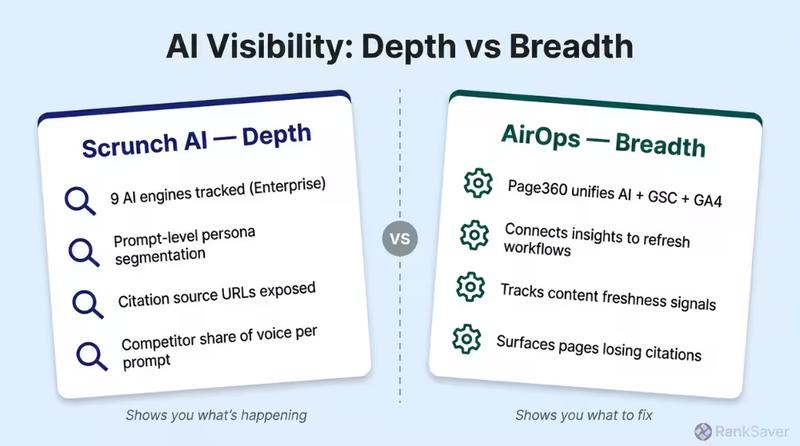
This one goes to Scrunch. It's what the entire platform was built for.
Scrunch monitors up to 9 AI engines on the Enterprise plan — ChatGPT, Perplexity, Gemini, Claude, Meta AI, Google AI Overviews, Google AI Mode, Microsoft Copilot, and Grok. Core covers 4 of those.
You set up prompts, define personas (CTO vs. marketing manager, for example), and Scrunch tracks who gets cited across each engine. It segments results by country, language, and funnel stage.
AirOps also tracks AI visibility — but it's a newer addition to the platform, not the core product. Its Insights module covers ChatGPT, Google, Perplexity, and Google AI Studio on the Pro tier. Solo only tracks ChatGPT.
AirOps' real visibility strength is Page360 — a unified dashboard that pulls together AI citation data, Google Search Console metrics, and GA4 engagement in a single view .
This is useful because it connects visibility to action. You can see a page losing citations and send it to a refresh workflow without leaving the platform.
Scrunch doesn't have that action layer. You see the data. You export a CSV. You fix it somewhere else.
Verdict: Scrunch goes deeper on pure visibility — more engines, more personas, more granular prompt data. AirOps goes wider by connecting visibility to content performance and action. Pick based on whether you need diagnosis or a full treatment.
Which tool has better content creation capabilities?
No contest. Scrunch doesn't create content. Period.
AirOps was built for this. Its workflow builder lets you chain research, drafting, optimization, and publishing into a single automated pipeline. You can mix 20+ AI models within one workflow — use GPT-4 for drafting and Claude for editing, for example.
The Grid feature runs those workflows across hundreds of pages at once. One G2 reviewer called it "an editorial calendar on steroids".
Brand Kits enforce your voice and tone rules across every piece of content. Knowledge Bases ground the content in your proprietary data — product specs, case studies, internal docs.
Scrunch's pricing page mentions "content generation (basic, coming soon)" under the Core plan and "content generation (advanced, coming soon)" under Enterprise. But as of writing, these features aren't live yet.
Verdict: AirOps wins by default. If you need to produce content at volume, AirOps is the only option between the two. Scrunch doesn't compete here today.
Which tool has better competitor benchmarking?
Scrunch tracks competitor share of voice at the prompt level. You define up to 5 competitors on the Core plan.
Here's what that looks like in practice: you type in a prompt like "best CRM for startups." Scrunch shows you which brands get cited in each AI engine's response, how often, and from which source URLs.
AirOps doesn't offer dedicated competitive tracking in the same way. Page360 does show how your content performs relative to competitors on specific prompts.
But it's more of a content performance signal than a standalone benchmarking tool.
AirOps does have an Offsite product — launched in 2026 — that helps you discover high-value publishers, land placements in sources that LLMs cite, and measure the visibility lift from each mention.
That's not exactly benchmarking, but it addresses the same underlying problem: where does my brand show up relative to competitors?
Verdict: Scrunch wins on structured competitive intelligence. You get prompt-level competitor tracking with share of voice percentages. AirOps gives you competitive context, but it's baked into the content performance view rather than a standalone module.
Which tool has better CMS integrations?
AirOps connects to 8 CMS platforms natively: WordPress, Webflow, Contentful, Ghost, Shopify, Strapi, and Sanity.
You build a workflow, approve the content, and push it live without copy-pasting. Version history, comments, and approval flows live inside the platform.
Scrunch connects to GA4 for traffic analytics and works with CDN providers (Cloudflare, Akamai, Vercel) for its AXP bot-detection layer. But it doesn't publish anything anywhere.
Verdict: AirOps wins outright. Scrunch doesn't have CMS integrations because it doesn't create content. Different product, different job.
Which tool has better workflow automation?
AirOps' no-code workflow builder is the core product. You drag and drop steps — research, generate, optimize, review, publish. Power Agents are pre-built components for common SEO tasks (SERP analysis, internal linking, schema generation).
Grid runs workflows across hundreds of URLs at once. You import a spreadsheet of URLs, apply a workflow template, and let it run with human review checkpoints before anything publishes.
According to AirOps' own research, content less than three months old is 3x more likely to be cited in AI answers. Page360 uses this signal to surface aging pages, and teams can feed them directly into refresh workflows (source: Business Wire).
Scrunch doesn't have workflow automation. The platform surfaces optimization recommendations — what to fix, which pages need work — but you have to execute them outside the platform.
Verdict: AirOps dominates. This isn't a comparison so much as a category mismatch. Scrunch monitors. AirOps automates.
Which tool has better technical optimization for AI crawlers?
This is where Scrunch has something nobody else in this comparison offers.
Scrunch's AXP (Agent Experience Platform) sits at the CDN level — Cloudflare, Akamai, or Vercel. It detects when an AI bot visits your site and serves a clean, code-light version of your page. The human-facing site stays untouched.
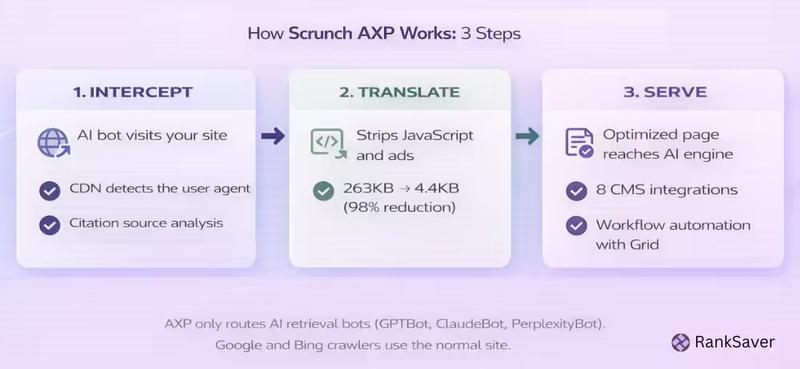
Here's how it works in three steps:
- Intercept — AXP detects AI user agents (GPTBot, ClaudeBot, PerplexityBot) at the CDN edge.
- Translate — It strips JavaScript, ads, and unnecessary code. One Scrunch example showed file size dropping from 263KB to 4.4KB — a 98% reduction
- Serve — The optimized version reaches the AI engine. Google and Bing crawlers are not routed to AXP — they still crawl your normal site.
This matters because many enterprise sites use heavy JavaScript frameworks. AI crawlers often can't render them. AXP fixes that without a developer sprint.
AirOps doesn't have an equivalent infrastructure product. Its agent analytics tracks which AI bots crawl your site (via Cloudflare and Vercel integration), but it doesn't serve alternate page versions.
Verdict: Scrunch wins decisively on technical optimization. AXP is unique in this comparison. If your visibility problem is that bots can't read your site, Scrunch is the only tool here that fixes it at the infrastructure level.
Which tool has better reporting for stakeholders?
Both tools have dashboards. Neither one makes reporting effortless.
Scrunch shows share of voice, citation trends, and competitor positioning in a clean interface.
But multiple G2 reviewers flag the lack of exportable reports. One reviewer wrote: "There's no good way to generate reports". Agency users working at scale often end up building manual Excel reports as a workaround.
AirOps' Page360 combines AI citations with GSC and GA4 data. That's better for showing a complete performance picture.
But the reporting is operationally focused — it's designed to surface which pages need work, not to produce a polished deck for your CMO.
Scrunch does have one advantage for agencies: the pitch workspace. You can spin up a temporary audit environment for a prospect without paying for a full seat. That's a built-in sales tool.
Verdict: Neither tool excels at polished reporting. Scrunch has better AI-specific visibility data for presentations. AirOps has a more complete data picture (AI + SEO + analytics) but it's designed for operators, not executives.
Which tool has a better learning curve?
Scrunch: 15–30 minutes to set up. You enter your brand, competitors, and prompts. Data starts flowing within a day.
AirOps: 2–4 weeks before your team is productive. G2 reviewers consistently flag the learning curve as the biggest complaint — "Learning Curve" appears as the #1 dislike tag with 25 mentions.
This isn't surprising. Scrunch is a dashboard. AirOps is a workflow engine. Dashboards are easier to learn than automation platforms.
AirOps tries to bridge the gap with cohort trainings, an async academy, and an in-platform Copilot. These help. But reviewers still report 2–3 weeks before meaningful output.
Verdict: Scrunch wins on time-to-value. If you need data fast, Scrunch gets you there in an afternoon. AirOps requires a meaningful setup investment before it pays back.
Which tool integrates better with existing SEO stacks?
AirOps connects to SEO research tools natively: Semrush, Ahrefs, Moz, and DataForSEO. It also integrates with project management tools like Asana, Airtable, ClickUp, Monday.com, and Wrike.
Scrunch integrates with Google Analytics for traffic data and CDN providers for bot tracking. Enterprise plans include a Query API, Advanced API, and Looker Studio access. MCP and CLI access are listed as "coming soon".
Scrunch also has a Data API for CRM and BI tools — useful for teams that want to pipe AI visibility data into HubSpot or Salesforce dashboards.
| Integration type | Scrunch AI | AirOps |
|---|---|---|
| SEO tools | Not native | Semrush, Ahrefs, Moz, DataForSEO |
| CMS platforms | None | WordPress, Webflow, Contentful, Ghost, Shopify, Strapi, Sanity |
| Project management | None | Asana, Airtable, ClickUp, Monday.com, Wrike |
| Analytics | GA4 + Looker Studio (Enterprise) | GA4 + GSC |
| CDN / bot tracking | Cloudflare, Akamai, Vercel (AXP) | Cloudflare, Vercel (agent analytics) |
| API access | Query API + Advanced API (Enterprise) | REST API + BYO model keys |
| Social | None | YouTube, Reddit |
Verdict: AirOps wins on breadth. It plugs into more tools across more categories. Scrunch wins on depth for teams whose priority is CDN-level optimization and BI pipeline integration.
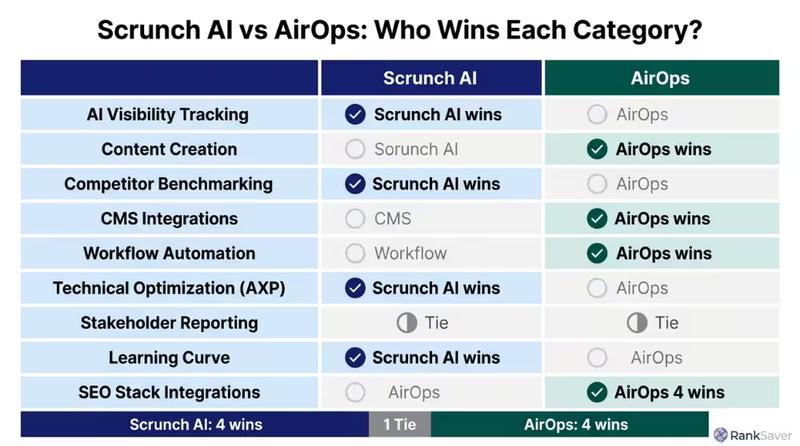
So, who wins each category:
Scrunch AI vs AirOps Pricing: What You'll Actually Pay
I already broke down each tool's plan structure above. Here I'll focus on the question most comparison articles skip: what's your real monthly cost after 90 days?
The hidden math behind Scrunch pricing
Scrunch charges per brand. If you track three brands, you pay three times.
On Core at $250/month, that's $750/month for a three-brand agency — before you even consider the Agency Core plan at $500/month.
And Core only covers 4 LLMs. Most enterprise teams want Claude and Gemini tracked too. That pushes you to Enterprise (custom pricing) on day one.
Add-on seats cost $25/month each. A 10-person marketing team on Core needs 5 extra seats — that's $125/month on top of the $250 base.
Realistic cost for a mid-size brand team: $375–$500/month. Realistic cost for a 3-client agency: $500–$1,500/month depending on prompt volume.
The hidden math behind AirOps pricing
AirOps charges per task. Every workflow step that runs — every generation, extraction, and optimization — consumes tasks from your monthly budget.
A single article workflow might use 500–800 tasks across research, drafting, and optimization steps.
On the free Starter plan with 1,000 tasks, you can produce roughly one to two articles before the budget runs out.
Paid Starter at $199/month gives a larger task budget, but overages at $0.025 per task add up fast if you're running bulk refreshes through Grid.
Teams scaling content production should expect the Scale tier (custom pricing, likely $1,000–$2,000+/month range based on third-party reports).
Realistic cost for a solo operator: $199/month + unpredictable overages. Realistic cost for a content ops team: $1,000–$2,000+/month at Scale.
Total cost of ownership comparison
| Scenario | Scrunch AI | AirOps |
|---|---|---|
| Solo founder tracking 1 brand | $250/mo (Core) | $0–$199/mo (Starter) |
| Small team (5 people, 1 brand) | $250/mo (Core, 5 seats included) | $199/mo (Starter Paid) + task overages |
| Mid-size agency (3 clients) | $500/mo (Agency Core) | Custom (Scale) |
| Enterprise (5+ brands, full LLM coverage) | Custom (Enterprise) | Custom (Enterprise) |
| Tool stack replacement | Still need content tools ($200–$500/mo extra) | Still need deeper AI visibility tools ($250–$500/mo extra) |
The last row is what most buyers miss. Scrunch doesn't create content, so you'll still pay for a writing tool or agency. AirOps doesn't go as deep on AI visibility, so you might still want a dedicated monitor alongside it.
Therefore, neither tool is a complete stack by itself.
Where Does Each Tool Fall Short?
Every comparison article lists features. Fewer talk about what breaks.
What Scrunch AI still needs
No content execution: This is the biggest gap. You see what's wrong. You can't fix it inside the platform. Every insight ends with an export and a context switch.
Reporting is still manual: Multiple users build their own Excel reports because Scrunch doesn't offer polished export templates.
Prompt volume data is limited: Scrunch converts keywords into prompts rather than tracking actual user prompts. The AI Search Trends feature covers a limited number of topics — you might not find any relevant to your brand.
Core plan locks out key engines. Claude and Gemini — two of the most important AI engines for B2B brands — require Enterprise pricing.
What AirOps still needs
Task billing is unpredictable: Some workflow steps count as tasks, others don't. Users consistently report confusion about limits and surprise bills.
AI visibility is secondary: The Insights module and Page360 are useful, but they're additions to a content engine — not the product's core. Teams with serious visibility tracking needs will outgrow them.
No mid-tier pricing: The jump from $199/month (Starter Paid) to Scale (custom, likely $1,000+) leaves growing teams stuck.
Grid bugs surface in reviews: G2 users mention unresponsive grids and JSON workflow logic deactivation issues. These are fixable, but they slow down teams during the critical first weeks.
The gap they both share
Neither tool closes the full loop from identify a gap → produce content → measure the citation lift.
Scrunch stops at identification. AirOps starts at production. The handoff between monitoring and execution still requires manual work, CSV exports, or custom scripting.
Teams using both tools together report better results — but that's a $450+/month minimum stack before you account for Scale pricing.
Who Should Use Scrunch AI vs AirOps?
Choose Scrunch AI if:
- Your primary question is "where does our brand appear in AI search?"
- You need competitor share of voice data at the prompt level.
- You have content production handled elsewhere (in-house writers, agencies, freelancers).
- You're an agency that needs pitch workspaces for sales.
- Your site has technical crawling issues that AXP can fix.
- You want to start tracking within 30 minutes, not 30 days.
Choose AirOps if:
- You're producing 50+ content pieces per month and need automation.
- You want to refresh aging content at scale using AI workflows.
- You need to publish directly to WordPress, Webflow, or Shopify.
- Your team has existing content processes that can be templatized.
- You're willing to invest 2–4 weeks in setup for long-term time savings.
Choose both if:
- You're an enterprise team with the budget for a full GEO stack.
- Your workflow: Scrunch identifies visibility gaps → AirOps produces and publishes the fix → Scrunch measures the citation lift.
Choose neither if:
- You're a solo founder spending under $200/month on tools.
- You need a simpler way to track AI visibility without enterprise complexity.
- You want one platform that handles monitoring AND content creation without switching between two products.
For teams in that last category, RankSaver is built specifically for that use case — AI visibility tracking designed for SEO teams who want monitoring with actionable insights in a single workflow, without the enterprise price tag.
Final Verdict: Scrunch AI vs AirOps
After spending real time in both platforms, here's my take.
Scrunch AI is the better tool for understanding what's happening in AI search. It tracks more engines, gives you prompt-level competitor data, and its AXP infrastructure is genuinely unique. No other tool in this comparison serves bot-optimized pages at the CDN edge.
AirOps is the better tool for doing something about it. The workflow builder, Grid, and direct CMS publishing turn insights into published content without manual handoffs.
Most teams should start with one based on their biggest bottleneck. If you don't know where your brand stands in AI search, start with Scrunch. If you know but can't produce content fast enough, start with AirOps.
The best teams will eventually use both — or find a single platform that covers both monitoring and execution without the $450+/month minimum stack.
That's the gap RankSaveris built to fill.
Frequently Asked Questions
Everything you need to know about this topic.
Neither is universally better. Scrunch wins on AI visibility monitoring — more engines, prompt-level tracking, competitor share of voice. AirOps wins on content execution — workflows, CMS publishing, and bulk operations. Your pick depends on whether your bottleneck is diagnosis or production.
No. Scrunch is analytics only. Its pricing page lists "content generation" as "coming soon" for both Core and Enterprise tiers, but those features aren't live yet. If you need to produce content, AirOps is the only option between the two.
Partially. AirOps' Starter plan tracks ChatGPT only. The Scale tier adds Google, Perplexity, and Google AI Studio. But Scrunch's Enterprise covers 9 engines including Claude, Gemini, and Grok — significantly wider coverage for dedicated visibility tracking.
Depends on your service model. If you sell AI visibility audits and reporting, Scrunch's Agency Core ($500/month) with pitch workspaces fits better. If you sell content production at scale, AirOps' workflow engine and CMS integrations are more useful.
Scrunch: 15–30 minutes. You enter your brand, competitors, and prompts. Data arrives within a day. AirOps: 2–4 weeks for productive workflows. The workflow builder has a real learning curve that G2 reviewers consistently flag.
No native integration exists. Teams using both typically export CSV data from Scrunch and import it into AirOps workflows manually. Scrunch does offer API access on Enterprise, which technical teams can use to build custom connections.
Profound, Otterly, BrightEdge, and RankSaver. Each covers different parts of the AI visibility monitoring space, at different price points.
Writesonic, Jasper, Clearscope, and Scalenut. These cover different ranges of the content creation and optimization spectrum, from pure writing tools to full GEO platforms.
Written By
Want help getting your brand ranked on Google and cited by AI?
We help businesses build AI visibility through SEO, content, and authority with clear revenue impact.
Book a Strategy Call