
Scrunch AI sits in a category that barely existed two years ago: dedicated AI visibility monitoring.
But, the question most buyers are actually asking is not "what does it do?" — it is "do I get $250 worth of value every month from it?"
So, in this guide I share Scrunch AI review, based on direct product use by our team.
It covers what the platform actually shows you, where the data gets genuinely useful, and where the pricing model creates friction before you have even started tracking.
Scrunch AI is worth it for agencies and brand teams that need structured, multi-LLM monitoring with competitive benchmarking built in. For solo SEOs or content teams whose primary need is acting on visibility gaps rather than measuring them, the per-brand pricing model makes the math harder to justify at scale.
Scrunch AI Review: Quick Verdict
| Feature | Details |
|---|---|
| Starting price | $250/month (Core, single brand) |
| Platforms tracked | 4 on Core; 9 on Enterprise (Claude, Gemini, Meta AI, Grok added) |
| Prompt allowance | 125 unique prompts on Core |
| Page Optimizations | 1 / brand / month |
| Brand Workspaces | 3 for agency and 1 for brand plan |
| Countries | 1 on Core; unlimited on Enterprise |
| Site audits | 5/month, up to 25 sitemap pages on Core |
| Best for | Agencies, mid-market brand teams, ecommerce brands, AI visibility consultants |
| Skip if | You need content execution alongside monitoring, or manage multiple brands without an Enterprise budget |
Strengths: AI Search Trends for spotting topic movement, citation domain analysis, agent traffic monitoring, competitive presence tracking, and Shopping visibility for product-level AI search data.
Limitations: Pricing is per brand per month, which compounds fast for agencies or multi-brand teams. The optimization layer is thin on Core — 1 page optimization per month, no API access, and content generation listed as "coming soon." AXP, the technical layer that serves AI bots an optimized version of your site, is Enterprise-only.
So, now let's break down each feature area with direct references to the dashboards, explain the pricing math, and give a clear recommendation by buyer type.
What Scrunch AI is and Who It is Built for
Scrunch AI is a brand visibility monitoring platform built for AI search. It tracks how your brand appears across LLMs when users ask relevant queries — presence, position, sentiment, citation sources, and competitor share of voice.
For ecommerce brands, it goes a layer deeper: tracking product-level visibility, retailer share, and which prompts are driving AI shopping results.
It is not an SEO suite. No keyword research, no backlink analysis, no content editor. The product answers one question: when AI platforms respond to queries in your category, does your brand show up, and how?
That focus is both its strength and its ceiling.
- Agencies that need to report AI citation performance to clients and benchmark brands against specific competitors
- Mid-market brand and growth teams running a deliberate AI search strategy and needing structured measurement
- Ecommerce brands that need product-level AI visibility data — which SKUs appear, which retailers capture the traffic, and which prompts are driving shopping results
- AI visibility consultants who need client-facing dashboards they can present without heavy data interpretation
Who should look elsewhere:
- Solo SEOs or consultants tracking fewer than 50 prompts across one or two platforms — the per-brand cost is hard to absorb without a clear client or revenue tie
- Content teams whose primary need is fixing visibility gaps, not measuring them — Scrunch surfaces the problem but hands the fix back to you
- Teams managing multiple brands — each brand requires a separate subscription, so costs multiply before you have added a single seat
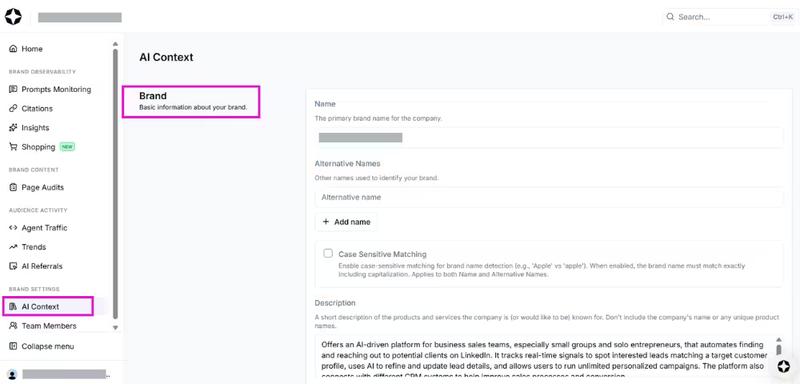
The setup process is fast. You define your brand context, add competitors, configure prompts, and select personas. The brand context screen asks for a name, description, and key attributes — straightforward, but the quality of what you get out depends heavily on how precisely you define what goes in.
Scrunch AI Features: What the Dashboards Actually Show You
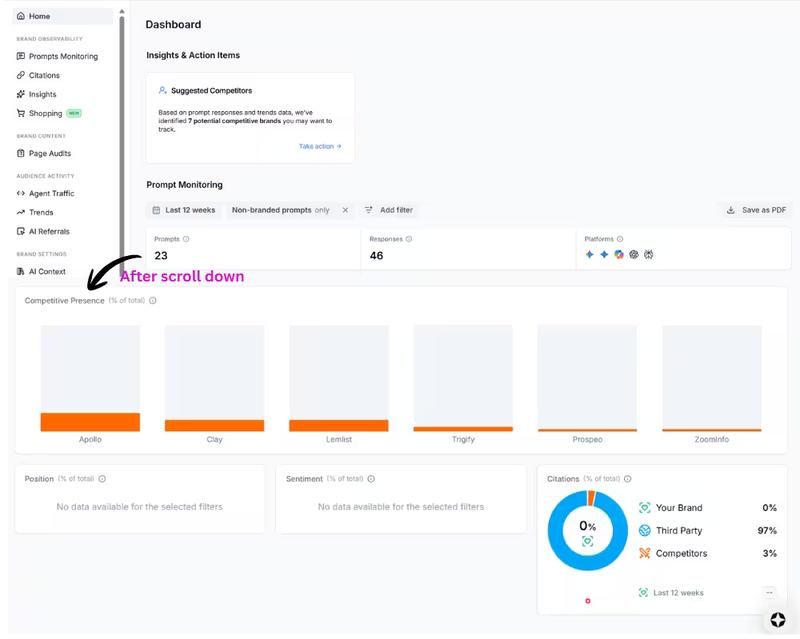
Once inside the dashboard, you’re not just seeing raw data — you get a structured view of how your brand appears across AI platforms.
From prompts to citations to traffic signals, so lets see what each section shows and how to read it.
Prompt Monitoring and Competitive Presence
The main monitoring dashboard shows prompt-level data across the LLMs you have configured. For each prompt, you get presence rate, position, sentiment, and which competitors appeared in the same response.
The competitive presence view breaks this down visually — you can see your brand's share of voice against specific rivals across your tracked query set.
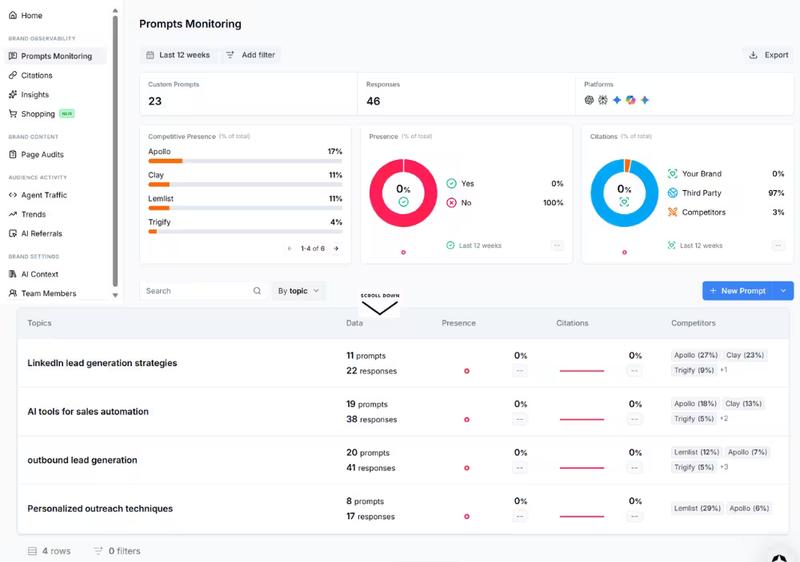
The rollup view is where this becomes useful for reporting. Instead of reviewing every prompt individually, you group them by topic or funnel stage and track aggregate performance over time.
For client-facing work, this is the feature that earns its keep — it gives you a narrative rather than a data dump.
On Core, you are limited to 5 competitors and 3 personas. That is workable for a single brand with a focused strategy, but it will feel tight if your competitive set is larger or if you are running persona-segmented campaigns across more than a few ICPs.
Citations and Domain Analysis
The citations dashboard shows which domains AI platforms are pulling from when they respond to your tracked prompts.
You can see the breakdown between first-party mentions (your own domain) and third-party sources, along with consistency scores per domain.
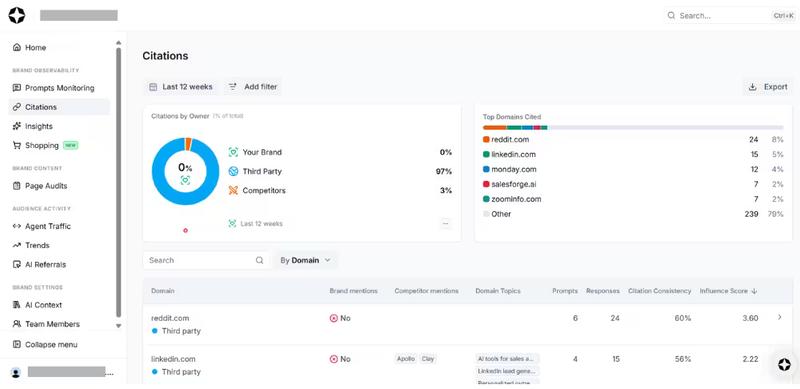
This view is genuinely useful for understanding where AI authority is being built in your category.
If a trade publication or review site keeps appearing in your citation data, that is a signal about where content investment matters — not just for your own pages, but for the broader ecosystem that AI systems treat as credible.
Optimization Opportunities
The opportunities view (in the insights tab) identifies gaps between your current presence and where competitors are winning.
It categorizes issues across competitive presence, content relevance, and metadata — giving you a prioritized list of areas to address.
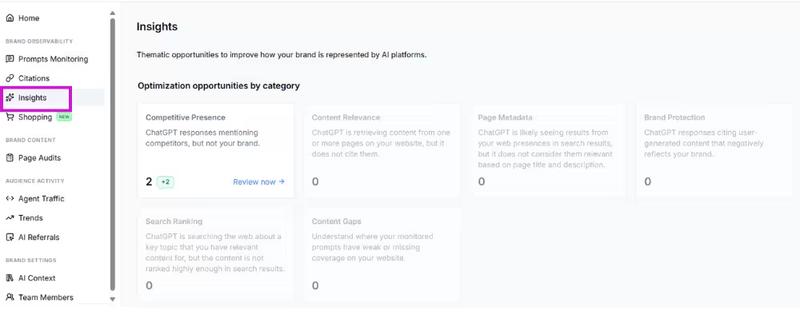
The diagnosis is solid — you can see specifically which prompts you are losing and what category of issue is causing it. The prescription is thinner. Scrunch tells you what to fix; it does not help you fix it.
On Core, you get one page optimization per month, which means acting on what the opportunities view surfaces requires a separate workflow or tool.
AI Search Trends
The AI Search Trends view covers 1,500+ curated topics and shows prompt volume and directional movement over a 12-week window.
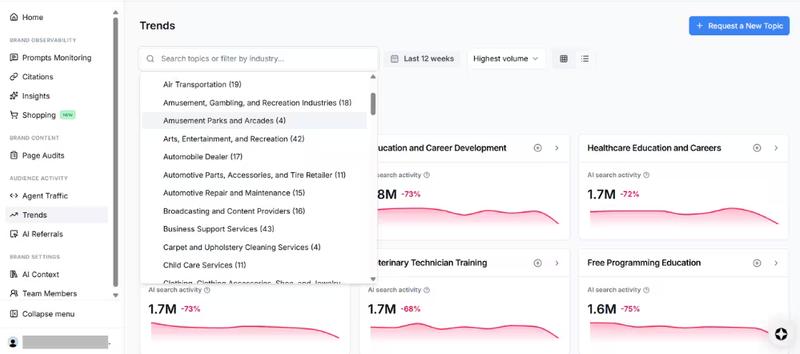
You can see which topics are gaining traction in AI search and how your brand shows up within them.
This is the feature that stood out most in real use. Most monitoring tools tell you where you are. Trends tells you where the conversation is going — a different and more strategically useful signal.
If a topic cluster is growing in AI search volume and your brand is not appearing in those prompts yet, that is a content gap worth acting on before competitors do. On Core, you can track 3 topics for brand and 6 for agency plan; Enterprise unlocks a custom number.
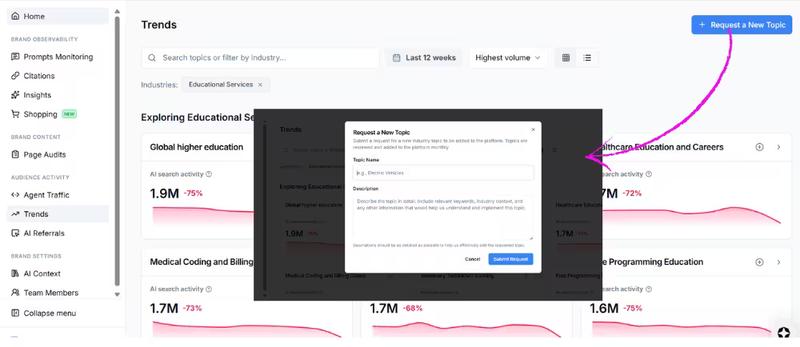
If you don’t find your desired topic in their curated list, you can send a request to add it by providing the topic name and a short description. See the screenshot below to understand how to request a new topic.
Agent Traffic Monitoring and AXP
This is one of the more technically substantive parts of the platform, and one that most reviews understate.
Scrunch's agent traffic monitoring captures near real-time access logs from LLM bots — showing which AI crawlers are hitting your site, when they crawl, and how frequently.
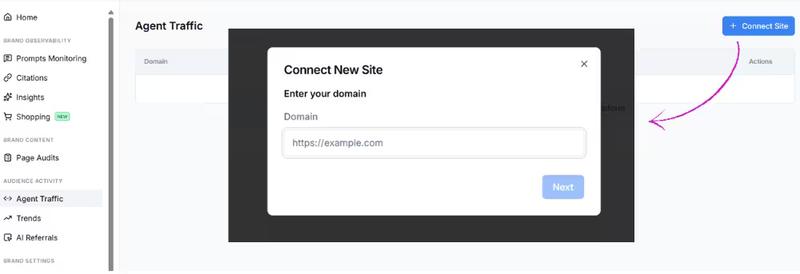
You can see which specific agents (ChatGPT, Claude, Gemini, and others) are consuming your content, track AI traffic trends over time, and identify pages that have technical issues preventing proper indexing.
This matters because AI visibility is not purely a content problem. A page can be well-written and well-structured but still fail to get cited if AI bots cannot reliably access or parse it.
Scrunch surfaces those access-layer failures directly — rendering issues, bot-blocking configurations, and other technical problems that would not appear in a standard SEO crawl.
For Enterprise customers, AXP (Agent Experience Platform: An AI-optimized content version designed to enhance how AI crawlers process and reference a website, delivered directly on the edge) goes further. It works at the CDN level to detect AI bots and serve them a lightweight, optimized version of your site built specifically for better indexing.
That is a more infrastructure-level solution than most AI visibility tools offer. It removes the need for dev sprints to fix bot accessibility issues and gives teams a direct lever on how AI agents consume their content.
AXP is not available on Core. For teams evaluating Scrunch at $250/month, agent traffic monitoring gives you visibility into crawler behavior, but the ability to act on it at the delivery layer requires Enterprise plan.
Shopping: Product-Level AI Visibility
Scrunch's Shopping feature tracks how your products appear in AI shopping results across ChatGPT, Copilot, and Perplexity.
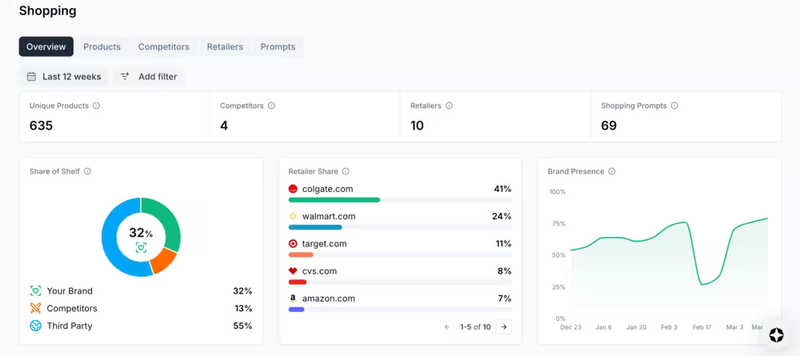
It goes beyond brand-level presence to answer more specific commercial questions: which of your SKUs are being recommended, at what shelf position, through which retailers, and for which prompts.
The competitive layer is particularly useful. Scrunch shows your share of shelf against specific rivals, first position win rate, and which prompts competitors are winning that you are not.
The retailer view adds another dimension: it shows which retailers are capturing AI-driven clicks for your products — including how much traffic may be bypassing your own site in favor of Amazon or other third-party storefronts.
For ecommerce brands, this reframes what AI visibility monitoring actually means. Brand-level monitoring tells you whether your name appears.
Shopping tells you whether your products are on the shortlist when someone asks AI what to buy — which is the question that connects AI visibility to revenue.
Feature Summary
| Feature | What It Does Well | Where It Falls Short |
|---|---|---|
| Prompt monitoring | Granular rollups, persona filters, competitive presence by query | 125 prompts on Core; 5 competitors max |
| Citation analysis | Domain-level citation data with consistency scoring | Read-only; no direct action from the view |
| Optimization opportunities | Categorized gap analysis by prompt and issue type | 1 page optimization/month on Core |
| AI Search Trends | Topic-level volume and 12-week directional movement | 3 topics on Core |
| Agent traffic monitoring | Real-time LLM crawler tracking, technical issue detection | AXP (CDN-level optimization) is Enterprise-only |
| Shopping | Product, competitor, retailer, and prompt-level AI shopping data | Availability varies by plan; confirm with sales |
| Site audits | AI bot traffic detection, page-to-prompt mapping | 25-page limit on Core |
| GA4 integration | AI referral traffic attribution | No Looker Studio or API access on Core |
Scrunch AI Pricing: Where the Model Gets Complicated
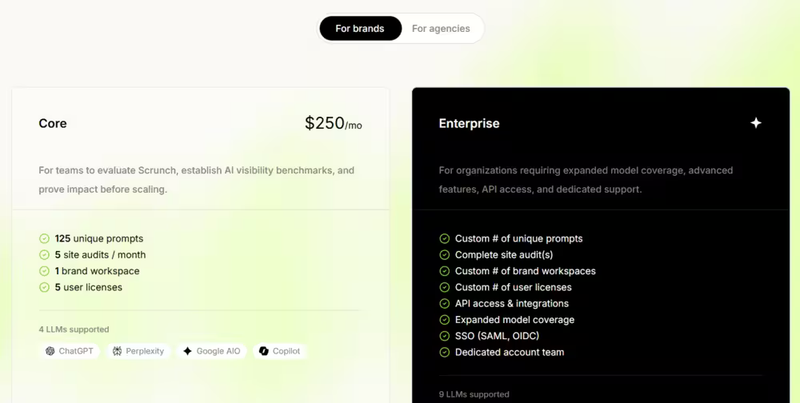
The headline price is $250/month for Core. That number is accurate but incomplete — the pricing model has two structural quirks that matter before you commit.
Per-Brand Billing
Every brand tracked in Scrunch requires its own subscription. If you manage three brands — even within the same agency account — that is three separate Core subscriptions at $250 each, or $750/month before you have added a single seat.
Agencies serving multiple clients need to factor this in from the start, not after onboarding.
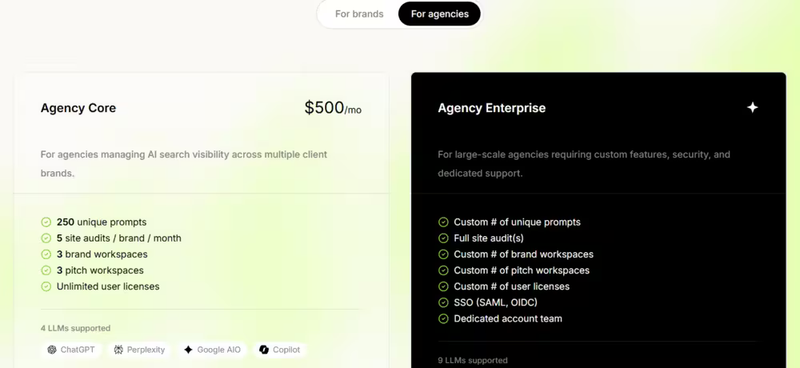
The Agency Core plan at $500/month addresses this with higher limits and multi-brand support, but the jump from $250 to $500 is significant for teams still evaluating whether AI visibility monitoring belongs in their stack at all.
The Prompt Allowance Math
Core includes 125 unique prompts. What the pricing page does not prominently explain is that each LLM you track consumes from that allowance.
Track 50 prompts across 3 platforms (ChatGPT, Perplexity, and Google AI Overviews) and you have used 150 credits — already over the limit.
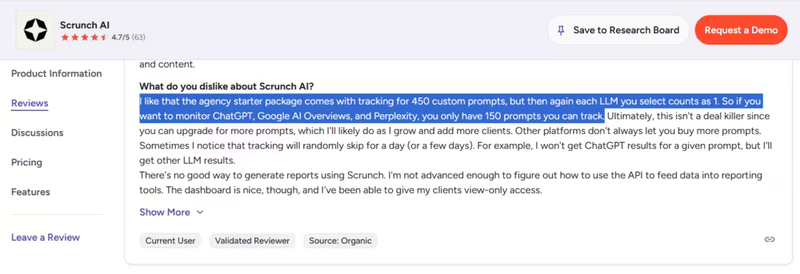
A G2 reviewer put it directly: "I like that the agency starter package comes with tracking for 450 custom prompts, but each LLM you select counts as 1. So if you want to monitor ChatGPT, Google AI Overviews, and Perplexity, you only have 150 prompts you can track."
So, for teams that want meaningful multi-LLM coverage, the effective entry price is closer to $500/month than $250.
Full Plan Breakdown
| Plan | Price | Prompts | LLMs | Countries | Personas | Site Audits |
|---|---|---|---|---|---|---|
| Core | $250/mo | 125 | 4 | 1 | 3 | 5/mo (25 pages) |
| Agency Core | $500/mo | Higher | 4 | Custom | Custom | Higher |
| Enterprise | Custom | Custom | 9 | Unlimited | Custom | Full site |
Additional seats: $25/month each, or $75/month for a 5-seat pack. API access, Looker Studio, AXP, MCP, and CLI are all Enterprise-only.
What Each Buyer Type Actually Gets at $250
Solo SEO or consultant: One brand, 4 LLMs, 5 competitors, 3 personas, and 3 AI Search Trend topics. Usable if your prompt set stays under 40 and AI visibility monitoring is a billable part of your service. Below that threshold, the cost-per-insight ratio is hard to defend.
Small content team: Solid for brand monitoring and competitive benchmarking. The 1 page optimization per month and 5-audit cap will feel restrictive quickly if you are trying to act on what the platform surfaces.
Agent traffic data is available, but AXP — the tool that actually fixes crawler access issues — requires Enterprise.
Agency: Core is too limited for multi-client work. Agency Core at $500/month is the realistic starting point, and the per-brand billing model means that cost scales with your client count rather than your team size.
Ecommerce brand: Shopping visibility adds meaningful commercial depth, but confirm availability and plan requirements directly with Scrunch before assuming it is included in Core.
Pros and Cons After Direct Use
- AI Search Trends is genuinely differentiated. Seeing 12-week directional movement across 1,500+ topic categories is more strategically useful than a static presence score. It tells you where the conversation is heading, not just where you stand today.
- Citation domain analysis adds real strategic depth. Knowing which third-party domains AI systems consistently cite in your category tells you where to build presence beyond your own site — a signal most monitoring tools do not surface clearly.
- Agent traffic monitoring goes deeper than most tools. Real-time LLM crawler tracking, top bot agent identification, and technical issue detection give teams a more complete picture of why visibility gaps exist, not just that they exist.
- Shopping is a meaningful differentiator for ecommerce. Product-level AI visibility — share of shelf, first position win rate, retailer interception — connects monitoring data to commercial outcomes in a way brand-level tracking cannot.
- Competitive presence by prompt is actionable for reporting. The ability to see exactly which competitors appear alongside your brand on specific queries gives agencies a concrete basis for content strategy recommendations.
- The team ships quickly. Multiple G2 reviewers note that feature requests get picked up and the product improves month over month — which matters when evaluating a platform that is still building out its optimization layer.
- Per-brand billing compounds fast. Each brand tracked is a separate subscription, which means the cost scales with client count rather than team size. Agencies need to price this into their service model before signing up.
- The optimization layer is thin on Core. One page optimization per month is not a workflow — it is a sample. The opportunities view surfaces a prioritized list of issues, but acting on more than one requires a separate tool.
- AXP is Enterprise-only. Agent traffic monitoring tells you which crawlers are hitting your site and where access issues exist. AXP is the tool that actually fixes those issues at the CDN level — and it is not available on Core.
- Insights are diagnostic, not prescriptive. Scrunch tells you what is wrong with clarity. What to do about it is left largely to you.
- Content generation is not available yet. Listed as "coming soon" on both Core and Enterprise. Buyers evaluating Scrunch partly on its optimization roadmap should factor that in.
- Core is restricted to one country. International brands or agencies with multi-market clients will hit this limit immediately.
- API, Looker Studio, and MCP access are all Enterprise-only. Teams that need to pipe data into their own reporting stack will find Core too closed.
Scrunch AI Alternatives Worth Considering
| Tool | Starting Price | Core Difference | Choose This If |
|---|---|---|---|
| Frase | $49/mo | Tracks up to 8 AI platforms with integrated content creation, optimization, and publishing in one workflow | You need to act on visibility gaps, not just measure them — research, writing, and tracking are all in one place |
| Scrunch AI | $250/mo | Deeper monitoring: agent traffic, citation domain analysis, AI Search Trends, Shopping, competitive presence by prompt | You have a content execution system already and need a dedicated monitoring layer — especially if ecommerce or technical AI accessibility matters |
| SE Ranking | $129/mo | AI visibility integrated into a broader SEO suite | You want AI tracking alongside keyword research and rank monitoring without a premium monitoring price |
Is Scrunch AI Worth It?
The decision axis is straightforward: monitoring depth versus workflow integration.
Scrunch is built to measure. It produces precise, segmentable data about where your brand stands across LLMs — and the reporting output is clean enough to present directly to clients or stakeholders.
Agent traffic and AXP give it a technical depth that pure content-focused tools do not have. Shopping gives ecommerce brands a commercial layer that most monitoring tools skip entirely.
What it does not do is help you close the gaps it finds. If your team needs to move from "we are not appearing on this prompt" to "we published content to fix it" inside the same platform, Scrunch will require you to export that insight and act on it elsewhere.
For teams still building their AI visibility practice from scratch, starting with an integrated tool and adding dedicated monitoring later is often the more practical sequence. In this case, if your budget is tight, you can use open source SEO tools.
Scrunch produces the most value when you already know what you are measuring and why.
Scrunch AI Review: Final Verdict
Scrunch AI is a well-built monitoring platform. The data is granular, the dashboards are clean, and features like AI Search Trends, citation domain analysis, agent traffic monitoring, and Shopping go deeper than most tools in this category. The team is shipping quickly, and the product has improved noticeably since launch.
The value question is not about quality — it is about fit and cost structure. So...
Buy Scrunch AI if:
- You manage client accounts that need structured AI citation reporting with competitive benchmarks as a deliverable
- You already have a content execution workflow and need a dedicated monitoring layer on top
- AI visibility monitoring is a core part of your service offering, not a secondary metric
- You are an ecommerce brand that needs product-level AI shopping visibility — share of shelf, retailer interception, prompt-level competitive data
- You need technical AI accessibility monitoring and are willing to invest in Enterprise for AXP
Consider alternatives if:
- You need content creation, optimization, and publishing alongside monitoring in one tool
- You manage multiple brands — the per-brand billing model will compound your costs faster than you expect
- You are evaluating AI visibility tools for the first time and want a lower-risk starting point
You can skip Scrunch AI if:
- You track fewer than 30 prompts across one or two platforms
- Your team needs a single platform covering research, writing, and visibility tracking end to end
- You cannot attribute the subscription to a client or revenue outcome within 60 days of signing up.
Frequently Asked Questions
Everything you need to know about this topic.
Scrunch AI Core starts at $250 per month for one brand. Agency Core starts at $500 per month, and Enterprise is custom. Pricing is charged per brand per month, so multi-brand teams need to factor in separate subscriptions.
Usually only if AI visibility monitoring is a paid service or core part of your offer. The Core plan can work for focused tracking, but the per-brand pricing and prompt limits make it harder to justify for light use.
Scrunch goes deeper on monitoring, especially prompt-level reporting, citation domains, agent traffic, and Shopping. It is stronger for measurement than execution, so it fits teams that already have a content workflow.
Agent traffic shows which AI bots and LLM crawlers are visiting your site, when they crawl, and whether technical issues may block indexing. It helps you understand visibility problems that are not caused by content quality alone.
Shopping tracks how your products appear in AI shopping results, which competitors show up, which retailers capture traffic, and which prompts drive those results. It is especially useful for ecommerce brands tracking product-level AI visibility.
Partially. Scrunch identifies gaps, citations, prompt performance, and technical issues, but it does not fully close the loop with content creation or publishing. Core is more diagnostic than prescriptive.
Written By
Want help getting your brand ranked on Google and cited by AI?
We help businesses build AI visibility through SEO, content, and authority with clear revenue impact.
Book a Strategy Call