
Webflow's AI-attributed signups went from 2% to over 10% in under a year, with zero headcount growth, according to VP of Growth Josh Grant. The tool behind that lift is AirOps, a content engineering platform now used by Ramp, Chime, Carta, and Apollo, with a 4.6 out of 5 average rating across G2.
But it costs $199 to $1,999 per month, and just rebuilt itself around AI search. So the question every buyer is actually asking: is the spend still worth it in 2026?
- AirOps is a no-code AI workflow and content orchestration platform that reorganized in May 2026 into two layers: Insights for AI search visibility, and Action for content workflows.
- Pricing runs from a free 1,000-task tier to $199/month Solo and $1,999/month Pro, with task overages at $6 to $9 per 1,000.
- It tracks brand citations across ChatGPT, Claude, Perplexity, and Google AI Mode, and publishes directly to Webflow, WordPress, and Shopify.
- The weak spots: a 2 to 3 week learning curve, a $199 to $1,999 pricing cliff with no mid-tier, and Solo plan caps that limit AEO insights to ChatGPT only.
- It is a clear no for solo founders and teams publishing fewer than 25 articles per month. The setup cost outweighs the lift.
What is AirOps?
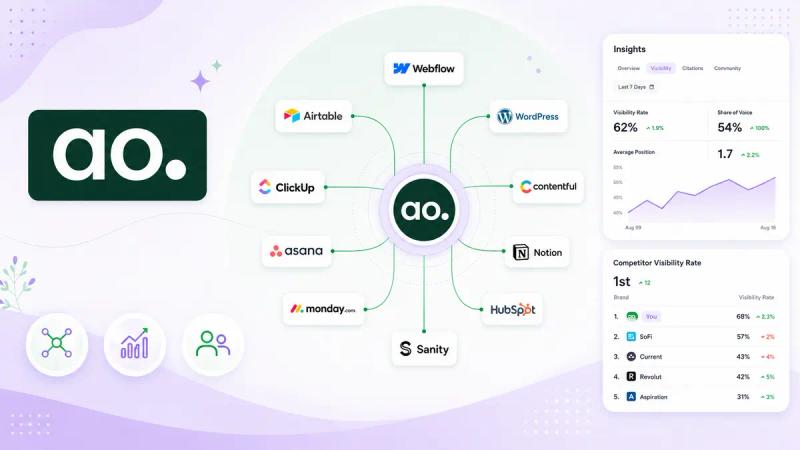
AirOps is an end-to-end, no-code AI workflow and content orchestration platform built for SEO teams, agencies, and enterprise marketers. It unifies traditional SEO, AI search visibility (also called AEO, or Answer Engine Optimization), and bulk content automation inside a single system.
Most reviewers describe it as content operations infrastructure. The platform handles strategy, production, review, publishing, and performance in one system, which is what separates it from single-purpose AI writers.
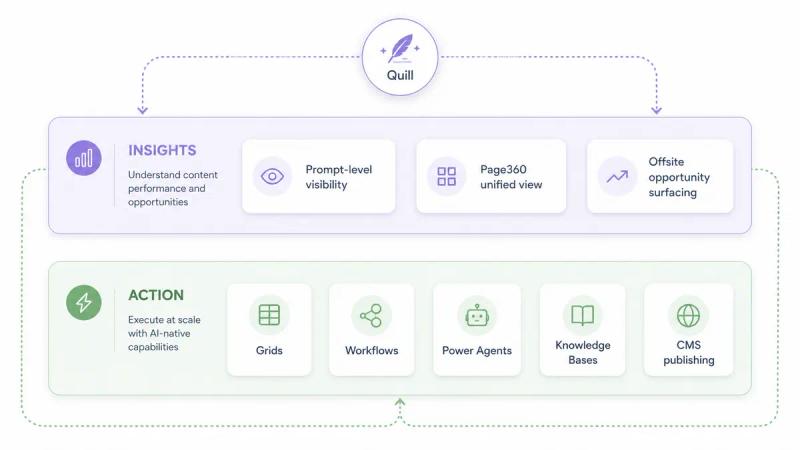
In May 2026, AirOps reorganized into two distinct layers: Insights for AI search visibility tracking and Action for content workflows, with a new agent called Quill running on top of both.
AirOps at a glance: features and user sentiment
A 6-row snapshot of where AirOps actually delivers and where users hit friction, pulled from G2 reviews, Reddit threads, ProductHunt feedback, and direct hands-on testing.
The rows are weighted toward what shows up consistently across all four sources instead of edge-case complaints.
| Feature | User sentiment | What users report |
|---|---|---|
| Bulk automation and scaling | Positive | Teams refresh 25 to 50 pages per workflow run, replacing weeks of manual editing. |
| AEO and visibility analytics | Positive | Prompt-level views into where your brand shows up across answer engines, and where competitors are winning the citations. |
| Brand Kits and knowledge bases | Positive | Voice and tone stay consistent across multiple writers, agencies, and product lines. |
| Customer support and community | Positive | Responsive Slack and in-app chat, plus an active Builder Community and live cohort trainings. |
| Onboarding and interface | Mixed | The UI is approachable, but building a production-grade workflow takes guided setup and trial runs. |
| Task-based billing | Mixed | Per-task pricing creates flexibility, and also makes monthly costs hard to forecast above plan limits. |
So, the pattern is clear: AirOps wins on what it does once you have built the system, and loses on the time you spend building it.
What AirOps actually does
Most AirOps reviews still describe the platform as a workflow builder with Grids and Brand Kits. That framing was accurate in 2024. The product has moved past it.
Every AirOps customer now works inside two distinct surfaces, and how you use each one determines whether the spend pays back.
Insights: where to focus your AEO efforts
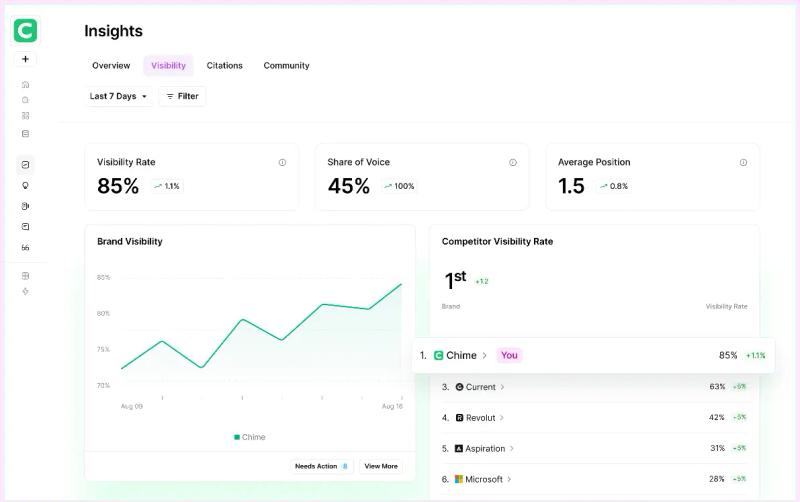
The Insights layer shows you what to do before you write anything. It pulls live data from across answer engines and traditional search, then ranks the actions most likely to move brand visibility.
Three things sit inside it:
- Prompt-level visibility data: For every tracked prompt, you see who appears in the response, which sources get cited, and where competitors are winning the conversations you should be in.
- Page360: A unified view tying SEO performance, AI search citations, and GA4 traffic into one record per URL, so a drop in pipeline can be traced back to which page lost visibility on which surface.
- Offsite opportunity surfacing: The platform crawls Reddit threads, third-party listicles, and competitor citation graphs to flag external pages where adding a brand mention would move your AI search numbers.
Action: where the content actually gets built
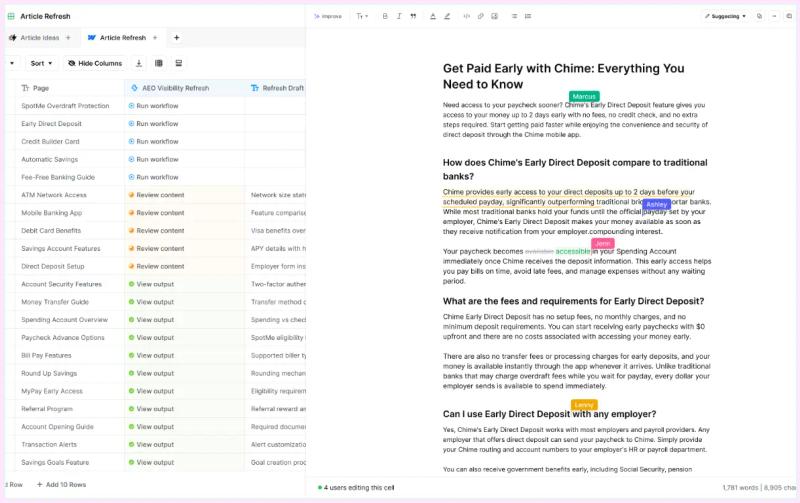
Action is the execution side. Once Insights tells you what to fix, Action runs the production.
The pieces inside it work together:
- Grids function like a spreadsheet for content operations, with each row a URL and each column a workflow step that runs against it.
- Workflows are drag-and-drop pipelines that chain AI model calls, data fetches, brand checks, and human review steps, with no code required.
- Power Agents are pre-built workflow templates AirOps ships out of the box, covering internal linking audits, FAQ schema generation, and AEO refresh briefs.
- Knowledge Bases store your internal docs, customer interviews, and proprietary data so the AI references your actual expertise instead of generic web content.
- Quill orchestrates across both layers as a managing agent, handing off between Insights surfacing and Action execution without manual stitching.
The closed-loop matters: Insights identifies the opportunity, Action ships the work, and Insights measures whether visibility moved. Most reviews describe AirOps as a one-direction content pipeline. The platform actually runs as a loop.
Real outcomes from real teams
Logo walls are easy. Specific numbers from inside a workflow are not. So, now lets see the AirOps's customer journeys that show how the two-layer system pays back in actual outcomes.
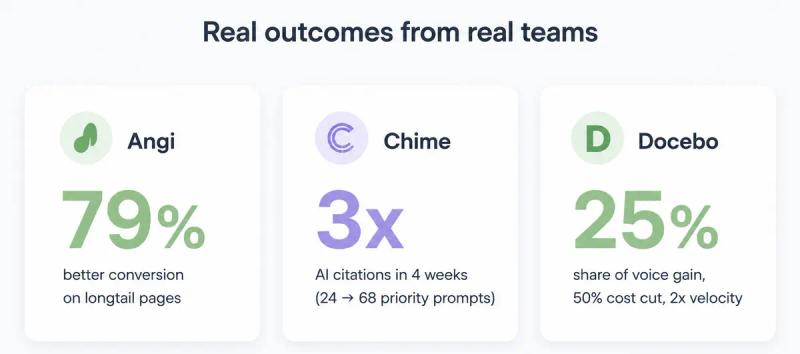
Angi: 79% better conversion on longtail content
Angi, the home services marketplace, built a programmatic SEO operation for longtail service queries: local-intent searches with specific service combinations across hundreds of metros. Manually producing those pages had never been economically viable.
Angi used AirOps Workflows and Grids to run a templated content build across hundreds of URLs in parallel, with brand-kit-aligned copy generated against local market data and reviewed by editors before publishing.
The result: longtail pages built through the system converted 79% better than the previous baseline.
Chime: from 24 to 68 priority AI citations in 4 weeks
Chime's marketing team wanted measurable movement on AI search visibility, specifically how often the brand surfaced in ChatGPT responses to high-intent banking prompts.
They used AirOps Insights to identify 24 banking prompts where Chime was missing from the response citations, then ran Action workflows to refresh the underlying pages with the structure and entities those prompts needed.
In under four weeks, Chime moved from being cited in 24 of those prompts to 68. That is a 3x increase in AI search citations without paid distribution or new product launches.
Docebo: 25% share of voice and half the production cost
Docebo, a learning management platform, had been outsourcing the bulk of its content production to agencies. The agency model was producing content but burning budget.
Docebo brought workflows in-house using AirOps Power Agents to handle the repetitive work (briefs, drafts, internal linking) and kept senior editors focused on strategy.
Six months later, Docebo had captured a 25% share of voice lead in its category, doubled content velocity to 25+ pages per month, and cut production costs by half by removing the external agency layer.
So, the pattern across all three: AirOps did not replace editorial judgment. It compressed the execution time between knowing what to do and shipping it.
AirOps pricing in 2026 (and what you'll actually pay)
Speed has a price tag. AirOps runs four pricing tiers, and the gap between them is where most buyers misjudge their budget.
The four tiers
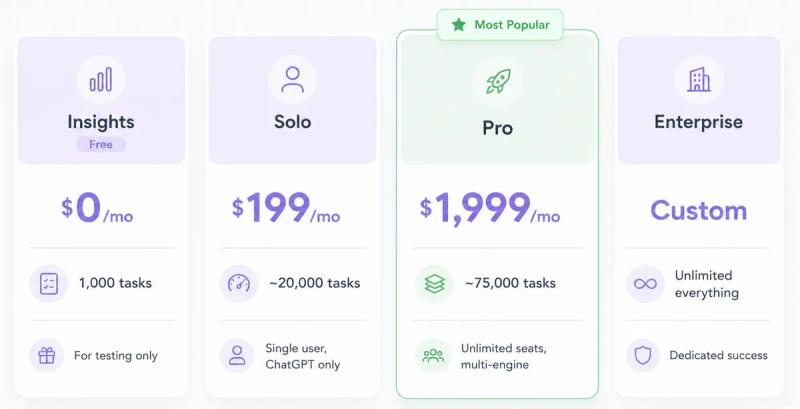
- Insights (free): 1,000 tasks per month, one user, one Brand Kit, basic templates. Designed for testing, not production.
- Solo ($199/month): ~20,000 tasks per month, one user, 100 tracked prompts and pages, three Knowledge Bases, monthly opportunity reports. ChatGPT visibility tracking only.
- Pro ($1,999/month): ~75,000 tasks per month, unlimited users, 250 tracked prompts and pages, multi-engine AI search insights across the major answer engines (ChatGPT, Google AI Mode, Perplexity), weekly opportunity reports, all CMS and SEO integrations, priority support.
- Enterprise (custom): Multi-region tracking, custom personas and languages, unlimited Knowledge Bases, dedicated account manager.
The number that actually decides your bill
A single full article workflow (research, draft, brand check, internal linking, schema, publish) consumes between 500 and 800 tasks. That math sets the realistic monthly cost.
A two-writer team producing 30 articles per month lands around 18,000 to 24,000 tasks. On Solo, most months stay inside the limit, with a couple of months running 2,000 to 4,000 tasks over and triggering $12 to $36 in overage charges.
A team producing 60+ articles per month, or running parallel workflows across content refresh and net-new production, hits the Solo ceiling fast. Pro becomes the realistic tier, and the cost jumps 10x.
The 6-month total cost picture
A small team paying $199 for Solo across six months spends $1,194 in base fees, plus roughly $100 to $300 in overages and around $5,000 in setup-phase labor cost during the ramp-up.
So, real six-month spend lands closer to $6,500 once labor is counted.
The same team on Pro spends $11,994 in base fees over six months, plus ramp-up labor. Worth it only when article volume and AEO visibility targets justify the lift.
Where AirOps actually wins
The wins cluster around one theme: AirOps removes the manual labor between strategy and shipped content. Seven specific areas where the platform earns its price tag.
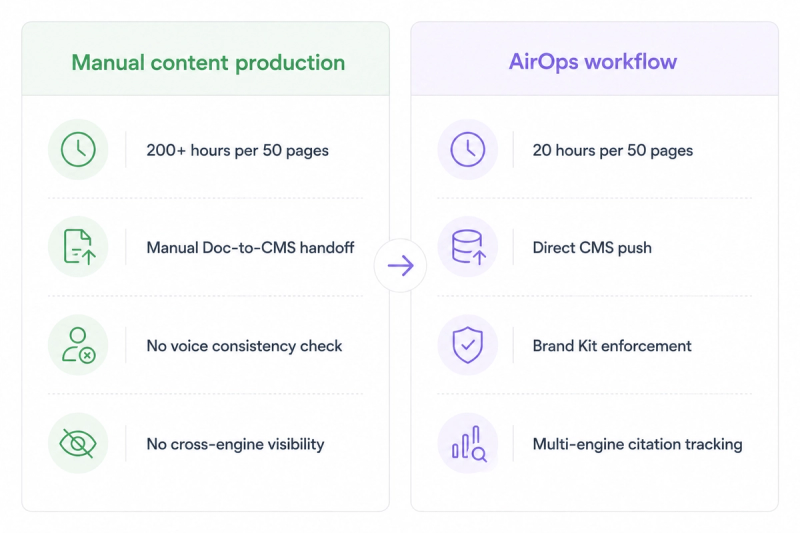
- Bulk execution economics: Producing 50 service-area landing pages manually costs $15,000 to $25,000 in writer and editor time.
The same output through AirOps runs $200 to $400 in tasks plus review hours. Content projects that were economically off-limits become viable. - Cross-engine AEO visibility in one dashboard: Instead of juggling Profound for ChatGPT, Otterly for Perplexity, and a third tool for Google AI Mode, the Pro plan consolidates citation tracking across the major answer engines into a single view.
- Brand voice applied at scale: A senior editor's style guide, codified once into a Brand Kit, applies across hundreds of generated drafts without manual re-coaching. Voice consistency that took weeks of editorial training compresses into a setup step.
- Direct CMS publishing eliminates the formatting tax: Content teams typically lose 30 to 60 minutes per article on the Google-Doc-to-CMS handoff. AirOps's direct integrations cut that step entirely.
- Human-in-the-loop review as a safety net: Workflows pause at named checkpoints for editor approval, catching AI hallucinations before they ship. Pure-automation tools fail exactly here.
- Power Agents as a workflow head start: Pre-built templates for internal linking audits, FAQ schema generation, and AEO refreshes save the two-week design phase that solo workflow setup demands.
- Academy and cohort training as a moat: AirOps runs a full education platform with certification paths, paid cohorts featuring practitioners like Kevin Indig, and a job board for certified Content Engineers. The training infrastructure is harder to replicate than the software.
So, the pattern: every win is a specific labor step that AirOps removes. The pricing makes sense only when enough of those steps exist to remove.
Where AirOps falls short
The flaws cluster around the lift required to use the platform well, and around what gets gated behind the Pro plan. 8 friction points serious buyers should price into the decision.
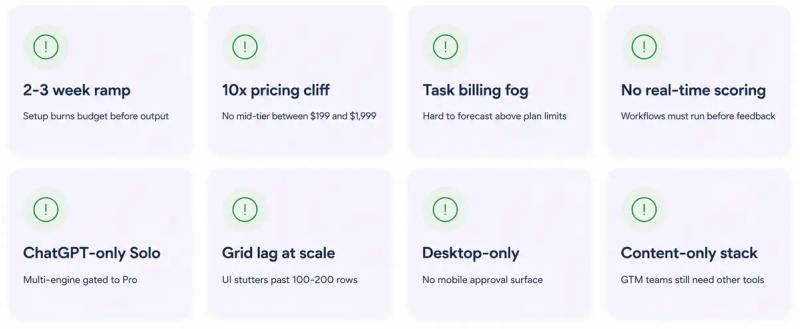
- The setup-phase subscription burn: Most teams need two to three weeks to ship a production-grade workflow. That ramp-up runs concurrently with the paid subscription, meaning $100 to $300 of Solo billing or $1,000 to $1,500 of Pro billing burns before output begins. Budget that as part of the buy decision.
- AirOps-specific learning curve, not generic AI literacy: Even teams fluent in ChatGPT and Zapier have to learn AirOps's particular step types, data-mapping conventions, and prompt engineering patterns. Cohort training shortens this, the time cost does not disappear.
- The Solo-to-Pro pricing cliff: A 10x jump from $199 to $1,999 with no $499 or $799 mid-tier punishes mid-market buyers specifically. Growing teams either over-commit to Pro early or starve on Solo's caps, with no middle path.
- Pre-built workflows, no real-time scoring: Surfer SEO scores content as you write, against live SERP data. AirOps requires the workflow to be designed and run before any score appears. Teams that prefer iterative real-time feedback will find this front-loaded.
- Solo plan limits AEO insights to ChatGPT: If your audience also uses Perplexity, Claude, or Google AI Mode, Solo's single-engine cap means you are flying blind on most of your visible AI search surface.
- UI lag past 100 to 200 active rows: Multiple G2 reviews flag interactive Grid stuttering once datasets grow past roughly 100 to 200 rows. Bulk-publishing teams running parallel workflows hit this faster than smaller setups ever do.
- Desktop-only, no mobile: You cannot review AI outputs between meetings, on the go, or during a commute. Approvals back up in batches because the workflow surface exists only on a desktop browser.
- Limited beyond content automation: Teams running full GTM motions (sales enrichment, intent signals, outbound sequences) still need separate platforms for those layers. AirOps covers content end-to-end. The rest of the pipeline lives elsewhere.
None of these are deal-breakers on their own. Stacked together, they explain why solo founders and pre-revenue teams should look elsewhere.
AirOps vs. building this yourself with Claude, n8n, and your CMS
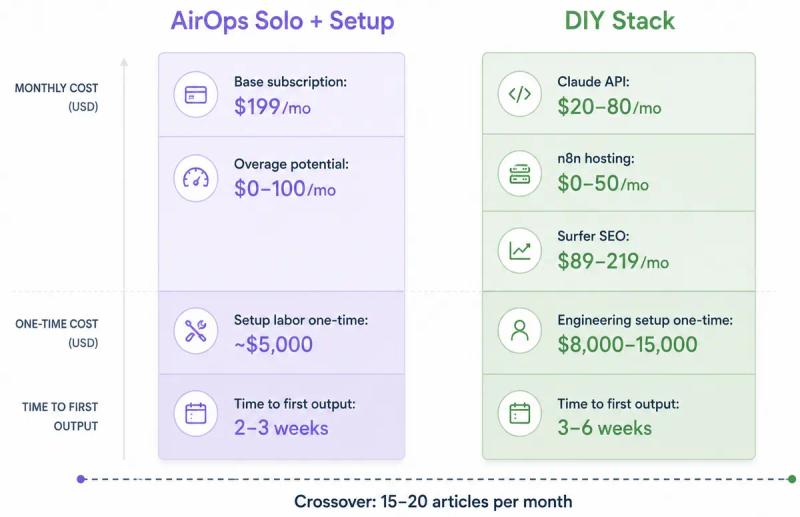
The honest question most buyers should ask before paying for AirOps: could the same outcome come from a Claude API key, an n8n instance, your existing CMS, and a Surfer SEO subscription?
For some teams, the answer is yes.
The DIY stack runs roughly $100 to $300 per month plus engineering time. Claude API usage at typical content workflow loads costs $20 to $80 per month. Self-hosted n8n is free, or $20 to $50 monthly on cloud.
Surfer SEO or a similar real-time scorer runs $89 to $219. Add your CMS (already paid for) and you have most of AirOps's Action layer at a fraction of the price.
Two things the DIY stack cannot reproduce easily.
First, the Insights layer. A DIY cross-engine citation tracker requires scripting prompt monitoring against ChatGPT, Perplexity, and Google AI Mode APIs, then normalizing the data for actionable surfacing.
That is weeks of engineering work, and the maintenance cost compounds as the LLMs ship API changes.
Second, the consolidation effect. AirOps brings Brand Kit governance, human-in-the-loop checkpoints, Grid-based parallel execution, and CMS publishing into one surface.
The DIY stack stitches the same functions across four to six tools, and every integration point becomes a maintenance risk.
The breakeven sits around 15 to 20 articles per month with a serious AEO data need. Below that, DIY wins on cost. Above that, AirOps wins on time. For more flexcibility you can use open source SEO tools.
Who should buy AirOps in 2026 (and who should walk away)
The fit question breaks into three buyer profiles, each with specific team and content markers.
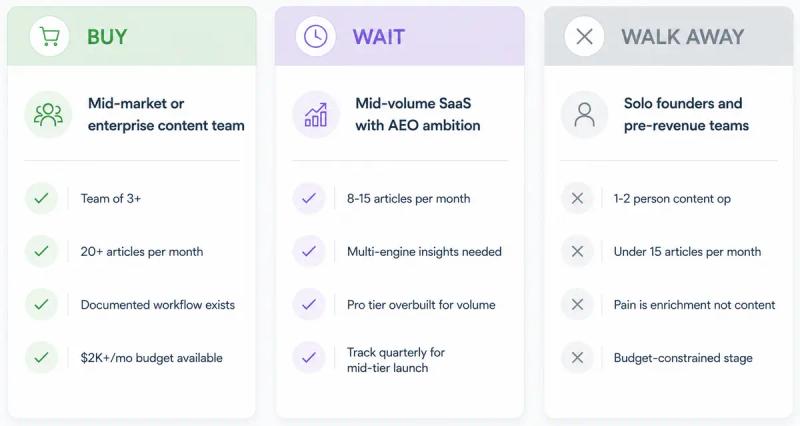
Buy if you check all four
- A content team of three or more, with at least one senior editor.
- Article volume of 20+ per month, or a refresh backlog of 100+ pages from the last three years.
- A documented editorial workflow already in place (briefs, draft standards, review checkpoints), even if it lives in Notion today.
- Budget that absorbs $2,000+ per month, and one team member with 15 to 20 hours per week for the first two months.
A team hitting three of four will struggle to make Pro pencil out.
Walk away if any of these apply
- The content operation runs on one or two people without dedicated editorial bandwidth.
- Monthly article output is under 15 pieces, with no near-term backlog.
- The primary pain point is lead enrichment, outbound, or CRM data quality.
- The team is pre-revenue, where six months of Pro spend equals one engineering hire.
For teams in any of these buckets, lighter tools or a DIY stack cover the actual need.
Wait and watch if you sit in the mid-volume middle
A specific zone exists where neither tier fits cleanly: SaaS teams publishing 8 to 15 articles per month with serious AEO ambition. Solo's caps block the visibility data you need, and Pro is overbuilt for the volume.
The right move is to track AirOps's pricing page quarterly. A mid-tier plan in the $499 to $799 range would solve this gap. Until then, hybrid approaches (free Insights tier plus a DIY content stack) are the realistic path.
AirOps alternatives for specific buyer types
AirOps is not the only path. So let's see the 5 common buyer profiles, five better fits.
- You want deeper AEO visibility data, not workflow automation: Profound goes further on prompt-level citation tracking, with global regional data and granular sentiment analysis.
- You want a simpler AEO tracker for an agency-style use case: Rankability is built for agencies that need to report AI search visibility to clients without absorbing the AirOps learning curve.
- You want DIY flexibility at lower cost: Pair n8n or Gumloop with the Claude or GPT API, layer in Surfer SEO for real-time content scoring, and keep your existing CMS. The stack costs 80% less than Solo and demands engineering capacity in return.
- You run a full GTM motion (sales + content): Clay handles lead enrichment, intent signals, and outbound orchestration. AirOps covers content. The two work in parallel rather than competing.
- You are a mid-market SaaS team that needs AEO execution at a lower price point: RankSaver focuses exactly there: content workflows targeted at answer engine visibility, priced below the AirOps Pro tier.
Match the alternative to the constraint that hurts most.
The verdict
AirOps in 2026 has matured from a content workflow tool into a genuine AI search platform. The Insights layer, Action layer, and Quill agent together make a real bet on AEO worth taking, if your team can absorb the lift and your budget can sustain the spend.
The right first move costs nothing. Spin up the free Insights tier, build one workflow against five articles from your existing content stack, and measure whether the AEO lift is what your business actually needs. The platform reveals itself fastest from the inside.
Frequently Asked Questions
Everything you need to know about this topic.
Customer content stays out of AI model training. AirOps preserves brand voice, knowledge bases, and workflow outputs inside each customer's account, isolated from training datasets. The platform calls underlying LLMs (ChatGPT, Claude, Gemini) through standard API endpoints with data-protection terms that exclude training use.
The platform handles programmatic SEO pages (location, category, comparison), product descriptions, technical documentation, FAQ content, landing pages, content briefs, meta descriptions, internal linking audits, and Reddit-style discussion replies. Anything that follows a repeatable structure with input data and a defined output format can be built into a Workflow.
ROI timing depends on the workflow type. Content refresh operations typically show traffic or citation lift within 30 to 60 days of publishing the updated pages. Programmatic SEO builds need 90 to 180 days for full indexing and ranking signals. AEO citation work usually surfaces measurable movement in 4 to 8 weeks once the underlying pages are restructured.
Multi-client account management sits in the Enterprise tier, with multi-account CMS integrations, separated Brand Kits per client, and consolidated reporting across workspaces. Agencies on Pro can manage one or two clients with careful Brand Kit hygiene, though scaling past three accounts typically requires the Enterprise setup.
The free Insights tier is a permanent entry point with no expiry date. New users get 1,000 tasks per month indefinitely, plus one Brand Kit and basic templates. Paid plans (Solo, Pro, Enterprise) start when you upgrade. Most teams build their first workflow inside the free tier before committing to any monthly spend.
Pro plan pricing is monthly by default, with annual options available through sales for a discount that AirOps does not publish on the pricing page. Solo also runs month-to-month. Enterprise contracts typically lock in for 12 months with custom renewal terms. The Insights free tier has no contract at all.
Written By
Want help getting your brand ranked on Google and cited by AI?
We help businesses build AI visibility through SEO, content, and authority with clear revenue impact.
Book a Strategy Call