
Profound AI is an enterprise AEO and GEO platform that tracks how your brand appears across 10+ AI engines - ChatGPT, Gemini, Perplexity, Grok, Copilot,
and more.
It holds a 4.6/5 on G2, is backed by $96M Series C at a $1B valuation, led by Lightspeed Venture Partners, and is used by Fortune 500 marketing teams to monitor citations, sentiment, and share of voice in AI-generated answers.
But powerful and right for you are two different things.
So, in this Profound AI review, I break down every feature, real customer results, honest limitations, and tell you exactly who should - or shouldn't - pay for it.
- Profound is a full-stack AEO platform — it monitors brand visibility across 10+ LLMs and helps teams optimize content to earn more citations in AI-generated answers.
- Its strongest modules are Prompt Volumes (what people actually ask AI),
Answer Engine Insights (how your brand appears), and Agent Analytics (how AI bots crawl your site). - Real customer results include Ramp growing AI visibility 7x, OpusClip
reaching 45% brand visibility in 30 days, and Hone achieving an 800%
visibility boost. - Pricing runs from $99/mo (Starter, ChatGPT only) to $399/mo (Growth, 3 engines + content creation) to custom Enterprise. Annual billing saves
roughly 17%. - The biggest limitation is an execution gap: Profound tells you what to fix
but doesn't build the content for you at lower tiers. - Best for mid-market and enterprise teams with a dedicated AEO owner and budget to match.
Who is Profound Actually Built For? (And Who Should Skip It)
Profound markets itself broadly. But after digging into the platform, the
customer base, and real user feedback - the fit is actually quite narrow.
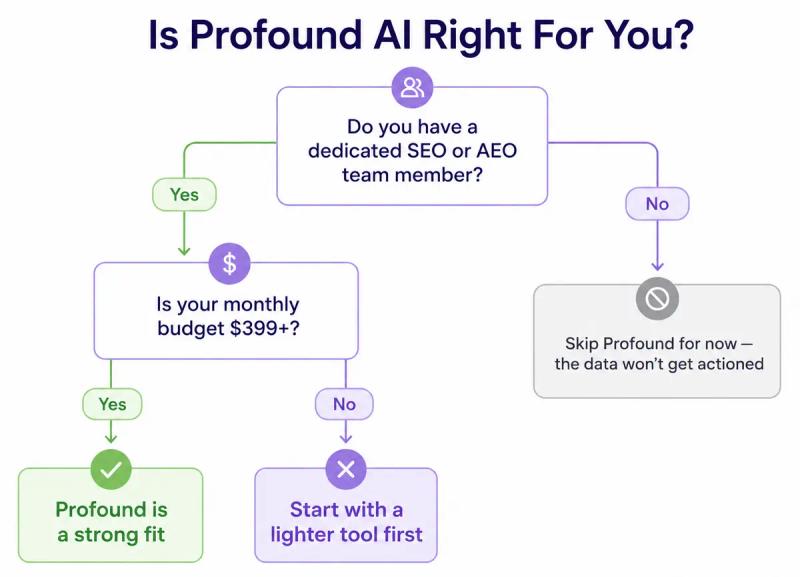
So who gets genuine value from it, and who doesn't.
The Right Fit
1. Mid-market and enterprise SaaS brands: If your brand is already showing up in Google but losing ground in ChatGPT and Perplexity - Profound is built for you.
These are teams with dedicated SEO or AEO ownership, a content pipeline, and budget to act on what the platform surfaces. The data depth only pays off when someone is actually driving the strategy.
2. SEO and AEO agencies managing multiple clients: The Agency Growth plan ($99/mo + add-ons) is specifically designed for this. You get pitch workspaces to run prospect audits, consolidated billing, and full client workspace management.
If AEO is becoming a core service offering for your agency, Profound gives you the infrastructure to productize it.
3. PR and communications teams at public or high-profile companies: AI engines don't just recommend products -- they shape brand narratives. Profound tracks the exact tone and context of how AI describes your
company across 10+ platforms.
For PR teams managing reputations at scale, that sentiment and citation visibility is difficult to get anywhere else.
4. E-commerce brands competing in AI shopping queries: If your category is the kind where people ask ChatGPT "what's the best [product] for [use case]," Profound's Shopping module tracks exactly where you appear, which competitors sit beside you, and what product attributes AI emphasizes in its recommendations. That's actionable for product and content teams.
Who Should Skip It (Or Wait)
1. Solo consultants and freelancers: The Starter plan at $99/mo only tracks ChatGPT and caps you at 50 prompts. So, for a one-person operation, that's a tight ceiling.
You'll hit the limits before you can extract meaningful trend data, and there's no guidance on what to do with what you find.
2. Teams with no dedicated AEO owner: This is the biggest red flag. Profound is an intelligence platform - it surfaces what's broken and what's missing. But it doesn't fix it for you.
If no one on your team owns the output, the dashboard becomes expensive reporting that nobody acts on. Multiple G2 reviewers flag exactly this: rich data, unclear next steps.
3. Brands primarily needing content creation: Profound has AI Agents and content workflows, but content execution is not its core strength.
If your primary bottleneck is producing AEO-optimized content at volume — not monitoring visibility - tools like Frase AI or RankSaver are a better starting point and a fraction of the cost.
4. Early-stage startups under $1M ARR: Not because the platform isn't useful - it's because the ROI math doesn't work yet.
At that stage, you don't have enough brand surface area in AI answers to track meaningfully, and $399–$999+/mo is hard to justify before AEO is a proven channel for your business.
Profound AI Key Features
Most reviews list Profound's features like a product brochure. But we explain here what each module does in practice - and where each one earns its place in a real AEO workflow.
Prompt Volumes - Finding What People Actually Ask AI
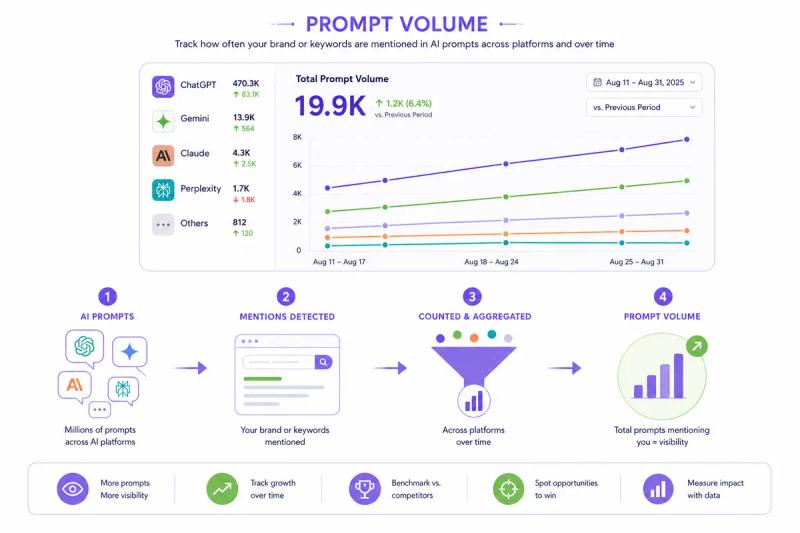
Traditional keyword research shows you what people type into Google. Prompt Volumes shows you what they ask ChatGPT, Perplexity, and Gemini.
The difference matters more than it sounds.
AI queries tend to be longer, more conversational, and intent-rich. Someone searching Google might type "best CRM software." The same person asking an AI engine says "what CRM should a 10-person SaaS startup use that integrates with HubSpot and costs under $200/month."
Profound clusters billions of these real prompts into commercially relevant topics so you can see where demand lives before you create a single piece of content.
It also shows Fan-Out tracking - how a single user prompt expands into multiple sub-queries that the AI engine runs behind the scenes. Optimizing for the surface-level prompt alone misses most of the signal.
So where this fits in your workflow: Use Prompt Volumes before content planning. It replaces the "keyword research" step for AEO the same way Ahrefs replaced guesswork for traditional SEO.
Honest limitation: Prompt volume data is aggregated and clustered - you won't get exact monthly search volumes the way you do in Google Search Console. It's directional intelligence, not precision tracking.
Answer Engine Insights - How Your Brand Shows Up Across 10+ AI Engines
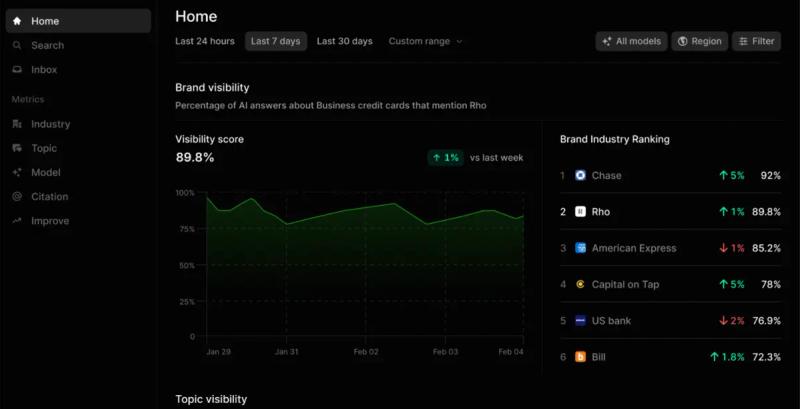
This is Profound's core monitoring module and the one most teams spend the most time in.
It tracks every instance your brand is mentioned, cited, or recommended across ChatGPT, Perplexity, Gemini, Copilot, Grok, Meta AI, DeepSeek, Claude, Google AI Overviews, and Google AI Mode.
For each tracked prompt, you get a full answer snapshot - not just a yes/no on whether you appeared, but your position, the sentiment framing, and which external sources the AI cited when mentioning you.
The AI Visibility Score gives you a single percentage: how often your brand appeared across all tracked prompts in a given period. Share of Voice layers your competitors into the same view so you can see who dominates which topics and where you're being displaced.
What makes this genuinely useful is the time-series data. You can see whether a content update improved your citation rate, whether a competitor's new landing page hurt your share of voice, or whether a specific AI engine is systematically ignoring your brand compared to others.
Where this fits in your workflow: Run this weekly as your AEO performance dashboard - the equivalent of checking rank positions in traditional SEO.
Honest limitation: Some users on G2 flag occasional discrepancies between Profound's reported citations and what manual checks in ChatGPT show.
AI responses vary by session, location, and model version — so some variance is expected, but it's worth validating key prompt results manually before reporting
upward.
Agent Analytics - Understanding How AI Bots Crawl Your Site
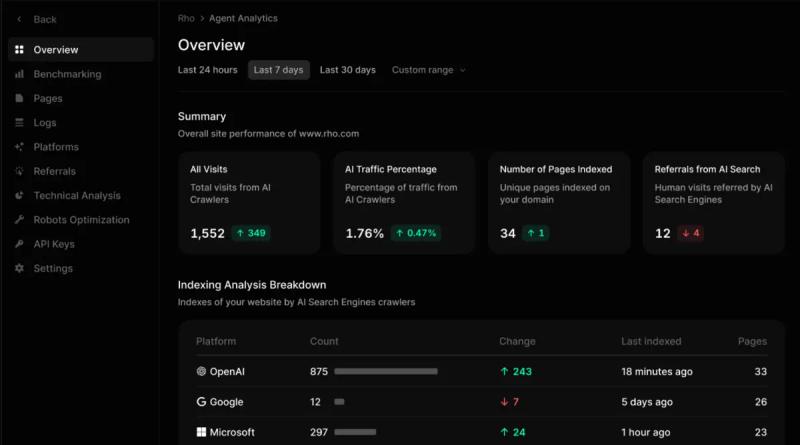
Every major AI engine - ChatGPT (GPTBot), Claude (ClaudeBot), Perplexity (PerplexityBot), Gemini - sends crawlers to your site before it can cite you. Agent Analytics tracks exactly which bots are visiting, how frequently, which pages they access, and whether they can render and interpret your content correctly.
This matters because a page that ranks well in Google can be completely invisible to AI engines if the content is locked behind JavaScript rendering, thin schema markup, or poor internal linking structure. Profound surfaces these technical barriers before they become citation gaps.
The attribution layer connects crawler activity to actual outcomes: which pages are being crawled heavily correlates with which pages earn citations. And when a bot suddenly drops its crawl frequency on a key page, Profound flags it so you can diagnose the cause before your visibility scores drop.
Where this fits in your workflow: Run Agent Analytics as a monthly technical AEO audit alongside your traditional crawl health checks.
Honest limitation: Smaller sites with lower overall traffic may not generate enough crawler data to surface meaningful patterns in the early months. The signal gets stronger as your site scales.
Profound Agents - The Read/Write Layer
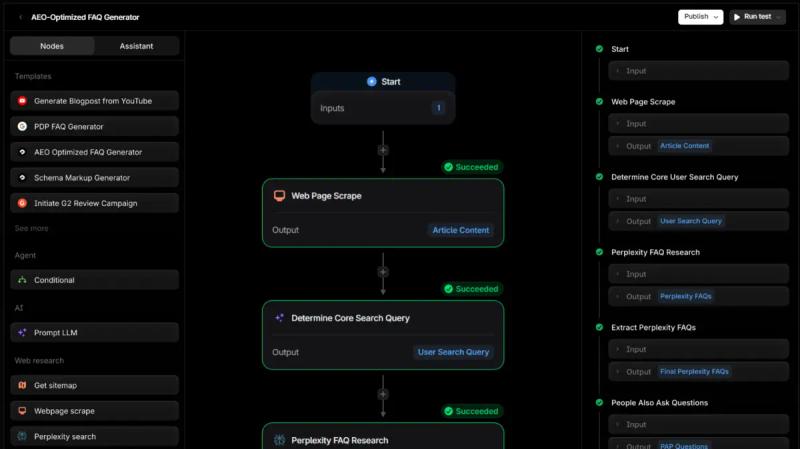
Every other feature in Profound is about monitoring. Agents is where the platform shifts from intelligence to execution.
Profound Agents are autonomous AI workers built for specific marketing functions: demand generation, brand, content, and AEO/SEO. You set up a workflow — Profound calls it a "Marketing Agent" - and it researches prompts, generates AEO-optimised content drafts, runs competitor analyses, and executes tasks in parallel without manual intervention.
The most powerful implementation is Profound Sheets - a spreadsheet-style workflow builder where each row acts as an individual agent running a parallel task. Think: localising the same piece of content for 20 different markets, or running competitor to content gap analysis across 50 tracked prompts simultaneously.
For enterprise teams running AEO at scale, this collapses what would be weeks of manual work.
Where this fits in your workflow: Use Agents to turn Answer Engine Insights gaps directly into content briefs and drafts — closing the loop between "we're missing here" and "here's the content that fixes it.
Honest limitation: Agents are available from the Growth plan upward. At the Starter tier ($99/mo) you get basic Agent credits but no access to Profound Sheets or bulk parallel runs - the features that make Agents genuinely powerful.
Shopping Visibility - For Brands Competing in AI Commerce
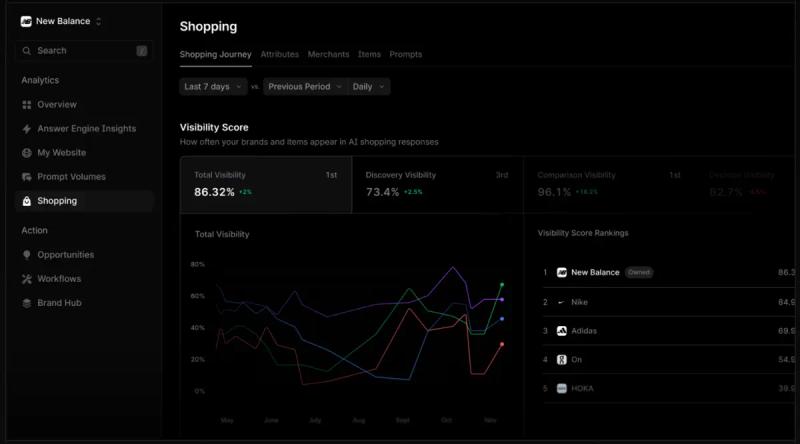
If your business sells products - physical or SaaS - and buyers research purchases through AI, this module directly tracks your competitive position in those conversations.
Shopping Visibility monitors how your products appear in AI-driven recommendation and comparison queries. It tracks which attributes AI emphasises when describing your product (price, features, use case fit), how your sentiment compares to alternatives sitting beside you, and gives SKU-level reporting so you can see individual product performance rather than just brand-level averages.
For SaaS brands, this is especially useful for "best [category] tool for [use case]" prompts — the queries where AI engines effectively act as a buying committee recommendation engine.
Where this fits in your workflow: Map your top 10–15 buying-intent prompts, run them through Shopping Visibility, and identify which product attributes your content is failing to communicate to AI engines.
Profound AI Pricing - What You Actually Get at Each Tier
Profound has four plans split across two tracks: one for brands, one for agencies.
For Brands
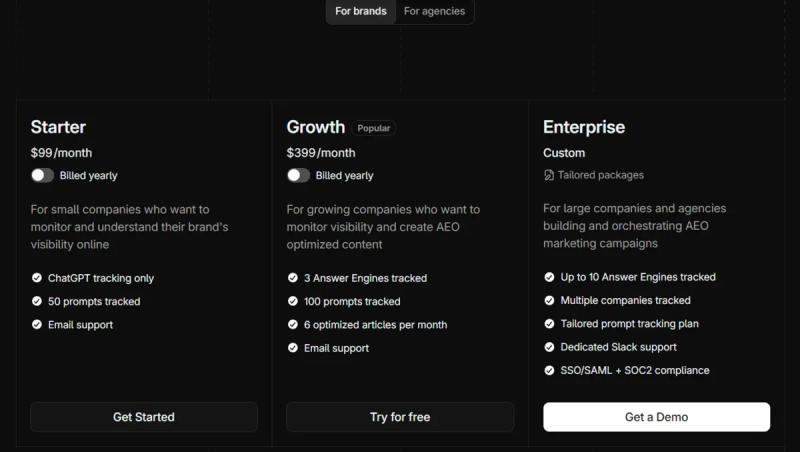
Starter — $99/month ($82.50/month billed annually)
The entry point. It tracks ChatGPT only, caps you at 50 prompts, and gives you email support. Annual billing saves you two months (roughly 17% off).
Honest take: this plan is useful for a brand that wants to understand its ChatGPT presence before committing further. But 50 prompts across one engine gives you a narrow slice of reality. You'll outgrow it fast if AI visibility is genuinely a strategic priority.
Growth — $399/month ($332.50/month billed annually)
This is where Profound becomes a working AEO tool. You get 3 answer engines tracked, 100 prompts, and 6 AI-optimised articles per month included. The article generation is what separates Growth from Starter — it starts closing the gap between insight and execution.
Honest take: for a mid-sized SaaS brand or a boutique SEO agency managing a flagship client, Growth is the minimum viable plan. The 3-engine limit still means you're missing Grok, DeepSeek, Meta AI, and others - but ChatGPT, Perplexity, and Google AI Overviews cover the majority of commercial AI search volume right now.
Enterprise - Custom pricing
Up to 10 answer engines, multiple companies tracked, tailored prompt plan, dedicated Slack support, SSO/SAML, and full SOC2 compliance. This is the plan for Fortune 500 marketing teams and large agencies running AEO at scale.
No public pricing - you book a demo to get a proposal.
For Agencies
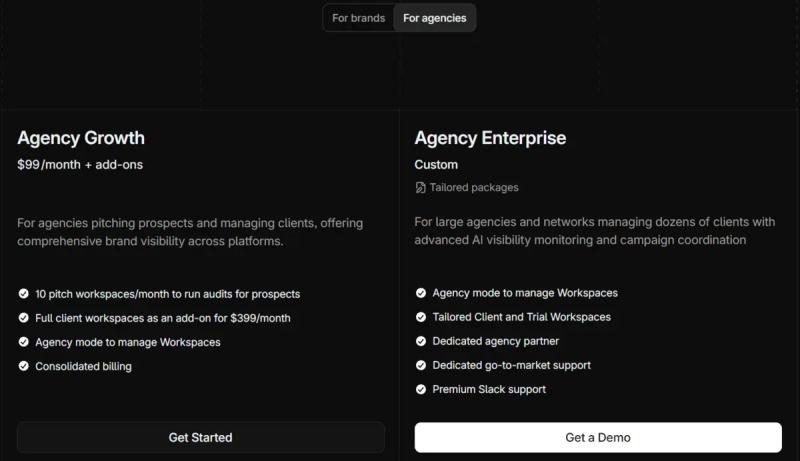
Agency Growth - $99/month + add-ons
Designed for agencies pitching AEO as a service. You get 10 pitch workspaces per month to run prospect audits — useful for new business conversations. Full client workspaces are available as an add-on at $399/month each. Agency mode lets you manage all workspaces from one dashboard with consolidated billing.
Honest take: this is genuinely well-structured for agencies building an AEO practice. The pitch workspace model means you can show prospective clients real visibility data before they sign — that's a strong sales tool.
Agency Enterprise - Custom pricing
For large agencies managing dozens of clients. Includes a dedicated agency partner, tailored client and trial workspaces, go-to-market support, and premium Slack support.
The Pricing Reality
The live pricing page shows $99 and $399 as the current self-serve tiers, with annual billing discounts applied.
The real cost question isn't the plan price — it's whether your team has the AEO bandwidth to extract the value. At $399/month, Profound costs $4,788/year.
That's justifiable the moment it helps you recover or capture AI-driven traffic worth more than that.
So for brands already seeing AI referral traffic, the math is straightforward. But for brands starting from zero, the ROI timeline is longer.
Profound AI Pros and Cons
No tool is perfect. Here's what Profound genuinely does well and where it falls short, based on platform analysis and verified G2 feedback.
Pros
1. The deepest prompt intelligence on the market: Prompt Volumes is a genuinely differentiated capability. No other tool in the AEO space gives you this level of visibility into what people are actually asking AI engines - clustered by topic, mapped by demand, and connected to your brand's performance against each query.
2. Crawler-to-citation attribution: Agent Analytics closes a loop that no competitor has solved cleanly - it connects how AI bots crawl your site to whether you earn citations in the answers those bots help generate. That's technically sophisticated and directly actionable for SEO teams.
3. Stakeholder-ready reporting: G2 reviewers consistently highlight that Profound's dashboards translate complex AI visibility data into charts and summaries that non-technical stakeholders — CMOs, board members, clients - can understand without a briefing. That matters in organisations where AEO is still being justified as a budget line.
4. Proven enterprise results: The customer evidence is substantial and specific. Ramp grew AI brand visibility 7x. OpusClip hit 45% brand visibility and #1 citation share in 30 days. Hone boosted visibility 800%. Zapier became the #1 cited domain for its most competitive prompts. These aren't vague case study claims - they're named companies with measurable outcomes.
5. Exceptional support at higher tiers: Enterprise and Growth users consistently praise responsive customer success teams and dedicated Slack channels. For a tool with a steep learning curve, quality onboarding support is a genuine differentiator.
Cons
1. Setup complexity is real: Profound is not plug-and-play. Defining your prompt set, configuring workspaces, and connecting your analytics stack takes time. Most teams report 1–3 months before the platform is generating insights they can act on confidently. If you need immediate value, this timeline is a problem.
2. The execution gap at lower tiers: The Starter plan gives you data with no path to action. The Growth plan includes 6 articles/month - but if your AEO gaps require 20+ content updates, you're still doing most of the execution work outside Profound. The platform tells you what's broken faster than it helps you fix it.
3. Prompt cap constraints: 50 prompts on Starter and 100 on Growth sound reasonable until you map out how many buyer-intent queries actually matter for your brand. A mid-sized SaaS company with 5 product categories and 3 buyer personas can easily need 200+ prompts tracked to get a complete visibility picture.
3. Occasional data discrepancies: Some G2 reviewers note differences between Profound's reported citation data and what manual checks in ChatGPT return. AI responses vary by session, region, and model version — Profound averages across many queries - but it's worth factoring in if your reporting requires high precision.
4. Price jump between tiers: Going from Starter ($99) to Growth ($399) is a 4x increase in monthly spend for what feels like a moderate capability step. There's no middle tier. So, teams that have outgrown Starter but can't justify Growth yet are left with limited options.
Real Results From Profound Customers
Profound's marketing page lists impressive numbers. But the more useful question is what conditions produced those results?
After going through every published case study, a clear pattern emerges. The fastest, largest wins happened when three things were true.
The team had a defined prompt set before onboarding. Someone owned AEO execution alongside the platform. Content changes were made within weeks of the first insights, not months.
Here's what that looks like in practice.
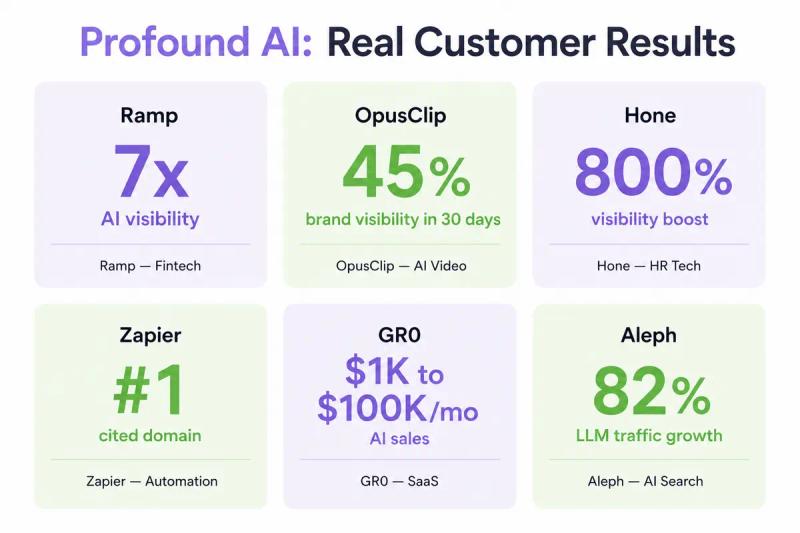
Ramp - 7x AI brand visibility in Accounts Payable
Ramp used Profound to identify the exact prompts driving fintech recommendations in ChatGPT and Perplexity, then optimized content specifically for those queries. They became the 5th most visible fintech brand globally across AI engines. George Bonaci, VP of Growth, put it plainly: "Before Profound, AI Search was a black box. Now it's a competitive advantage."
OpusClip - 45% brand visibility + #1 citation share in 30 days
One of the fastest documented results on Profound's customer page. OpusClip moved from low visibility to dominating its most competitive prompts in a single month by pairing Profound's gap analysis with rapid content deployment.
Hone - 800% visibility boost using AI-optimized content workflows
Hone used Profound's Agents and content workflow features to scale AEO content production. The 800% figure is the standout stat, but the mechanism matters. They didn't just monitor. They built a repeatable publishing system inside the platform.
Zapier - #1 cited domain for most competitive prompts
Zapier's result is arguably the most strategically significant on the list. Becoming the default citation source for your category's hardest prompts is the AEO equivalent of ranking #1 for your highest-volume keyword. Profound's Prompt Volumes data guided which prompts to target first.
GR0 - client grew from $1K to $100K/month in AI-driven sales
This agency case study is the most relevant for SEO teams pitching AEO as a service. GR0 used Profound's Agency plan to build and execute an AEO program for a client from scratch, taking their AI-attributed revenue from negligible to six figures monthly.
Other notable results: Aleph grew LLM-attributed website traffic 82%. Omnilux tripled AI-attributed revenue. CRS Credit API increased AI visibility 20x. Airbyte tripled AI brand visibility in one week. Jordan Digital Marketing grew client revenue 34%.
So, what the pattern tells you: Across all 15 published case studies, the common thread is not the plan tier or the company size. It's speed of execution after insight. Teams that waited to fully understand the platform before acting on its data consistently saw slower results than teams that ran their first content experiment within two weeks of onboarding.
Profound gives you the intelligence. The ROI comes from what you do with it the week after.
How Profound Compares to Alternatives
Profound is the most capable AEO platform available right now. But "most capable" doesn't mean "right for every team."
Here's how it stacks up against the tools most commonly evaluated alongside it - including where RankSaver fits in this landscape.
| Profound | RankSaver | Rankability | Scalenut | Radarkit | |
|---|---|---|---|---|---|
| Best for | Enterprise AEO intelligence | SaaS founders, ecommerce + SEO agencies | Mid-size SEO agencies | GEO content execution | AEO tracking for SMBs |
| Starting price | $99/mo (brands) | From $49/mo | From ~$79/mo | From $59/mo | From $29/mo |
| AI engines tracked | Up to 10 | up to 9 | Multiple | Multiple | Multiple |
| Prompt Volumes | ✅ | ❌ | ❌ | ❌ | Partial |
| Crawler analytics | ✅ | ✅ | ❌ | ❌ | Partial |
| Content creation | ✅ (Growth+) | ✅ | ✅ | ✅ | ❌ |
| Agency plan | ✅ | ✅ | ✅ | ❌ | ❌ |
| Free trial | ❌ | ✅ | ✅ | ✅ | ✅ |
| SOC2 compliance | ✅ (Enterprise) | — | — | — | — |
So, if you're deciding, let me clarify - Profound is a strong fit when your team has a dedicated AEO owner and you're managing brand visibility at enterprise scale.
But if your priority is content planning, creation, optimization and AI tracking within a single workflow, while keeping costs below $399/month, go with RankSaver.
Is Profound AI Worth It? My Final Verdict
Profound is the most technically advanced AEO platform on the market in 2026. The prompt intelligence, crawler analytics, and citation tracking are genuinely best-in-class - there is no direct competitor that covers all three with the same depth.
But "worth it" depends entirely on whether your team is ready
to extract the value.
Worth every dollar if:
You're a mid-market or enterprise brand with a dedicated AEO or SEO team member who owns the output. You have a defined set of buyer-intent prompts you know matter for your category. You're already seeing some AI referral
traffic and need to understand and scale it. You can commit 4–8 weeks to proper onboarding before expecting clean, actionable data.
Hard to justify if:
You don't have anyone who will own the platform week to week. You're pre-product-market-fit and AI search isn't yet a measurable channel for your business. You primarily need content creation support - not visibility intelligence. You need a free trial before committing budget.
The bottom line:
Profound earns its position as the category leader. The case study results are real, the feature depth is unmatched, and for enterprise teams the ROI case is straightforward. For smaller teams, the value is there - but only if someone is driving the strategy with it.
So, if you're evaluating Profound alongside other options, the smartest move is to map your top 20 buyer-intent prompts first, check manually how your brand appears in ChatGPT and Perplexity today, and then assess whether Profound's depth justifies its price for your current stage.
Frequently Asked Questions
Everything you need to know about this topic.
Profound does not offer a free trial on any of its current plans. The Starter plan at $99/month is the lowest-cost entry point for brands. Agencies can access the Agency Growth plan at $99/month which includes 10 pitch workspaces for prospect audits — the closest thing to a trial environment Profound currently offers.
Traditional SEO tools track keyword rankings, backlink profiles, and Google SERP positions. Profound tracks how your brand appears in AI-generated answers across ChatGPT, Perplexity, Gemini, and 7+ other engines. The two tool types are complementary — Profound fills the visibility gap that no traditional SEO platform currently covers.
Small businesses will find the Starter plan limited — 50 prompts and ChatGPT-only tracking narrows what you can learn. Agencies are better served by the dedicated Agency Growth plan ($99/mo + add-ons), which is built specifically for client management and new business pitching.
Profound sits at the intersection of both. GEO (Generative Engine Optimization) focuses on creating content that earns citations in AI-generated results. AEO (Answer Engine Optimization) is the broader practice of optimising for AI answer engines. Profound monitors your current AEO performance and helps you execute GEO content improvements - it covers both disciplines in one platform.
No - and Profound doesn't position itself as a replacement. You still need traditional SEO tools for keyword research, backlink analysis, and Google rank tracking. Profound sits alongside these tools as your AI search intelligence layer. Most enterprise teams run both.
Profound integrates with Google Analytics (GA4), Vercel, Cloudflare, AWS, Netlify, and Fastly on the infrastructure side. Enterprise plans include API access for connecting to BI tools, CDPs, and CRM stacks. Profound Sheets enables bulk agent runs that connect to external data sources at the Enterprise tier.
Profound combines its own prompt runs across AI engines with large-scale opt-in clickstream and conversation data from third-party providers. According to the company, all third-party data is GDPR and CCPA compliant. The platform processes 1B+ citations, 30B+ crawler visits, and 10M+ prompts daily.
Written By
Want help getting your brand ranked on Google and cited by AI?
We help businesses build AI visibility through SEO, content, and authority with clear revenue impact.
Book a Strategy Call