
Content gap analysis in 2026 is about identifying where your content fails to answer or get cited across Google Search, voice queries, and AI platforms like ChatGPT, where users search, compare, and make decisions.
In this post, I cover how to do content gap analysis using Google Search Console, GA4, and actual SERPs, along with prompting your topics on AI platforms, so it covers SEO, AEO, and GEO in one workflow.
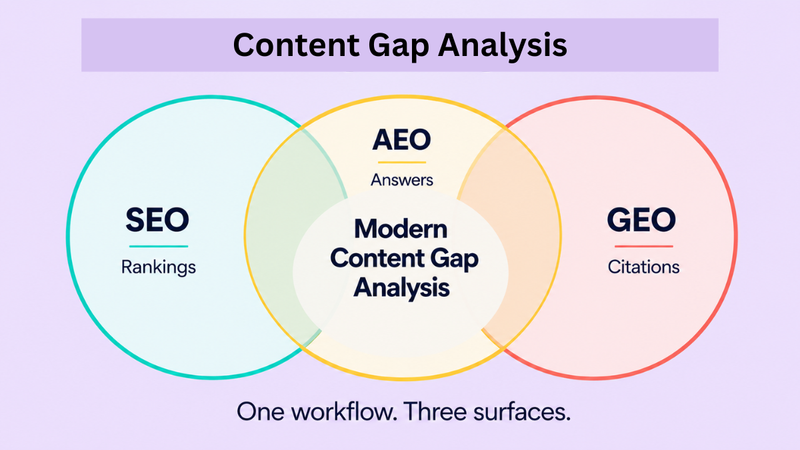
What is Content Gap Analysis?
Content gap analysis is the process of identifying topics, keywords, and answer formats your site is missing or underperforming on, by comparing your coverage against competitor rankings, AI-generated answers, and LLM citation patterns.
The classic definition was simpler: find topics competitors rank for that you don't. Fill the gap, get the traffic. That assumes the only battleground is the SERP and the only prize is a click. Both assumptions have cracked.
Now, user types a question into Google, and AI Overview summarizes the answer at the top. The user reads the summary and closes the tab.
You could rank #1 under that AI Overview and still lose the click. The same user opens ChatGPT and asks a follow-up. The AI cites three websites. You want to be one of them.
So, modern content gap analysis covers three kinds of missing visibility:
- Search gap - topics where you don't rank on Google or Bing.
- Answer gap - queries where AI Overviews, featured snippets, or PAA boxes cite competitors.
- Generative gap - prompts where ChatGPT, Claude, Perplexity, and Gemini cite competitors.
These three gaps map to three disciplines that now sit side by side:
| Discipline | What It Optimizes For | Primary Surface |
|---|---|---|
| SEO (Search Engine Optimization) | Rankings on traditional SERPs | Google, Bing organic results |
| AEO (Answer Engine Optimization) | Citations inside AI-generated answers | AI Overviews, featured snippets, PAA |
| GEO (Generative Engine Optimization) | Mentions inside LLM responses | ChatGPT, Claude, Perplexity, Gemini |
An Ahrefs study found 80% of sources cited by AI search platforms don't appear in Google at all. A proper gap analysis covers all three surfaces.
Why Content Gap Analysis is Non-negotiable
Skipping content gap analysis in 2026 means accepting traffic loss from at least four compounding directions: AI Overview click cannibalization, citation pool drift, faster content decay, and missed update ROI.
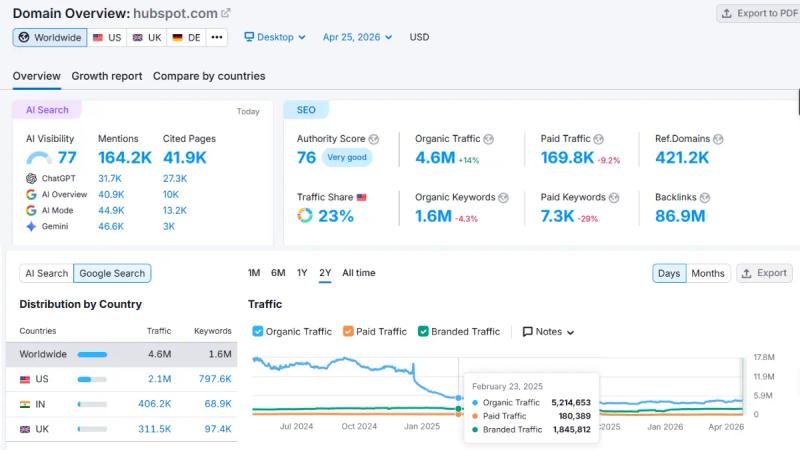
HubSpot lost roughly 70% of its blog traffic between late 2024 and early 2025. A domain with 76+ DA, 86.9+ million backlinks, and a content team most SEOs treat as a reference point. If that happened to them, assume it can happen to you.
Four reasons it matters more in 2026:
- Clicks are evaporating even when you rank. Pew Research tracked 900 U.S. adults across 68,879 Google searches in March 2025 and found users clicked a traditional result just 8% of the time when an AI summary appeared, versus 15% without.
- LLM citations run on a different shortlist. Just 28% of ChatGPT's most-cited pages have any organic visibility in Google.
- Content decays faster. AI assistants prefer content that's 25.7% fresher than what Google ranks, with ChatGPT citing URLs averaging 393 days newer than Google's top results.
- Updates beat new posts on ROI. HubSpot's data shows updating old posts can boost organic traffic by up to 106%, and 51% of companies report refreshing existing content as their most efficient content tactic.
Fall behind for two quarters and you're catching up for four.
How to Do a Content Gap Analysis
A content gap analysis works in five strategic steps: define your audience, study competitor positioning, audit your existing content, map the buyer journey, and prioritize gaps by ROI.
So, before opening any tool, the conceptual workflow stays the same regardless of whether you use Ahrefs, Semrush, or free alternatives. The five steps and what they accomplish:
1. Define Your Audience and Search Intent
Lock down who you're trying to reach and how they actually search. A B2B SaaS buyer searches differently from a consumer comparing shoes.
The same keyword can mean three different things depending on who's typing it. Without intent clarity, the rest of the audit produces noise.
2. Study Competitor Positioning
Then, pull the top 5–10 sites ranking for your priority keywords. Look beyond keyword overlap. Note their angle, depth, content format, and how they handle objections.
The goal is to find what they all do the same way, because that's the consensus formula your page needs to beat.
3. Audit Your Existing Content
Next, the bigger lift sits in pages that already rank between positions 5 and 20. Those pages have earned partial trust from Google. A targeted update closes a depth gap faster and cheaper than publishing from scratch.
4. Map the Buyer Journey
Sort every gap into awareness, consideration, or decision stage. A site with 50 awareness-stage articles and zero comparison or pricing objection content has a structural gap that no keyword tool will surface.
The journey map is what turns a flat keyword list into a prioritized roadmap.
5. Prioritize by ROI
Score each one on three factors: traffic potential, ranking difficulty, and revenue relevance.
A high-volume keyword with low business intent is worse than a low-volume keyword that pulls qualified buyers. So, sort the action list before you start writing.
| Strategic Benefit | What It Solves |
|---|---|
| Identify high-value opportunities | Surfaces keywords competitors monetize that you've ignored |
| Improve user experience | Closes unanswered questions across the journey |
| Strengthen topical authority | Fills coverage gaps that signal expertise to Google and LLMs |
| Replace guesswork with data | Turns content planning into a measurable, repeatable system |
The conceptual workflow gives you the what. And next, I show you how - the exact tool steps to execute every part of this audit using Google Search Console and GA4 alone.
5 Types of Content Gaps You Need to Find
Modern content gap analysis covers five gap types - topic, depth, format, angle, and citation - not just the keyword overlaps most legacy guides focus on.
Most gap analyses stop at "topics competitors cover that you don't." That's one type out of five. The other four explain why pages rank well and still lose visibility everywhere else.
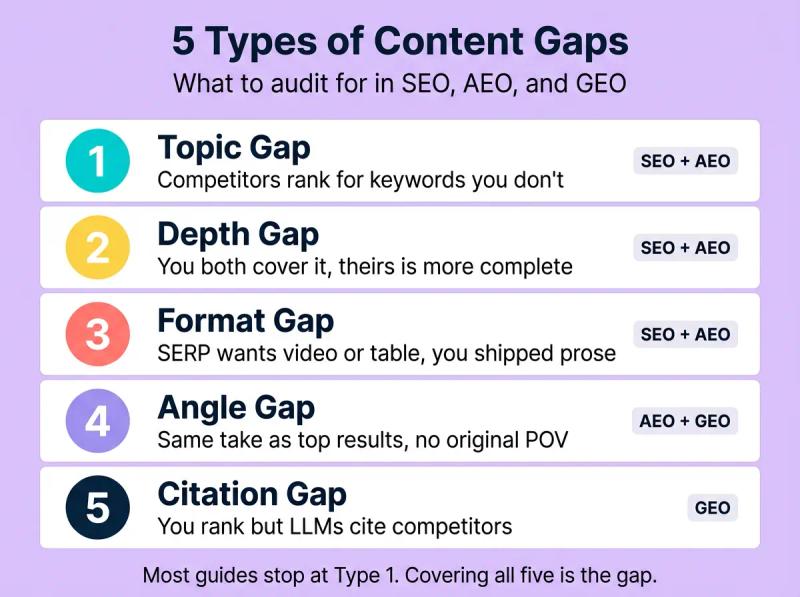
Topic gaps are the classic kind. Competitors rank for keywords your site doesn't cover at all. The runway is wide open, but only worth chasing if the keyword clustering is relevant and your domain authority can compete.
Depth gaps show up when you and a competitor cover the same topic, but theirs ranks higher because it's more complete. Take any keyword where you rank on page 2 or 3 and pull up the top five results.
If they cover angles, yours doesn't - more FAQs, examples, comparison tables - you have a depth gap. Highest-ROI fix because the page already exists.
Format gaps mean the SERP wants one thing and you shipped another. You wrote a 2,000-word article but the top three results are videos.
Run your target keyword through Google in an incognito window. Count the format types in the top results. The dominant format is what the SERP wants.
Angle gaps are the gap nobody audits for, and the most likely to keep you invisible in AI search. An angle gap means you cover the topic with the same take as everyone else.
You can rank for the keyword and still be useless to an LLM because there's no reason to cite you over nine interchangeable sources.
The Princeton, Georgia Tech, Allen Institute, and IIT Delhi research paper on Generative Engine Optimization, published at KDD 2024 across 10,000 test queries, found content with original statistics, cited sources, and quotations boosted visibility in generative engine responses by up to 40%.
Citation gaps are the endpoint of the AI search shift. Your content ranks. Competitors still get cited in AI Overviews and ChatGPT. You don't.
Detection is brutally simple: ask the question in ChatGPT, Claude, or Perplexity, and read which domains the model cites. If yours isn't there, you have a citation gap independent of your Google ranking.
| Gap Type | How to Detect | Primary Impact |
|---|---|---|
| Topic | Competitor ranks, you have no page | SEO + AEO |
| Depth | Both rank, theirs more complete | SEO + AEO |
| Format | SERP wants video/table, you have prose | SEO + AEO |
| Angle | Same take as top results, no original POV | AEO + GEO |
| Citation | You rank, LLMs cite competitors | GEO |
The gaps stack. A page can have a depth gap and a citation gap at the same time. A fresh topic may have no gap on day one and develop an angle gap six months later once five competitors publish on it.
How to Do a Manual Content Gap Analysis with Free Tools
The manual content gap analysis workflow uses Google Search Console, GA4, and direct SERP and AI engine checks to surface all five gap types in roughly three hours per audit.
Five steps. Run them in order once, then set a recurring schedule.
Step 1: Pull Your Underperformers from Google Search Console
GSC is the only tool showing what Google actually thinks about your site - impressions, position, CTR - pulled from Google's own index.
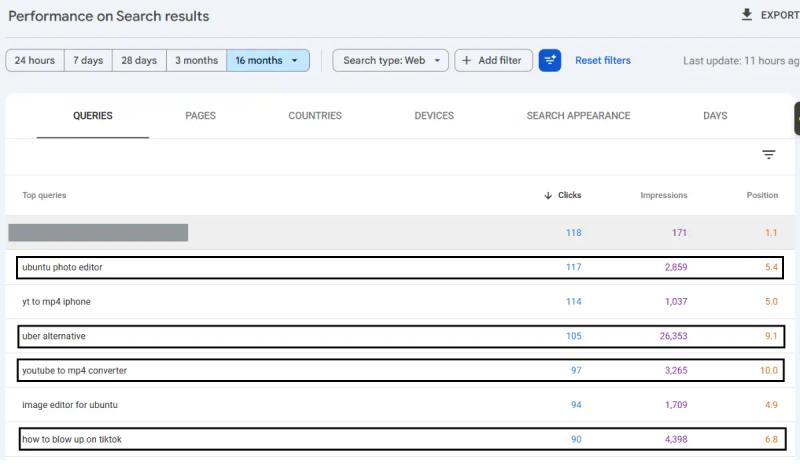
- Open GSC, go to Performance → Search results.
- Set the date range to 16 months, GSC's hard retention limit.
- Click the Queries tab.
- Add filters: Position between 5 and 20, Impressions greater than 50.
- Sort by impressions, descending.
You're looking at the shortlist of queries where Google trusts your page enough to show it but not enough to put it in the top three. These are depth gaps waiting to be closed. Export as CSV.
Switch to the Pages tab. Same filters. Cross-reference: when a specific URL appears alongside specific queries, you have a clean page-level depth gap candidate.
Step 2: Cross-Reference Declining Pages in GA4
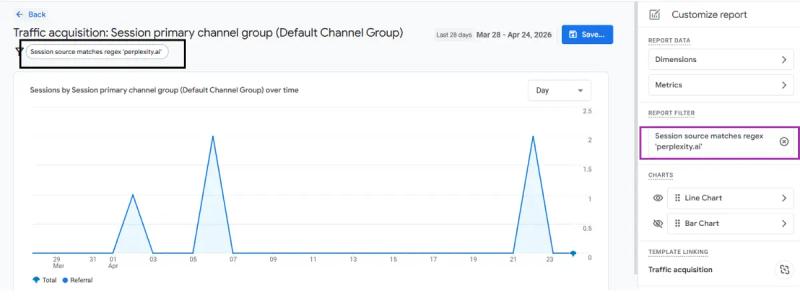
GSC tells you where you rank. GA4 tells you what happens after the click.
Go to Reports → Acquisition → Traffic acquisition. Run two queries:
Organic decline: Filter session medium matches organic, compare last 90 days vs. previous 90, sort by negative change.
AI platform decline: Filter session source matches regex -openai.com|chat.openai.com|perplexity.ai|claude.ai|gemini.google.com|copilot.microsoft.com. Same comparison.
Pages dropping in both reports are high priority. Pages dropping only in the AI query usually signal a citation gap - the SERP ranking is stable, but LLMs have stopped citing you.
Step 3: Do a Real SERP Teardown
Pick five to ten candidate keywords from your GSC export. Run each through a clean incognito window. For each SERP, check:
- AI Overview present? Note which domains get cited inside it.
- Top three result formats - video, article, table, calculator, Reddit thread.
- People Also Ask - screenshot all four visible questions, then expand to load more.
- Featured snippet type - paragraph, list, or table.
- SERP features - image pack, video carousel, Things to Know, Forums.
Keep a tracking sheet, one row per keyword. After 10 keywords, patterns emerge.
Step 4: Query the AI Engines Directly
Your SERP teardown covers AEO. Step 4 covers GEO. Take your same 5–10 keywords. Rephrase each as a natural conversational prompt - not "content gap analysis tool" but "what's the best way to do a content gap analysis for my SaaS blog."
Run each through ChatGPT (with browsing), Claude, Perplexity, and Google AI Mode. Note the cited domains for every response.
After 10 prompts across four engines, you'll have 40 data points. If a competitor appears in 30 of 40 responses and you appear in 2, your citation gap is structural.
Step 5: Map Findings to the Five Gap Types
You now have four data sources: GSC queries, GSC pages, GA4 decliners, SERP and AI teardown sheet. Sort by gap type and assign priority based on current impressions and competitive intensity.
Low-impression keywords on low-competition SERPs are your quick wins. High-impression, heavy competition keywords go on a longer timeline but carry the biggest payoff.
The whole workflow takes about three hours for 10 keywords the first time. Subsequent audits drop to 60–90 minutes once your tracking sheet is reusable.
Competitive Content Gap Analysis:
Competitive content gap analysis means comparing three competitors who outrank you on at least five target keywords, then finding the topics all three cover that you don't.
Self-audits tell you where you're weak. Competitive audits tell you where the opportunity actually is.
Pick the Right Three Competitors
Use the free Semrush Competitor Finder tool to pull your top 10 organic competitors by shared keywords.
Filter on relevance (genuine product or audience overlap) and ranking strength (the competitor outranks you on a meaningful slice). Three is the sweet spot - one gives anecdote, two opinion, three consensus.
Pull Each Competitor's Top Pages
Visit competitor.com/sitemap.xml for the full URL list. For speed, use the site: operator - site:competitor.com content gap returns every indexed page matching the term. Copy the top 20 URLs from each competitor into your tracking sheet.
Find the Overlap
| Competitor Coverage | Your Status | Action |
|---|---|---|
| All 3 rank top 10 | You have no page | High-priority topic gap |
| All 3 rank top 10 | You rank page 2-3 | High-priority depth gap |
| Only 1 of 3 ranks | You have no page | Low priority (unvalidated intent) |
| All 3 rank but SERP format is video/tool | You have text | Format gap |
3 competitor consensus eliminates keywords where one competitor got lucky with a specific backlink. When three independent sites rank for the same term, Google has validated the intent.
Read more about search intent gaps.
Backlink Layer
The reason competitors outrank you on hard keywords is usually their backlink profile also. So, use the free Ahrefs Backlink Checker to pull the top 100 referring domains for each. Publishers appearing across two or more competitors are outlets already accepting content from your space.
Ahrefs found a 0.664 correlation between brand mention volume on authoritative sites and AI Overview citation frequency. Your backlink gap doubles as a citation signal audit.
Advanced Content Gap Analysis
Advanced content gap analysis means using prompt-based audits to find where AI engines cite competitors instead of you, then closing those citation gaps through entity signals, original data, and freshness work.
Topic, depth, and format work moves you up the SERP. Angle and citation work gets you into AI-generated answers. So, the starting point is a smart prompt sequence instead of a tool.
Step 1: Prompt the AI Engines Like Your Customers Do
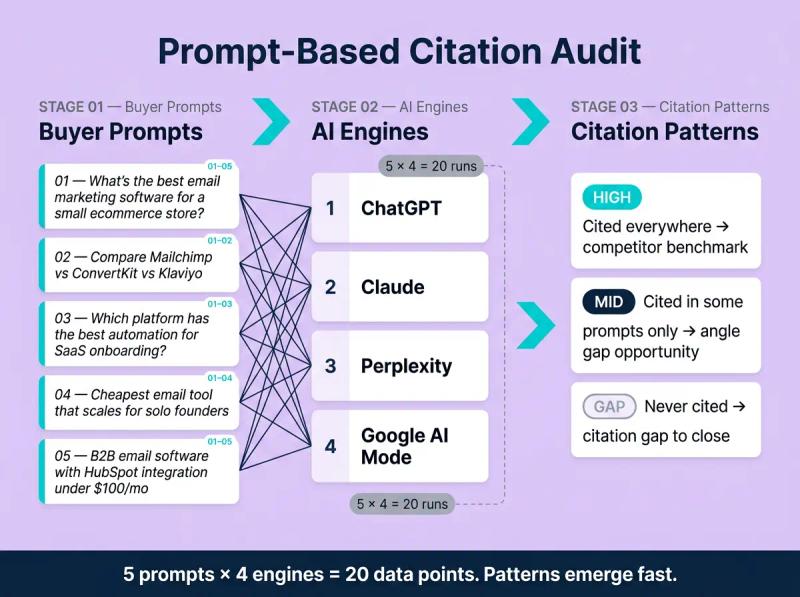
Open ChatGPT, Claude, Perplexity, and Google AI Mode in four tabs. Pick your core topic. Then type the same kinds of prompts a real buyer would, not keywords, full questions.
Let's take "email marketing software" as an example. A buyer never types those three words into ChatGPT.
- What's the best email marketing software for a small ecommerce store?
- Compare Mailchimp vs ConvertKit vs Klaviyo for someone sending 50,000 emails a month.
- Which email marketing platform has the best automation for SaaS onboarding?
- I'm a solo founder, what's the cheapest email tool that won't break when I scale?
- Email marketing software for B2B with HubSpot integration, under $100 a month.
Run all five prompts in all four engines. That's 20 separate answers. For each one, write down which domains the AI cited. After 20 runs, patterns emerge fast.
Step 2: Read the Patterns Like a Detective
Three things to look for in your prompt logs:
Who shows up everywhere. If Klaviyo's blog gets cited in 14 of 20 prompts and your tool gets cited in 1, that's not luck. Klaviyo built citation density.
Pull up those 14 cited URLs and read them side by side. Notice the structure: short direct answers near the top, original benchmarks, named author bios, schema-rich pages.
Who shows up only in specific prompt types. A competitor might dominate "best for ecommerce" prompts but disappear on "best for SaaS." That's an angle gap on their side and an opportunity on yours. Build the comparison page they don't have.
Who never shows up. If your domain doesn't appear in any of the 20 responses, that's not a depth problem. That's a citation gap. The fix isn't more keywords — it's the four moves below.
Step 3: Audit Your Entity Signals
An LLM doesn't cite a URL. It cites a source it can identify, disambiguate, and trust. Three checks:
- About page clarity - name founders, founding year, products, and the specific problem you solve in one readable block.
- Author bylines - every credible piece needs a visible author with a linked bio including credentials and external profiles. Microsoft's Fabrice Canel confirmed at SMX Munich in March 2025 that schema markup helps Microsoft's LLMs understand content. Organization plus Person schema are the two types most directly tied to entity disambiguation.
- sameAs properties in schema: Organization schema should include
sameAslinks to LinkedIn, Crunchbase, Wikipedia (if one exists), and major social profiles.
Step 4: Restructure for Extractability
LLMs scan for cleanly-formatted answer chunks they can lift into a response. Essays fail even when the information is correct. The fix:
- 40-to-60-word direct answers under every H2, before any elaboration.
- One verifiable data point with a source link every 150–200 words.
- Question-format H2/H3 headings matching how users phrase queries in LLMs.
- Self-contained paragraphs that make sense quoted in isolation.
Step 5: Publish Proprietary Data and Real Freshness Signals
Every AI model trained on roughly the same public web. If your page is the only source for a specific statistic, you get cited because nobody else can be.
The bar is lower than most teams assume: a 100-responder customer survey, analysis of your own support tickets or churn data, or a before-and-after case study all qualify.
For freshness, the visible "Last Updated" date alone is noise. What registers: content changes of 20%+ at paragraph level, dateModified in Article schema matching the visible body timestamp, and re-submitting the URL via GSC URL Inspection after each major update.
An llms.txt file at your site root is an emerging standard worth implementing.
Run the prompt audit once a quarter. The citation pool rotates fast, a domain dominating in April rarely dominates in October without active maintenance.
The teams winning AI visibility are the ones running prompt audits often enough to catch shifts before competitors do.
Content Gap Analysis Tools Compared
The right content gap analysis tool depends on your bottleneck: backlink-heavy audits favor Ahrefs, content-heavy audits favor Semrush, page-level depth work favors Surfer, and small-scale audits stay free with Google Search Console.
Six tools cover the full spectrum. Pricing verified as of April 2026:
| Tool | Best For | Monthly Cost |
|---|---|---|
| Google Search Console | Real ranking and impression data | Free |
| GA4 | Traffic source and AI referrer analysis | Free |
| Ahrefs | Backlink-heavy audits, competitive research | $29 (Starter) to $449 (Advanced) |
| Semrush | Content-driven sites, Keyword Gap tool | $139.95 (Pro) to $499.95 (Business) |
| SE Ranking | Budget teams, rank tracking | $103.20+ annual |
| Surfer SEO | On-page depth-gap closing | $89 (Essential) to $219+ (Scale) |
Want GEO tracking without paying?
Several free and open-source options cover the basics, from brand mention tracking across ChatGPT and Perplexity to citation monitoring across AI Overviews. We've broken down the full list in our guide to open source SEO tools.
If one round of gap analysis takes you under four hours manually, stay manual. Above that, a paid subscription pays for itself inside the first month.
Conclusion
Every SEO tool can find a topic gap. Almost no one can tell you why ChatGPT cites your competitor and ignores you for the same query. That's the gap worth closing first.
Semrush projects search visitors from AI to overtake traditional search visitors by 2028. The systems you build this year decide whether your content shows up when that shift completes.
So, open Google Search Console. Set the date range to 16 months. Filter the Queries tab to position 5 through 20 with more than 50 impressions. What you'll see in five minutes is the shortlist of pages already in the fight.
Start there.
Frequently Asked Questions
Everything you need to know about this topic.
Length correlates with citations up to a point. Content between 1,500 and 4,000 words with strong structure and cited sources tends to outperform shorter pieces. Beyond 4,000 words, depth stops helping unless the content genuinely covers more ground - padding drops AI citation rates.
A monthly 30-minute GSC check for ranking drops, a full 3-4 hour audit quarterly, and a complete entity and schema review once a year. Skipping the monthly check means you catch decay at position 10 instead of position 5, where fixes are four times faster.
Not yet. ChatGPT can summarize SERPs and suggest topic angles, but it can't access your GSC impressions, GA4 traffic patterns, or your page-level competitive position. The most productive workflow uses AI to accelerate specific steps while humans run the analysis.
Keyword gap analysis is a subset. It finds terms competitors rank for and you don't. Content gap analysis covers that plus depth, format, angle, and citation gaps, the reasons a page underperforms even when the keyword is targeted.
Run your target keyword as a conversational prompt in each engine. If your domain appears in the cited sources, you're in. Free tools like Peec AI monitor at scale. Paid options like Semrush's AI Visibility Toolkit track mentions across ChatGPT, Perplexity, Gemini, and AI Overviews in one dashboard.
Depth gaps on pages already ranking 5 to 15 in Google. Those pages have earned trust, sit in the index, and need a rewrite rather than a net-new page. Updates routinely produce the largest short-term traffic lifts because the page already has internal links and a foothold to build on.
Written By
Want help getting your brand ranked on Google and cited by AI?
We help businesses build AI visibility through SEO, content, and authority with clear revenue impact.
Book a Strategy Call