
You pulled 1,000 keywords from a research tool. Looks solid until you actually try to use them.
Pick one per page and most of them won't rank, group them the wrong way and your pages start competing with each other, and that's where things break.
So in this guide, I'll show you how we cluster keywords for our clients, and how you can do the same so a single page ranks on Google, shows up in AI Overviews, and gets cited by ChatGPT.
Keyword clustering is the process of grouping search queries that share the same intent so you can target them with a single page.
Take three queries: "king mattress," "king size mattress," and "king size bed mattress." Different wording, same thing. Google shows nearly identical results for all three. One page should rank for all of them instead of three separate pages fighting each other.
That's the core idea. You cluster the queries, you build one page, and that page pulls rankings for everything in the cluster.
Note: Clustering groups the pages Google or an LLM would cite, using the keywords as evidence. Same top-10 results equals same intent equals same page.
Why it matters in 2026 & beyond
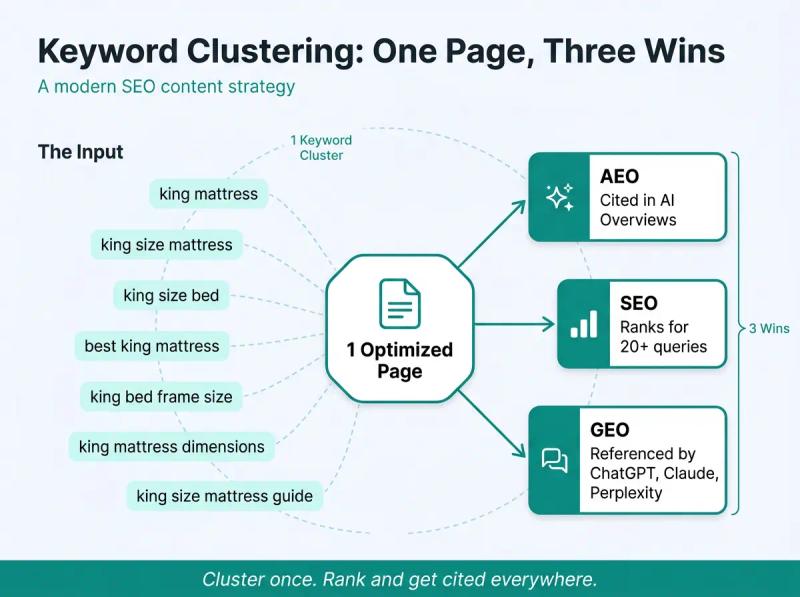
Keyword clustering used to be a Google SEO technique. In 2026, one clustered page earns visibility across three different surfaces:
- SEO - the page ranks for 20+ related queries instead of one
- AEO - the cluster becomes the answer block AI Overviews extract
- GEO - the same cluster satisfies the fan-out queries LLMs use to pick citations
One technique, three wins. That's why SEO keyword clustering is doing more work than it was five years ago and why getting it right matters more.
Keyword cluster vs topic cluster
A keyword cluster is what goes on one page. You take a handful of search queries that mean the same thing, group them together, and write one page that ranks for all of them.
A topic cluster is what happens across multiple pages. You link a bunch of related pages to one main pillar page. That signals to Google your site covers the topic in depth.
So build your keyword clusters first. Once every page targets a clean cluster, the topic cluster forms on its own through internal links.
| Keyword cluster | Topic cluster | |
|---|---|---|
| Unit | Queries grouped for one page | Pages grouped around one theme |
| Goal | Rank one page for many queries | Build topical authority sitewide |
| Example | "king mattress," "king size mattress" → one page | 40 mattress pages linking to a pillar |
Why Clustering Wins on Google, AI Overviews, and LLMs
Clustering used to be a Google-only play. In 2026, one clustered page earns visibility across three different surfaces, traditional search results, AI Overviews, and LLM answers in ChatGPT, Claude, and Perplexity.
SEO: Google ranks pages that match intent instead of keywords
Google stopped rewarding single-keyword optimization years ago. Hummingbird (2013), RankBrain (2015), and BERT (2019) moved the algorithm toward intent-level matching.
By the time you read a SERP in 2026, Google has already clustered the queries it thinks belong together and decided which pages best satisfy that intent group.
A page built around one keyword while Google clusters 15 synonyms under it will lose. The cluster-aligned page wins because it matches Google's own grouping.
This is where SEO keyword clustering earns its keep. You rank for the primary query, the synonyms, the long-tails, and the question variants, all from one URL.
AEO: AI Overviews extract from pages that answer the query and its neighbors
AI Overviews now appear in 47% of Google searches, up from 18% in March 2025. And each Overview pulls an average of 10.2 links from 4 unique domains.
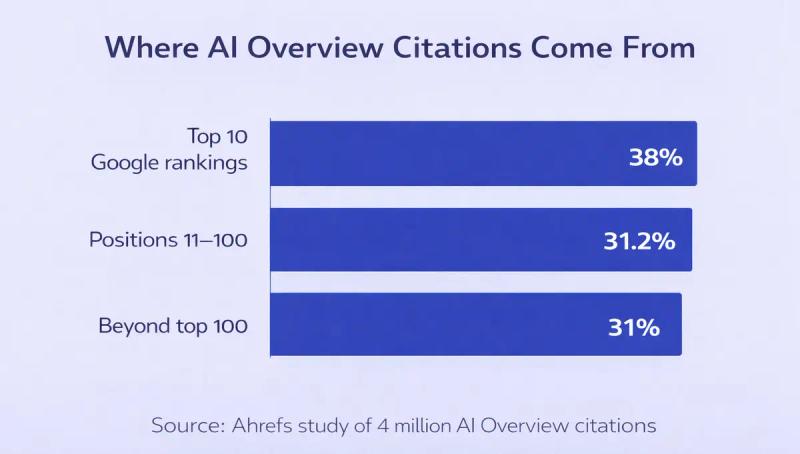
That matters because Ahrefs analyzed 4 million AI Overview URLs in March 2026 and found only 38% of cited pages rank in the top 10 for the exact query.
The rest come from deeper pages - 31% from positions 11–100, and another 31% from pages that don't rank in the top 100 at all.
Why does that happen?
Google has confirmed it uses query fan-out, the system splits each search into multiple sub-queries, runs them all, and pulls citations from whichever pages show up across those sub-SERPs.
A page optimized for a single keyword gets ignored by fan-out. A page optimized for a cluster, the primary query plus its intent-neighbors, shows up in multiple sub-SERPs and gets cited.
GEO: LLMs cite pages that satisfy fan-out queries
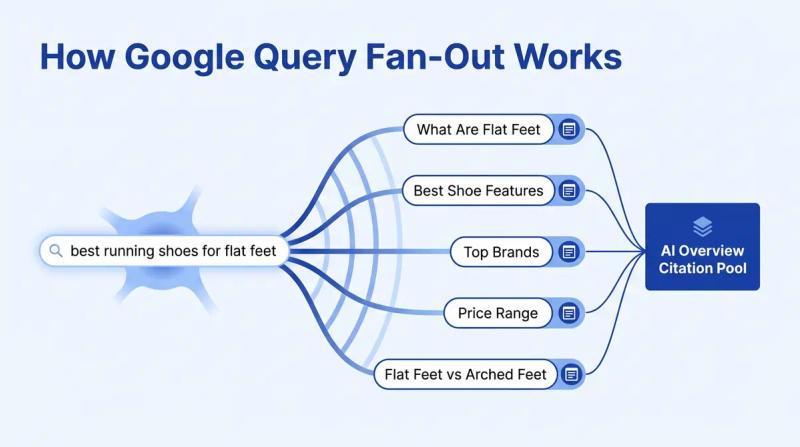
Same mechanic, different surface. When someone prompts ChatGPT or Claude with "best running shoes for flat feet," the model fans the query out into sub-questions: what are flat feet, what shoe features help, which brands lead, what price range is reasonable. Then it searches, reads, and cites pages that satisfy those sub-questions cleanly.
Fan-out queries are keyword clusters. Different name, same concept. A page built around a well-formed cluster is already answering 60–80% of the fan-outs an LLM will generate for the primary query.
That's why it gets cited.
One move. Three surfaces. That's the case for treating clustering as the foundation of your 2026 content strategy instead of a spreadsheet exercise you do once a quarter.
Semantic vs SERP-Based Clustering
There are two ways to group keywords, and picking the wrong one is the fastest way to ship a content plan that doesn't rank.
What is semantic keyword clustering?
Semantic keyword clustering groups queries by meaning. Shared root words, synonyms, and vector embeddings from NLP models decide which terms belong together. "Running shoes," "runners," and "jogging sneakers" all cluster because the words are close in meaning.
It's fast and cheap. Plenty of Python libraries handle it for free.
And it's blind to what Google actually ranks.
What is SERP-based clustering?
SERP-based clustering groups queries by top-10 URL overlap. You run each keyword through Google, pull the top 10 results, and cluster queries whose SERPs share enough URLs to suggest Google sees them as the same intent.
Costs money - someone has to pay for the SERP scrapes. But the output matches how Google actually interprets intent in the real world.
When to use each
| Situation | Semantic | SERP-based |
|---|---|---|
| Under 200 keywords, single niche | ✓ | |
| Budget is zero | ✓ | |
| Ecommerce or commercial queries | ✓ | |
| Cannibalization audit | ✓ | |
| Low-data languages | ✓ | |
| Mixed commercial + informational | ✓ |
Hybrid clustering: what most experienced SEOs actually do
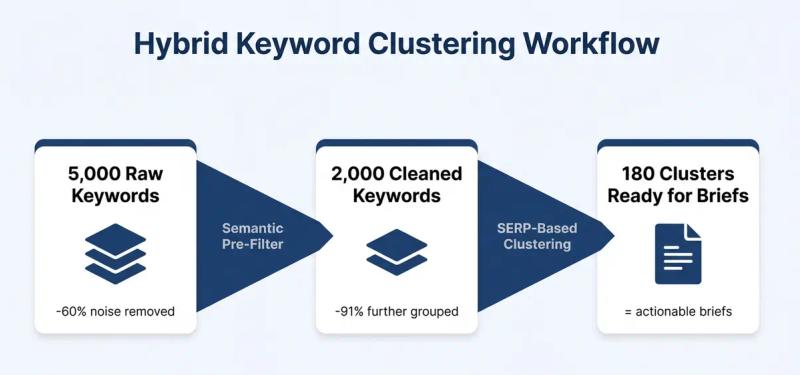
Pure semantic misses intent splits. Pure SERP-based is expensive on large lists and produces fragmented clusters when SERPs shift by a URL or two.
The fix most experienced SEOs use is to run semantic first to clean the list, strip obvious synonyms, remove noise, and compress 5,000 keywords down to 2,000. Then run SERP-based on the survivors for final page assignments.
Most paid clustering tools already work this way under the hood. Keyword Insights, Semrush Keyword Strategy Builder, and SE Ranking all blend the two.
A free keyword clustering tool that only uses semantic matching will get you 60% of the way there. Useful for a first pass, not enough to ship a content plan on. So here's the actual workflow that gets you the rest of the way.
How to Cluster Keywords in 6 Steps
Every clustering workflow ends up looking like a variation of this. Tools handle the mechanics, but the decisions that make or break the output are yours.
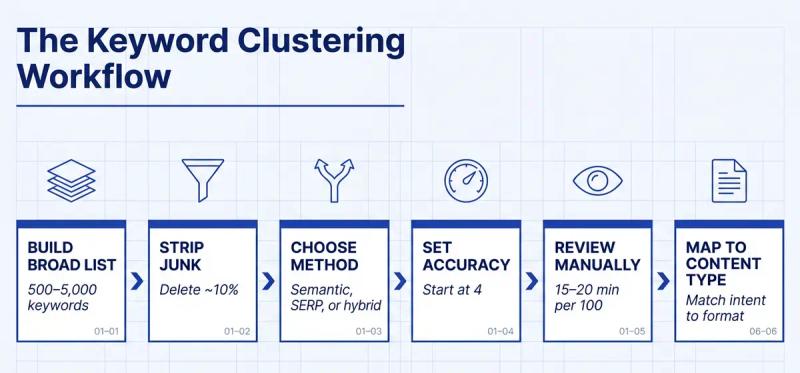
Step 1: Build the list broad
Pull everything from 1 to 2 seed keywords. Ahrefs, Semrush, SE Ranking, or any tool you already pay for. Don't filter by volume or difficulty yet, since filtering now creates gaps clustering would have caught naturally.
Target 500 to 5,000 keywords for a mid-sized project. Under 500 and you won't surface enough variants to form useful clusters. Over 5,000 and most tools start choking on API rate limits.
The columns you actually need are keyword, search volume, intent, and a blank "cluster" column. Skip the rest.
Step 2: Strip the obvious junk
Before any tool touches your list, delete three categories manually.
Branded competitor queries you can't realistically target. If you're running SEO for a mid-sized shoe brand, "Nike air max price" doesn't belong in your cluster pipeline.
Irrelevant homonyms. "Apple" the fruit and "Apple" the tech company. "Mercury" the planet and "Mercury" the element. Clustering tools will group them if the SERPs happen to overlap on a few UGC pages.
Zero-volume non-questions. Zero-volume questions are worth keeping, since they're often voice or AI search queries that haven't yet been indexed. Zero-volume noise isn't.
Trim about 10%. Any more and you're filtering when you should be clustering.
Step 3: Choose the clustering method
Reference the table from the previous section. For most readers, the default is SERP-based clustering with a semantic pre-filter, a hybrid approach that handles both speed and accuracy.
If your entire list is under 200 keywords and you're working in a niche with no budget, pure semantic works fine for a first draft. Everything else: SERP-based.
Step 4: Set clustering accuracy correctly
Most keyword clustering tools use a 1–10 threshold to decide when two keywords belong together. The number represents the minimum matching URLs required across the top 10 results of both queries.
Keyword Insights uses a default of 3 , three overlapping URLs triggers a cluster merge. That's a reasonable starting point for most work. And here's how to think about the full range:
- Accuracy 2 to 3: broad clusters, fewer ungrouped keywords. Good for niche discovery and early-stage research where you want to see how topics bleed into each other.
- Accuracy 4 to 5: balanced. The sweet spot for most content planning projects. Clusters are tight enough to be actionable, loose enough to surface intent patterns.
- Accuracy 6 to 7: tight clusters, many ungrouped keywords. Use when you're mapping exact page targets on a mature site and can't afford intent bleed.
- Accuracy 8+ : rarely useful. Only valuable for commercial audits where you need near-identical SERPs to justify merging.
So, start at 4 and adjust from there.
Step 5: Manually review every cluster
This is the step most guides soft-pedal. Tool output is a draft, not a final plan.
For each cluster, ask three questions:
- Do these queries share primary intent, or just surface similarity?
- Would one page satisfy all of them without stretching?
- What's the dominant keyword that should name this cluster?
Rename clusters as you review. "best running shoes for flat feet (commercial listicle)" beats "Cluster_47" every time, and when a writer picks up the brief three weeks later, they'll know immediately what format to write.
Budget 15–20 minutes per 100 keywords for manual review. Feels slow. Pays off when every page ranks.
Step 6: Map each cluster to a content type
Assign each cluster to a format based on its dominant intent. This is where your keyword clustering work becomes a content calendar.
| Cluster intent | Content type | Target length |
|---|---|---|
| Informational, high-volume primary | Pillar guide | 3,000+ words |
| Informational, supporting | How-to or tutorial | 1,200–1,800 words |
| Commercial | Listicle or comparison | 2,000–2,500 words |
| Transactional | Product or category page | Short, grid-heavy |
| Question-heavy | FAQ hub | 800–1,500 words |
Every format in that table, especially FAQ hubs and comparison listicles, is structurally clean for AI Overview extraction and LLM citation. The same clustering that feeds your SEO plan is already shaping your GEO and AEO footprint.
The six steps sound linear on paper. In practice, Steps 5 and 6 loop. You review a cluster, map it to a format, realize two clusters should merge or one should split, and circle back. That's normal. The tool's job is to get you 70% there. The last 30% is judgment.
When to Split or Merge a Keyword Cluster
Your clustering tool just spat out 80 clusters. Some are obviously right. Some feel off, two clusters that should clearly be one page, or one cluster that's trying to cover three different intents.
This is the decision that separates a good content plan from a great one. So the framework is:
3-question split test
Run these questions against any cluster that looks too broad. One "yes" means split the cluster into two pages.
1. Do the top 10 SERPs show fundamentally different page formats?
If half the SERP returns long-form guides and the other half returns product grids, you're looking at two different intents wearing the same keyword root.
2. Would one page push past 3,500 words without natural flow?
Length isn't the problem. Forced length is. When covering both intents requires padding, jumping between tones, or creating a Frankenstein page that serves nobody, split it.
3. Are the conversion paths different?
One query drives to a lead form. The other drives to a product page. Even if the keywords look similar, the business logic behind them is different. Split them so each page can convert cleanly.
The 3-question merge test
Run these against any cluster that feels too narrow, like your tool over-fragmented the output. One "yes" means merge two clusters into one page.
1. Do the clusters share 40%+ SERP overlap despite being split?
This usually happens when your accuracy threshold is too high. Run the two keyword sets through a quick SERP check. If nearly half the URLs overlap, Google sees them as the same intent and so should you.
2. Are both pages ranking sub-page 20 for terms they should own?
Two weak pages targeting closely related clusters usually means one strong page would rank better than either. Merge, 301 the weaker URL, and let link equity concentrate on one target.
3. Is combined word count under 1,500 with genuinely inseparable topics?
If a merged page still reads tight and the two sub-topics flow into each other naturally, there's no reason to keep them apart. Two thin pages almost always lose to one complete page.
When a cluster should become a pillar instead
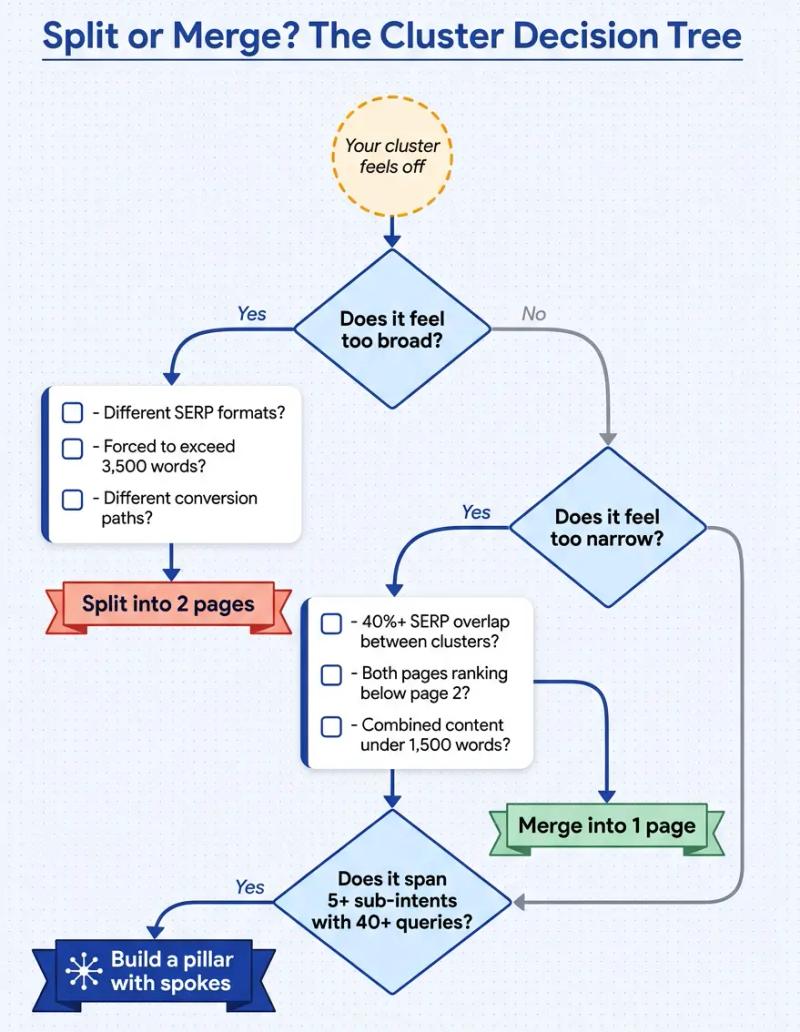
Sometimes the merge/split question has a third answer: it's a hub.
The tell: you keep merging and end up with 40+ queries spanning 5 or more sub-intents. Covering all of them on one page would need more than six natural H2 sections. At that point, you're not writing a page. You're writing a pillar with spokes.
When this happens, restructure:
- Pillar page covers the primary query and links out to each sub-intent spoke
- Spoke pages, each targets one sub-intent cluster, links back to the pillar, and links laterally to 1–2 related spokes
This is how keyword clusters feed topic clusters. The hub-and-spoke structure signals topical depth to Google, keeps internal link equity flowing through your most important pages, and gives AI Overviews multiple URLs on your domain to cite from within the same topic.
The rule: if a single cluster feels like it wants to be a table of contents, that's your cue to build a pillar instead of a page.
How to Cluster Keywords for AI Overviews and LLM Citations
AI Overviews and LLMs don't read your page the way a user does. They break the query apart first, search for each piece separately, then assemble an answer from the pages that happen to satisfy the most pieces.
That process has a name. Google calls it query fan-out and if your cluster isn't built around it, you won't get cited.
How fan-out queries work
When someone asks ChatGPT "how should I structure a B2B SaaS pricing page," the model doesn't search for that exact string. It generates sub-queries: what elements a pricing page needs, how competitors structure theirs, what converts best, what pricing models exist, what common mistakes look like.
Then it searches each one, reads the top results, and pulls facts from whichever pages show up across the most sub-searches.
Google does the same thing for AI Overviews. Different model, same mechanic.
Each fan-out is a keyword in disguise. Six fan-outs means six hidden keywords your page needs to answer clearly. Miss two or three, and you drop out of the citation pool, even if you rank #1 for the primary query.
10-minute fan-out audit
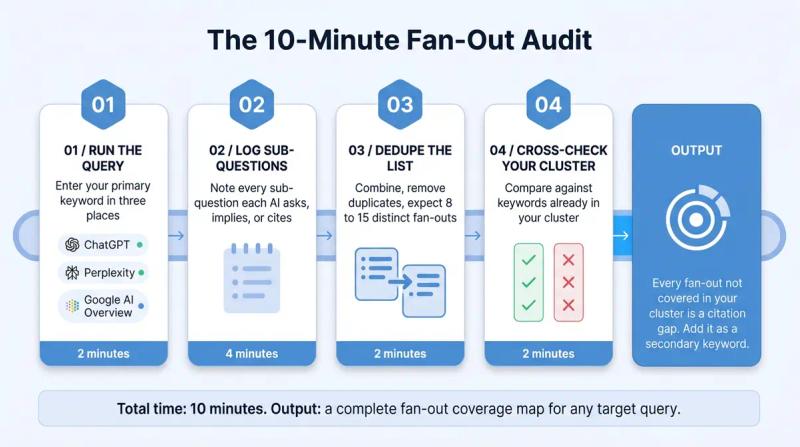
You can reverse-engineer the fan-outs for any target query in under ten minutes. Here's the process:
- Open ChatGPT, Perplexity, and Google (with AI Overviews on). Run your primary keyword through each.
- For each response, note every sub-question the AI asks, implies, or cites a source for.
- Combine the three lists. Remove duplicates. You'll end up with 8–15 distinct fan-outs.
- Cross-check them against the keywords already in your cluster.
Every fan-out not covered in your cluster is a citation gap. Add it as a secondary keyword and build a section around it.
Three moves that get your cluster cited
Fan-out coverage gets you into the citation pool. These three moves get you selected from it.
Front-load the definitional answer. The first 50 words of your page should answer the primary query cleanly, no setup, no context. That block is what AI Overviews extract. If your intro is a three-paragraph hook before you get to the point, the system grabs someone else's first-paragraph answer instead.
Use fan-out queries as H3 subheadings. Don't paraphrase them into cleverer headlines. If "what is topical authority" is a fan-out, that exact phrasing becomes an H3. AI systems match on semantic similarity, and verbatim fan-out phrasing scores highest on that match.
Add an FAQ block with 4–6 question-format H3s. Answers should run 250 to 350 characters. Clean, self-contained, no pronouns referencing earlier content. That format extracts cleanly into answer boxes across every major AI surface.
What gets cited vs what ranks on Google
Cited pages aren't always the most comprehensive. They're the most structurally clean.
A 5,000-word guide with buried answers, pronouns referencing earlier sections, and no clear definitional block will lose AI citations to a 1,500-word page that answers every fan-out in a labeled H3 with a clean paragraph underneath.
This is where SEO keyword clustering quietly becomes GEO strategy. A well-built cluster already has the structural bones AI systems need: clean headings, tight answers, natural coverage of adjacent questions. Clustering does most of the work. Structuring finishes it.
Bringing It All Together
Clustering used to be a spreadsheet exercise but in 2026, it's the difference between a page that ranks and a page that gets cited.
The mechanic is the same on every surface. Google AI Overviews, ChatGPT and Claude fan out queries. A page built around a well-formed cluster answers more of those sub-queries than a single-keyword page ever could, and that's why it wins visibility on three surfaces at once.
So, start with one cluster this week. Pick a page that ranks somewhere between positions 8 and 20, run a 10-minute fan-out audit on it, and add the missing sub-queries as H3 sections.
You can run the whole audit using free open source SEO tools if you don't have a paid clustering subscription yet. Watch what happens to its AI Overview citations over the next 30 days.
That's the smallest possible test of everything in this guide. And the fastest way to see clustering work on your own site.
Want help auditing your existing pages and building clusters that earn citations across Google, AI Overviews, and LLMs? Book a free strategy call and we'll show you exactly where your current clusters are leaking visibility.
Frequently Asked Questions
Everything you need to know about this topic.
Grouping sorts keywords into folders by topic or theme. Clustering goes further, validating that the grouped keywords share the same intent and would be best served by a single page based on SERP overlap or semantic similarity.
Most well-formed clusters hold 5 to 25 keywords. Under 5 and the cluster is probably too narrow. Over 25 and you're likely looking at a pillar that needs to be split into spokes. The right number depends on intent, not volume.
ChatGPT handles semantic clustering on small lists (under 200 keywords) reasonably well. It struggles with SERP-based clustering since it can't pull live top-10 results across queries. Use it for first-pass grouping, then validate with a real clustering tool.
Free options include Keyword Insights' free tier (limited monthly clusters), the open-source Python library keybert, and Google Sheets with manual SERP overlap checks. None match paid tools for accuracy on lists over 500 keywords.
Re-cluster every 6 to 12 months for established sites, and after any major Google update that shifts SERP composition. New keyword research projects should always start with fresh clustering, since cached cluster files go stale fast.
Clustering matters more in 2026 than it did before AI search. Fan-out queries from ChatGPT, Perplexity, and Google AI Overviews are functionally identical to keyword clusters, so a clustered page satisfies AI extraction in ways a single-keyword page can't.
You end up with thin pages competing against each other for the same intent (cannibalization), missed long-tail rankings, and pages that AI systems skip during fan-out citation. Most "ranking but not converting" pages have an underlying clustering problem.
Written By
Want help getting your brand ranked on Google and cited by AI?
We help businesses build AI visibility through SEO, content, and authority with clear revenue impact.
Book a Strategy Call