
Profound is an enterprise AEO platform built around AI visibility intelligence, prompt-demand research, and content creation.
Scrunch is a monitoring and technical optimization platform built around operational coverage, persona segmentation, and bot-optimized content delivery.
They serve different teams with different execution models, and choosing the wrong one wastes both budget and time.
AI platforms generated 1.13 billion referral visits in June 2025, a 357% year-over-year increase. That growth has made AEO tooling a real budget decision in 2026.
In this guide, I compare Profound vs Scrunch across pricing, features, analytics, and workflow fit, with a clear verdict by use case so you can make an informed decision based on your needs.
Profound vs Scrunch at a Glance
If you are evaluating both platforms and need a fast answer before reading the full breakdown, here it is.
Profound fits teams that need to research AI demand, create content, and report strategic intelligence.
Scrunch fits teams that need operational monitoring, persona-level segmentation, and technical delivery optimization for existing content.
| Category | Profound | Scrunch |
|---|---|---|
| Best for | Enterprise AEO programs, content strategy, ecommerce | Operational monitoring, technical optimization, growth teams |
| Entry plan | $99/mo (ChatGPT only, 50 prompts) | $250/mo (4 LLMs, 125 prompts, 5 audits) |
| Multi-engine access | 3 engines at Growth; up to 10 at Enterprise | 4 engines at Core; 9 engines at Enterprise |
| Prompt research | Prompt Volumes (real panel data, weekly refresh) | AI Search Trends (1,500+ curated topics) |
| Technical optimization | Agent Analytics (server-log crawl visibility) | AXP (edge-layer bot-optimized content delivery) |
| Content creation | Agents (6 articles/month at Growth) | Insights only — no writing tools |
| Ecommerce | ChatGPT Shopping (SKU-level tracking) | Not offered |
| Free trial | Growth plan trial available | 7-day Core trial |
| SOC 2 Type II | Yes | Yes |
Key caveat: Neither entry tier is sufficient for a real AEO program. Both platforms gate meaningful multi-engine coverage behind mid-tier or enterprise pricing. Compare Growth-tier plans, not entry plans, when evaluating budget.
5 Questions to Ask before You Choose either Platform
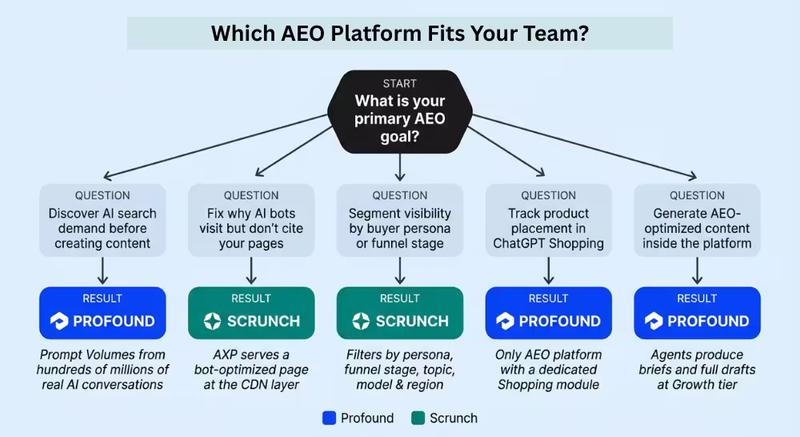
Most teams shortlist Profound and Scrunch based on a feature comparison table. The better filter is a set of operational questions that expose which platform actually fits your workflow.
1. Do you need to find new AI search opportunities, or optimize for ones you already know about?
Profound is built for discovery. Its Prompt Volumes feature pulls from hundreds of millions of real AI conversations to show what people are asking across ChatGPT, Gemini, Claude, and Perplexity, before you decide what content to create.
Scrunch's AI Search Trends covers 1,500+ curated topics, which is useful for orientation but does not replace demand-signal data at the prompt level.
2. Does your site have a JavaScript rendering problem that is blocking AI crawlers?
If AI bots are visiting your site but not citing your content, the problem is often a delivery issue, not a content issue.
Scrunch's AXP solves this at the CDN layer by serving a code-light version of your pages to AI agents.
Profound's Agent Analytics diagnoses the same problem via server logs but does not fix it automatically.
3. Do you need to segment AI visibility by buyer persona or funnel stage?
Scrunch lets you filter monitoring data by persona (e.g., CTO vs. developer), funnel stage (awareness, consideration, decision), topic, model, and region.
Profound does not offer persona or funnel-stage filters on standard tiers. For demand gen teams tying AI visibility to pipeline, this is a decisive difference.
4. Do you sell products through ChatGPT Shopping?
Profound is the only AEO platform with a dedicated ChatGPT Shopping module, covering SKU-level visibility, attribute accuracy, shopper sentiment, and merchant share.
Scrunch does not offer ecommerce-specific tracking. For direct-to-consumer or retail brands, this alone may settle the decision.
5. How many people on your team will use this tool, and what is your support expectation?
Scrunch's Core plan includes 5 seats at $250/month, with additional seats at $25/month each. Profound's Growth plan includes 3 seats with no public add-on pricing listed.
Scrunch includes dedicated Slack support at Enterprise. Profound includes dedicated Slack and a named AI Search Strategist at Enterprise.
So, if your team is larger than 3 people, Scrunch's seat structure is more predictable before you reach enterprise pricing.
Platform Philosophy: What Each Tool is Actually Built to Do
The fastest way to understand this comparison is to look at what each platform lists as its core modules.
| Profound | Scrunch | |
|---|---|---|
| Core modules | Answer Engine Insights, Agent Analytics, Prompt Volumes, Shopping, Agents | Monitoring & Insights, Site Audits, AXP (Agent Experience Platform) |
| Primary output | Strategic intelligence and content | Operational visibility and technical optimization |
| Data source | Front-end browser captures + double opt-in panel data | Browser automation + official APIs |
| Content layer | Agents generate AI-optimized articles | Insights surface recommendations only |
| Technical layer | Server-log crawler observability | Edge-layer AI-optimized content delivery |
| Ecommerce layer | ChatGPT Shopping tracking | Not available |
Profound's operating model
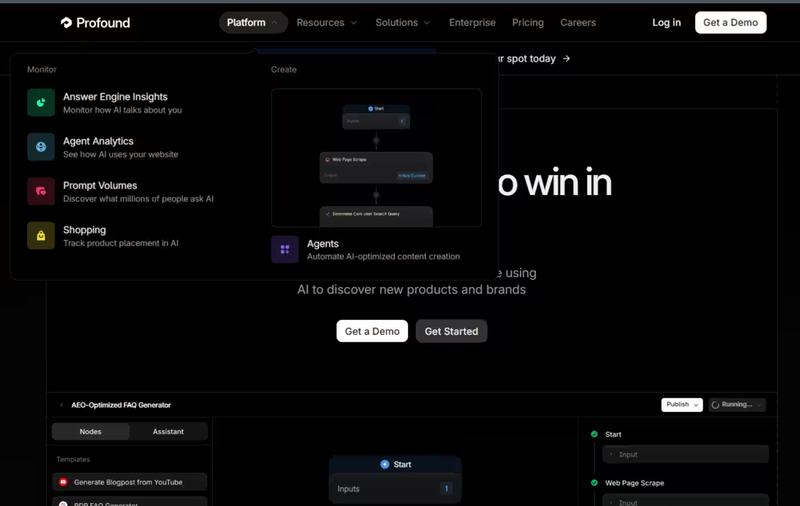
Profound is built for teams that treat AEO as a dedicated program. Its platform spans monitoring, prompt-demand research, crawler observability, ecommerce visibility, and AI-native content creation.
The Agents module generates content briefs and full drafts. The Prompt Volumes feature pulls from hundreds of millions of real user conversations via double opt-in panels to show what people are actually asking AI engines, not just what keywords rank in Google.
This makes Profound the stronger fit for teams whose primary job is understanding AI perception, building content strategy around AI demand signals, and reporting AI visibility to stakeholders.
Scrunch's operating model
Scrunch is built for teams that want to move from monitoring to action without rebuilding their content stack. Its monitoring layer filters by topic, persona, model, region, and funnel stage. Its site audit layer identifies technical barriers to AI crawling.
Its AXP layer serves bot-optimized versions of pages at the CDN level, without touching the human-facing site.
Scrunch does not offer content generation. It assumes you have content and focuses on making that content more accessible and visible to AI systems.
The bottom line: Profound is a research and content platform with monitoring built in. Scrunch is a monitoring and optimization platform with delivery built in. They are not substitutes for each other.
Pricing Reality: What You Actually Get at Each Tier
Pricing pages rarely tell the full story. So, in this section, I break down what you actually get at each tier for Profound and Scrunch, based on their official plans.
It highlights feature access, limits, and hidden trade-offs so you can assess real value, not just headline pricing, before making a decision.
Profound pricing:
| Plan for Brands | Monthly billing | Annual billing | Engines | Prompts | Seats | Notable inclusions |
|---|---|---|---|---|---|---|
| Starter | $99/mo | $82.50/mo | ChatGPT only | 50/mo — 1,500 responses | 1 | 100 Agent credits/mo, all-time history, email support |
| Growth | $399/mo | $332.50/mo | 3 (ChatGPT, Perplexity, Google AIO) | 100/mo — 9,000 responses | 3 | 400 Agent credits/mo, 6 articles/mo, Opportunities (4/week), CSV/JSON exports |
| Enterprise | Custom | Custom (2 months free) | Up to 10 (adds Gemini, Copilot, Meta AI, Grok, DeepSeek, Claude, AI Mode) | Custom | Custom | ChatGPT Shopping, Profound Sheets, Prompt Volumes searches, API, SSO/SAML, dedicated Slack + 24hr specialist SLA |
Annual billing saves roughly 2 months of cost versus monthly.
| Plan for Agencies | Price | Engines | Prompts | Notable inclusions |
|---|---|---|---|---|
| Agency Growth | $99/mo | 3 (ChatGPT, Perplexity, Google AIO) | 100/mo — 9,000 responses per workspace | 400 Agent credits/mo, 6 articles/mo, prospect audits, per client workspace pricing, 3 seats per workspace |
| Agency Enterprise | Custom | Up to 10 | Custom | All Enterprise inclusions, multi-workspace management, consolidated billing |
Scrunch pricing:
| Plan for Brands | Price | Engines | Prompts | Seats | Notable inclusions |
|---|---|---|---|---|---|
| Core | $250/mo | 4 (ChatGPT, Perplexity, Google AIO, Copilot) | 125/mo | 5 | 5 audits/mo, 3 personas, funnel stages, citations, 7-day free trial |
| Enterprise | Custom | 9 (adds Claude, Gemini, Meta AI, Google AI Mode, Grok) | Custom | Custom | Full site audit, API, SSO (SAML/OIDC), AXP, dedicated account team |
| Plan for Agencies | Price | Engines | Prompts | Seats | Notable inclusions |
|---|---|---|---|---|---|
| Agency Core | $500/mo | 4 (ChatGPT, Perplexity, Google AIO, Copilot) | 125/mo | 5 | 5 audits/mo, 1 brand workspace, 7-day free trial |
| Agency Enterprise | Custom | 9 (adds Claude, Gemini, Meta AI, Google AI Mode, Grok) | Custom | Custom | Full site audit, API, SSO (SAML/OIDC), AXP, dedicated account team |
What these numbers actually mean for buyers
Profound’s pricing is publicly visible for its self-serve tiers. The Starter plan is listed at $82.50/month, while the Growth plan is priced at $332.50/month, both billed yearly with two months free.
Enterprise pricing remains custom, which is typical for larger teams but requires direct contact for full cost details.
Scrunch's Core plan is stronger than most third-party writeups suggest. At $250/month you get 4 LLMs, 125 prompts, 5 site audits, 5 seats, persona tracking, and funnel-stage segmentation.
That is a meaningfully richer entry point than the $83 or $100 figures still appearing in older comparison pages.
The real comparison is at the operational tier, not the entry tier. Here is where the economics split:
- Profound Growth unlocks 3 engines and 100 prompts.
- Scrunch Enterprise unlocks 9 engines, full site audits, AXP, and API access.
- For teams that need broad engine coverage and technical delivery, Scrunch's Enterprise tier covers more ground.
- For teams that need Prompt Volumes, Shopping, and Agents, Profound's Enterprise tier is the only option.
Three things to check before signing either contract:
- Confirm whether Prompt Volumes searches are included in your Profound tier or are an Enterprise-only add-on.
- Confirm whether AXP is included in Scrunch's Core plan or requires an Enterprise upgrade (it requires Enterprise).
- Confirm whether Agent Traffic Analytics in Scrunch is included by default or is an add-on at mid-tier (it is an add-on at Growth, default at Enterprise).
Analytics, Segmentation, and Reporting Depth
Both platforms track visibility, citations, and sentiment. Where they diverge is in how deeply they let you slice that data and what you can do with the output.
Profound: intelligence depth
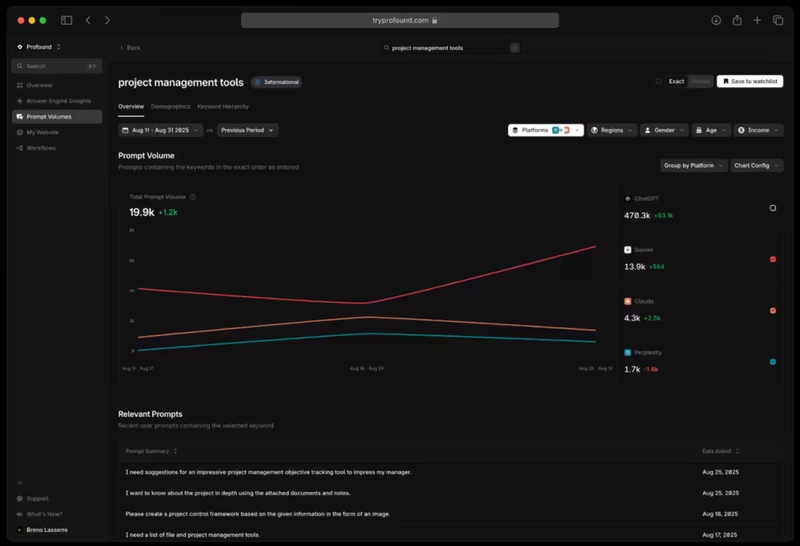
Profound's analytics stack is built around two capabilities that no other self-serve AEO tool currently matches.
Prompt Volumes pulls from a dataset of hundreds of millions of real AI conversations, sourced from double opt-in consumer panels, anonymized, aggregated, and refreshed weekly.
According to Profound's Prompt Volumes page, coverage spans ChatGPT, Gemini, Claude, and Perplexity, with demographic and intent segmentation, URL-level prompt analysis, and co-citation mapping.
This is the AI equivalent of keyword search volume data, and no competing platform offers it at this scale on self-serve tiers.
Answer Engine Insights adds competitive benchmarking, sentiment tracking, citation authority analysis, and multi-region monitoring across 30+ languages and 150+ regions.
Prompts run daily from the front-end browser interface, not the API, so results reflect what users actually see.
Where Profound is weaker: the depth of data can overwhelm generalist teams. Multiple G2 reviewers describe the interface as "overwhelming" without a dedicated strategist to interpret outputs.
Scrunch: segmentation breadth
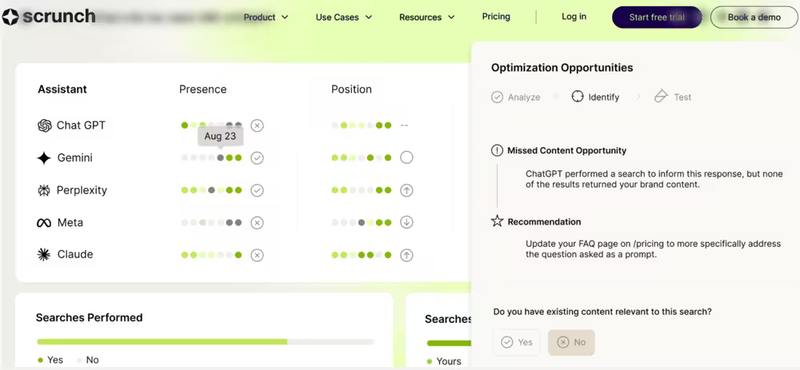
Scrunch's reporting layer is built around operational flexibility. According to Scrunch's monitoring page, reports can be filtered by:
- Topic
- Persona (ideal customer profile)
- Funnel stage (awareness, consideration, decision)
- AI model
- Region
- Custom tags
This combination of funnel-stage and persona filtering is something Profound does not offer on its standard tiers. For a demand gen team that needs to know whether they are winning awareness-stage queries but losing decision-stage queries for a specific buyer type, Scrunch's segmentation is more directly actionable.
Scrunch also surfaces AI Search Trends across 1,500+ curated topics, giving teams a signal on where to focus content without needing to build a full Prompt Volumes query.
Side-by-side comparison
| Capability | Profound | Scrunch |
|---|---|---|
| Real prompt volume data | Yes (Prompt Volumes, panel-based) | No (AI Search Trends, curated topics only) |
| Funnel-stage segmentation | No | Yes |
| Persona-based filtering | No | Yes (up to 3 personas on Core) |
| Competitor benchmarking | Yes | Yes |
| Sentiment analysis | Yes | Yes |
| Multi-region tracking | Enterprise only | Enterprise only |
| API access | Enterprise only | Enterprise only |
| Daily prompt runs | Yes | Yes (72-hour default after 14 days) |
| Data export | CSV, JSON (Growth+) | Looker Studio, CSV |
Verdict: Profound wins on research depth and strategic intelligence. Scrunch wins on operational segmentation and day-to-day campaign management.
If your team needs to brief executives on AI visibility trends, Profound's data is richer. If your team needs to isolate which funnel stage or persona is underperforming, Scrunch's filters get there faster.
Technical Optimization: Profound Agent Analytics vs Scrunch AXP
This is the most important architectural difference between the two platforms, and it is also the most commonly misrepresented section, especially if you are new to AEO terms and concepts.
Profound Agent Analytics
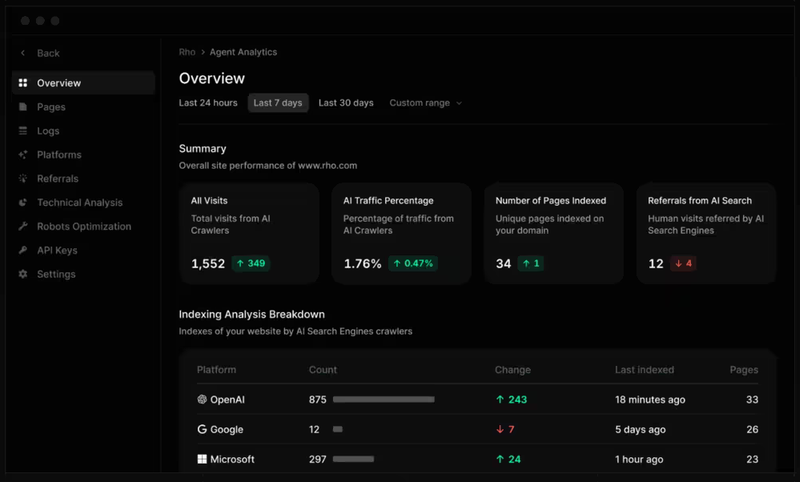
Profound's Agent Analytics uses server logs rather than JavaScript trackers to identify and analyze AI crawler behavior.
This matters because JavaScript-dependent tracking often misses bot visits entirely — AI crawlers do not execute JavaScript the same way browsers do.
What Agent Analytics covers:
- Which AI bots are crawling your site, how often, and which pages
- Technical analysis to identify indexing and retrieval barriers
- Attribution tracking to connect AI crawler activity to human traffic via GA4 integration
- Bot verification to distinguish real AI crawlers from spoofed traffic
- "Submit to AI Search" workflows to accelerate content discovery
Infrastructure integrations include AWS, Akamai, Cloudflare, Fastly, Google Cloud Platform, Netlify, Vercel, and WordPress.
This breadth makes it plug-and-play for enterprise engineering teams running on major CDN and cloud stacks.
Agent Analytics tells you what AI systems are doing with your site. It does not change what they see.
Scrunch AXP (Agent Experience Platform)
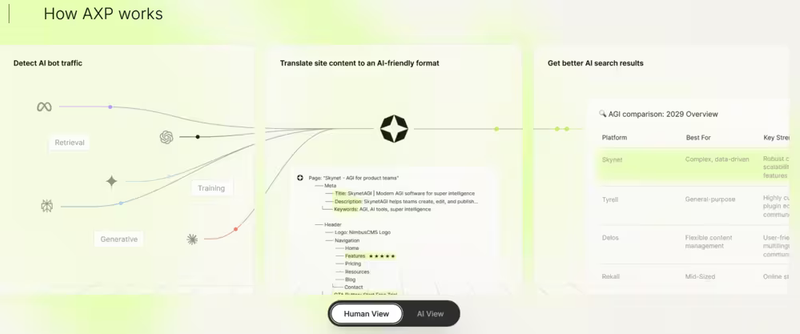
Scrunch's AXP takes a different approach. Rather than observing crawler behavior, it intercepts it.
When an AI bot visits a page, AXP:
- Detects the bot using CDN-level traffic routing
- Strips JavaScript, ads, navigation, and other elements AI systems do not need
- Serves a restructured, code-light version of the page to the bot
- Leaves the human-facing version of the page unchanged
Scrunch's own documentation shows a pricing page going from 263,220 bytes for human visitors to 4,578 bytes for AI agents.
That is a 98% reduction in file size. AXP currently works with Akamai, Cloudflare, and Vercel.
The real debate: diagnostic vs delivery
The controversy around AXP in the SERP largely comes from one comparison page that argues AXP violates Google's cloaking guidelines and cites Scrunch's own low AI visibility score as proof it does not work. Both points deserve scrutiny.
On cloaking: Scrunch explicitly states AXP excludes Googlebot and Bingbot, targeting only AI agent crawlers. Whether this satisfies Google's guidelines in the long term is an open question, but the concern is narrower than most coverage suggests.
On effectiveness: using a competitor's self-reported visibility ranking as evidence that a rival's product does not work is not a reliable methodology.
| Profound Agent Analytics | Scrunch AXP | |
|---|---|---|
| Approach | Observe and diagnose | Intercept and deliver |
| What it changes | Nothing — read-only observability | What AI bots receive from your site |
| Implementation | Server log integration | CDN-level middleware |
| CDN support | AWS, Akamai, Cloudflare, Fastly, GCP, Netlify, Vercel, WordPress | Akamai, Cloudflare, Vercel |
| Requires engineering | Yes (log forwarding setup) | Minimal (CDN configuration) |
| Available on | Growth and Enterprise | Enterprise only |
| Controversy | None | Ongoing debate on cloaking risk |
Who should care about AXP: teams whose sites use heavy JavaScript frameworks, have slow render times, or have confirmed that AI bots are visiting but not citing their content. AXP solves a delivery problem, not a content problem.
Who should care about Agent Analytics: teams that need to prove AI crawler activity to engineering or leadership, connect bot visits to traffic attribution, or identify which pages are being indexed versus ignored by AI systems.
Scrunch vs Profound: Workflow Fit by Team Type
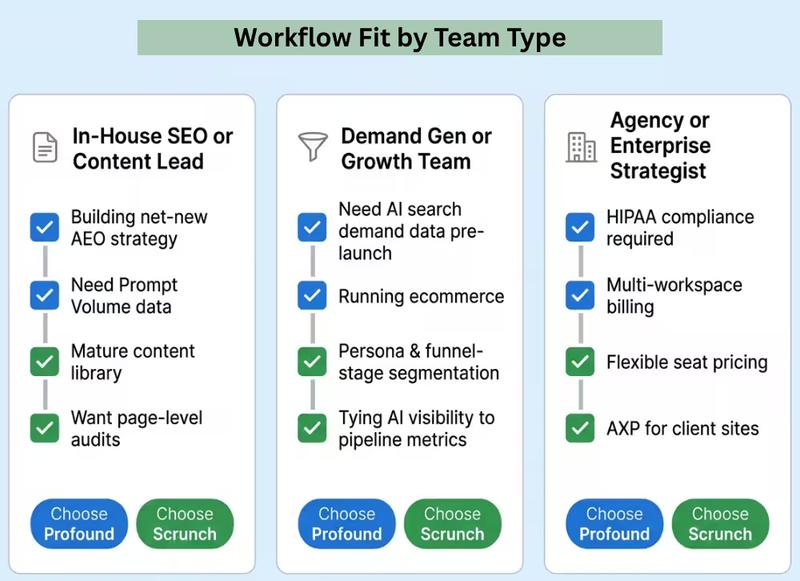
The platform choice comes down to how your team executes AEO day-to-day. Here is how each tool maps to the three most common buyer profiles for this comparison.
Profile 1: In-house SEO or content lead
Your job is to own the AEO roadmap, brief content, and report visibility gains to stakeholders.
Choose Profound if:
- You need to build a content strategy grounded in AI search demand data, not just monitor what you already have
- Prompt Volumes is useful for your category (B2B SaaS, fintech, ecommerce, or any sector with meaningful AI query volume)
- You need to generate AEO-optimized content briefs and drafts without a separate writing tool
- Executive reporting requires deep visibility intelligence and citation narratives
Choose Scrunch if:
- Your content library is mature and the priority is improving how existing pages perform in AI answers
- You want to filter visibility by topic or persona without building a full research workflow
- You need page-level audit recommendations that your team can act on without a strategist
Profile 2: Demand gen or growth team
Your job is to treat AI visibility as a pipeline channel and tie it to acquisition metrics.
Choose Scrunch if:
- You need to segment visibility by funnel stage to understand where you are losing buyers in the AI journey
- Persona-based tracking matters because your product has distinct buyer types (e.g., CTO vs. developer)
- You want AI search data to flow into your BI stack via API without enterprise negotiation
- Scrunch's customer case studies are relevant to your model: Runpod reported 4x growth in new paying customers after using Scrunch to turn AI search into an acquisition channel
Choose Profound if:
- You need to understand AI search demand before creating net-new content for acquisition
- Your ecommerce product needs ChatGPT Shopping tracking at the SKU level
- You are running structured AEO campaigns and need Agents to generate content at volume
Profile 3: Agency or enterprise strategist
Your job is to manage AEO for multiple clients or business units and report results to leadership.
Choose Profound if:
- You need enterprise-grade security including HIPAA compliance (available on Profound, not listed on Scrunch)
- Clients require multi-workspace management with consolidated billing
- Strategic depth matters more than operational speed — Profound's enterprise tier includes a dedicated AI Search Strategist
- Ramp's 7x increase in AI brand visibility is the kind of outcome your clients expect and want documented
Choose Scrunch if:
- Clients need seat flexibility without renegotiating contracts ($25/month per additional seat on Core)
- Technical teams need AXP to fix JavaScript rendering issues across multiple client sites
- Operational reporting by persona and funnel stage is a client deliverable
Profound vs Scrunch: Which Platform Should You Choose?
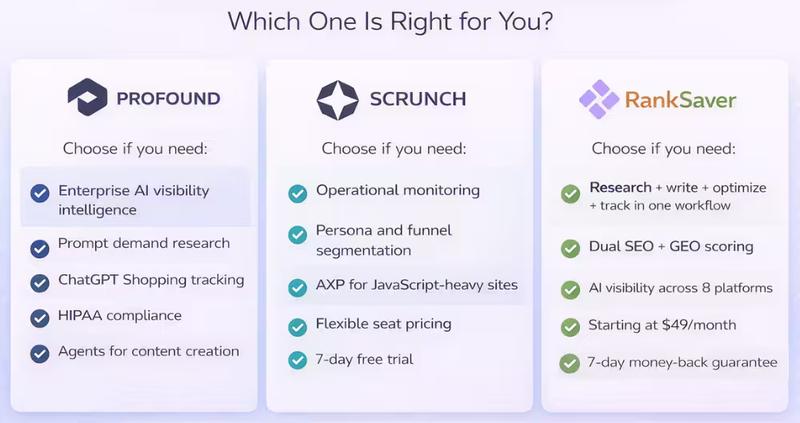
Choose Profound if your team:
- Needs prompt-demand research grounded in real AI conversation data
- Is building a net-new AEO content program and needs Agents to produce drafts
- Runs an ecommerce operation that needs ChatGPT Shopping tracking at the SKU level
- Requires enterprise security compliance including HIPAA
- Has the budget and headcount to support a dedicated AEO function
Choose Scrunch if your team:
- Has an existing content library and needs to improve how those pages perform in AI results
- Needs funnel-stage and persona segmentation to connect AI visibility to acquisition
- Has JavaScript-heavy pages where AI bots are visiting but not citing content (AXP use case)
- Wants a 7-day free trial before committing to a contract
- Needs flexible seat pricing without enterprise negotiations
The gap both platforms share: neither Profound nor Scrunch closes the loop between monitoring and execution at the content level without additional tools or significant budget.
Profound's Agents are capped at 6 articles per month on Growth. Scrunch offers no content writing tools at all.
If your team needs to research, write, optimize, and track AI visibility in one workflow, both platforms require you to bolt on a separate content tool.
When to consider RankSaver instead
RankSaver takes a different approach to this problem. Rather than monitoring AI visibility as a standalone function, we combine SEO research, content creation, dual SEO + GEO scoring, and AI visibility tracking across 8 platforms in one workflow.
The GEO content optimizer scores your content's readiness for AI citation and identifies exactly what to change, while the AI Search Tracker monitors brand visibility across ChatGPT, Perplexity, Claude, Gemini, and more.
For teams that want to move from research to published, optimized, tracked content without stitching together a monitoring tool, a content tool, and an optimization tool, rankSaver covers that workflow starting at $49/month.
The choice between Profound, Scrunch, and RankSaver is ultimately a question of whether you need deep intelligence, fast technical optimization, or an integrated content-to-citation workflow. Each platform is built for a different answer to that question.
Frequently Asked Questions
Everything you need to know about this topic.
Profound is stronger for prompt demand research because its Prompt Volumes feature uses panel-based data from real AI conversations. That gives you a clearer view of what people are asking AI engines before you decide what content to create. Scrunch’s AI Search Trends is useful for orientation, but it is not the same as real demand data.
Yes. Scrunch offers a 7-day free trial on its Core plan. That makes it easier to test monitoring, segmentation, and reporting before committing to a larger contract. Profound’s Growth plan includes a try-for-free option, but the pricing structure is more enterprise-oriented overall.
Scrunch is stronger for technical delivery because AXP serves a lighter, bot-friendly version of your page to AI agents. Profound’s Agent Analytics is useful for diagnosing crawler behavior and attribution, but it does not change what AI bots receive from the site.
Profound’s Starter plan tracks ChatGPT only, Growth tracks 3 engines, and Enterprise can track up to 10. Scrunch’s Core plan tracks 4 LLMs, and Enterprise expands to 9. If broad engine coverage matters, compare the higher tiers rather than the entry plans.
Both can work for agencies, but they fit different agency models. Profound is stronger if your agency needs deeper research, content generation, and consolidated client workspaces. Scrunch is stronger if your agency needs flexible monitoring, persona and funnel filters, and technical optimization for client sites.
Profound gets closer because it includes Agents for content generation on higher tiers. Scrunch does not include writing tools, so it is more of a monitoring and optimization layer. If you want research, writing, optimization, and tracking in one place, you will still need a broader workflow tool.
If you are just getting started, choose based on your immediate bottleneck. Use Profound if you need to find content opportunities from real AI demand and build new assets. Use Scrunch if you already have content and need to improve how AI systems crawl, segment, and cite it.
Written By
Want help getting your brand ranked on Google and cited by AI?
We help businesses build AI visibility through SEO, content, and authority with clear revenue impact.
Book a Strategy Call