
Your SEO team just gained two new coworkers you didn't hire. One is the agent running audits, rewriting metadata, and flagging decay while you sleep. The other is the LLM reading your content to decide who gets cited.
Agentic SEO is the shift that puts both in your workflow, and it changes what the human in the loop is actually for.
What is Agentic SEO?
Agentic SEO is search optimization executed by autonomous AI agents that plan, decide, and act across multi-step workflows, instead of generating output one prompt at a time. The shortest version: you hand the system a goal, not a task, and it figures out the steps.
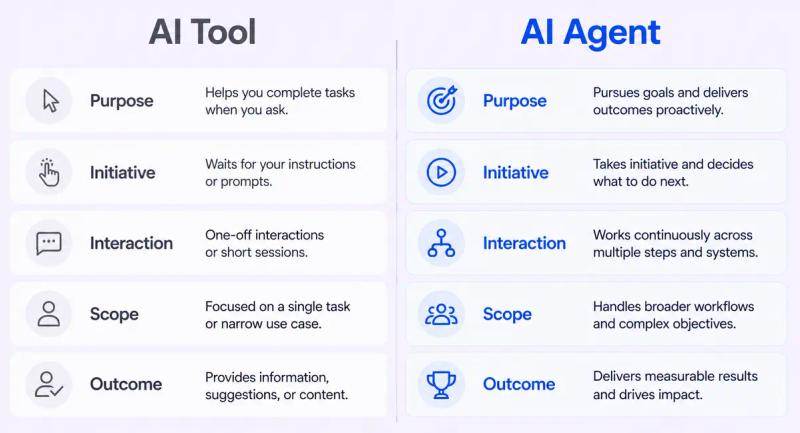
That definition sounds close to "AI-powered SEO - SEO done by a prompt-based AI tool."
But four components separate the two.
1. An agent has reasoning (it interprets signals and decides what matters),
3. tools (APIs, crawlers, CMS access - the hands that touch your stack),
3. memory (it remembers what worked last month and what broke),
4. and autonomy (it executes without asking permission on every step).
Strip any one of those out and you're back to a faster autocomplete.
What this means in practice: you stop saying "write me a meta description for this page" and start saying "keep meta descriptions across the site aligned with current SERP intent."
The second instruction is a standing directive. The agent handles discovery, drafting, validation, and publishing on its own loop.
This is also where most people get the terminology tangled. Agentic SEO is not the same thing as AI SEO or AEO.
AI SEO is the discipline of being visible inside AI-generated answers.
Answer Engine Optimization is the structural work - schema, answer blocks, citation design, that makes your content extractable.
But agentic SEO is the execution model that runs the work, whatever the target surface happens to be.
You can do agentic SEO for Google rankings, for ChatGPT citations, for Perplexity visibility, or all three in parallel. The agent doesn't care. Your signals and governance do.
Why Agentic SEO is in the Modern Search
Roughly 90% of marketing organizations already have AI agents somewhere in their stack framework, and the teams moving fastest are the ones running lean.
Solo SEOs, two-person content teams, agency operators juggling fifteen client portfolios. The pull is practical instead of philosophical.
The first reason is coverage. A modern visibility footprint spans Google, 5 major LLM platforms, and a growing list of answer surfaces that each weigh content differently. No human audit cycle catches drift across all of them in real time. Agentic workflows do.
The second margin. Freelance rates haven't kept pace with client expectations, and agency hours per deliverable keep compressing. When the same $3,000 retainer now has to cover GEO monitoring, AI citation tracking, and traditional SEO, the math breaks unless execution moves off human hours.
The third is a shift in what "working fast" even means. BCG's research on AI-powered workflows shows business processes accelerating 30 to 50%, with low-value work time cut by 25 to 40%. Those numbers reshape what a single operator can run in a week.
The people building and studying this space have been clear about the direction. Anthropic frames agentic systems as goal-driven, not prompt-driven - the distinction that makes the category possible.
BCG's research goes further, arguing that organizations leading in agentic AI are capturing five times the revenue gains of laggards, driven mostly by multi-agent specialization rather than single-tool adoption.
On the practitioner side, WordLift has made the case that agentic AI for SEO succeeds when the agent is trained by the team, for the team - not dropped in as a generic assistant.
That’s why we, who have been doing SEO since 2021, built RankSaver - a leading AI visibility platform that acts as your brand intelligence through agent orchestration.
The logic of the platform is designed by SEO professionals based on buyer psychology to handle organic marketing for your business, helping you get qualified inbound leads when people search in your space.
How Agentic SEO Actually Works: The Architecture
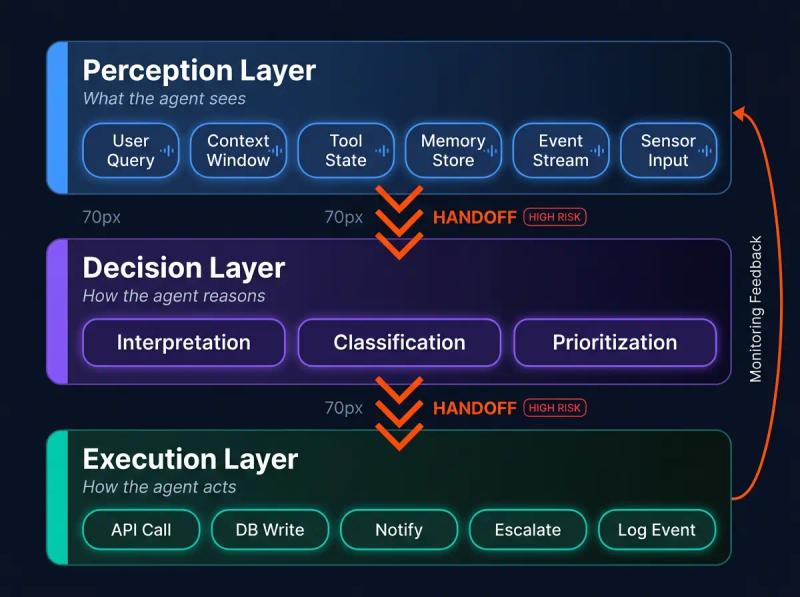
An agent is a stack of three layers, stitched together by handoffs. When agentic ai seo deployments fail, the failure is almost never inside a layer. It's in the seams between them.
The Perception Layer
Perception is what the agent sees, and everything downstream is bounded by it. Inputs feed in from SERP data, Google Search Console, AI citation tracking across ChatGPT, Perplexity, Claude, Gemini and the rest, competitor movement, log files, and engagement metrics. Each stream has its own latency and noise profile.
The quality of this layer decides what the agent can reason about. Stale APIs produce confident decisions on conditions that changed two weeks ago.
A single source biases the entire stack. Clean connectors, freshness thresholds, and trust scoring between first-party and scraped signals are the foundation.
The Decision Layer
The layer runs perception data through three filters: interpretation (what does this signal mean), classification (intent drift, technical decay, competitor displacement), and prioritization (which of today's forty issues gets attention).
Two things get underestimated here. Memory turns the agent from a consultant you re-hire every morning into a colleague who remembers last quarter.
Patterns compound - the agent notices your pricing page decays faster than your comparisons, or that AI citations drop after a specific competitor publishes.
Instructions are the standing directives that bake human judgment into autonomous behavior. "Flag pages losing more than 20% citation share over four weeks."
Bad decision layers feel thorough but miss what matters. Good ones prioritize ruthlessly and act on fewer things, faster.
The Execution Layer
Execution is where the agent touches your stack through tools - CMS APIs, schema scripts, internal link systems. It's the riskiest layer and the most underinvested.
Three things separate production-grade from demo-grade: reversibility (every action rollbackable), scoped permissions (the agent fixing metadata can't deploy new URLs), and atomic actions (small independent commits, not opaque batches).
Then there are the seams. Perception hands to Decision. And, decision to Execution. Execution feeds back to Perception. Each handoff is where format mismatches, timing drift, and state loss quietly break the whole system.
The Real Difference: Designing Signals, Not Managing Tasks
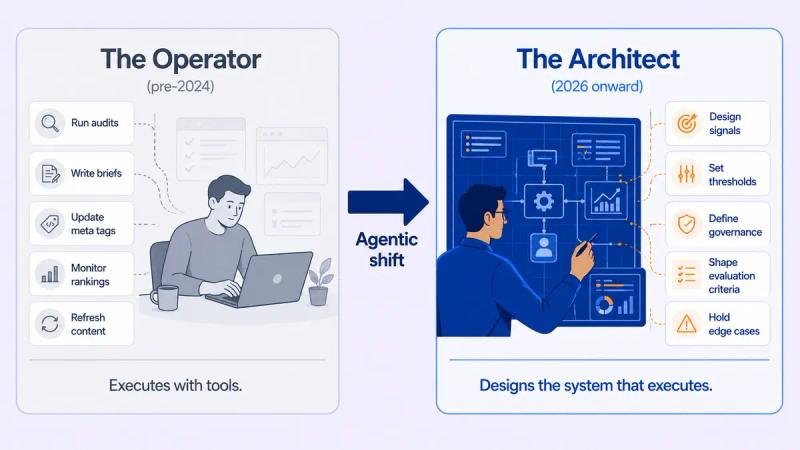
The tidy framing - agents execute, humans strategize - is half useless. Strategy in that sentence is a shrug. The humans who make agentic SEO work, are doing design work across four specific disciplines.
1. Signal architecture: It sets the ceiling on everything else. What data does the agent see? How clean, how recent, how cross-validated? Which sources outweigh others?
A brilliant agent on contaminated inputs is a confident liability. A modest agent on clean ones outperforms it on day one. Most agentic AI for seo projects quietly fail here, not in the model.
2. Intent modeling: "Winning" means different things on different surfaces. A page at position 3 on Google can be invisible in Perplexity. A page heavily cited by ChatGPT can pull zero organic traffic.
Someone has to decide what the agent optimizes for, how those goals trade off, and which surface gets priority. That call lives in the brief a human writes.
3. Governance design: It's the one skipped until something breaks. Approval thresholds, rollback rules, blast-radius limits on how many pages one decision can touch before it pauses for review.
The higher the autonomy, the more these constraints define the system. Governance is part of the architecture.
4. Edge-case judgment: The least automatable. Brand voice calls, regulatory lines that shift by jurisdiction, the moments when an agent's confidence and the business's risk appetite diverge. Agents can't hold reputation. That still sits with you.
The shift underneath all four is simpler than it looks. You're no longer the one operating. You're designing the system that operates. Operator becomes architect.
Which is also why the same three failure patterns keep showing up in production.
Where Agentic SEO Breaks (The Failure Modes)
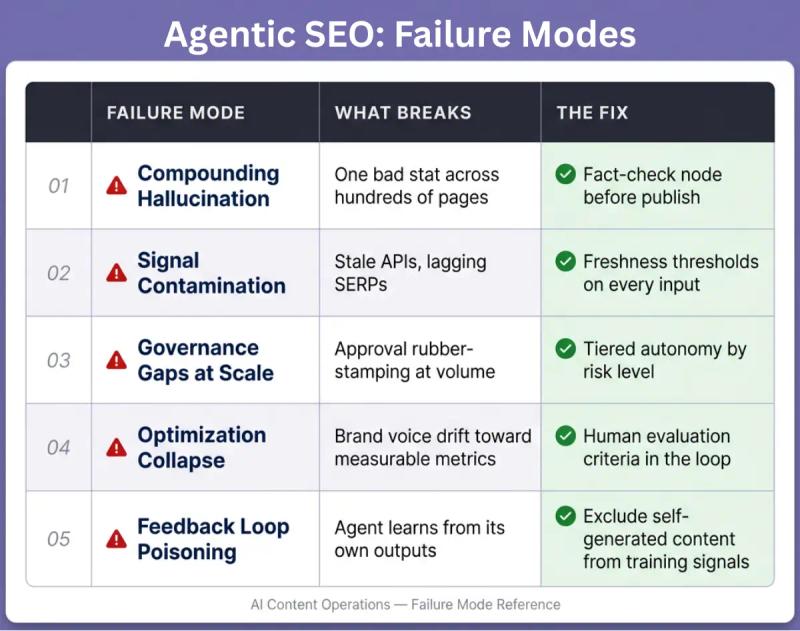
Before building RankSaver, we saw the gaps as we went deeper into the process. We identified them, tested solutions, and then launched this platform. Here are the 5 failure modes that show up in production, and how you can overcome them.
1. Compounding hallucination: An agent ingests one wrong stat - a fabricated benchmark, a misremembered API response, a number it confidently invented - and propagates it across hundreds of pages before anyone notices.
The damage is the credibility hit when you discover your authority pages cite a percentage that doesn't exist. The fix isn't trust. It's a fact-check node between draft and publish that verifies every numeric claim against a source the agent didn't generate.
2. Signal contamination: The perception layer pulls from outdated APIs, scraped SERPs that lag the live index by days, or analytics dashboards still running on stale connectors. The agent acts on yesterday's reality with today's confidence.
The fix is freshness thresholds on every input and a hard rule: if the signal is older than its decay window, the agent flags rather than acts.
3. Governance gaps at scale. The approval process that worked for ten pages collapses at ten thousand. Reviewers rubber-stamp because the volume forces it.
The fix is tiered autonomy — low-risk changes (meta refreshes, internal link updates) ship automatically, mid-risk changes (content rewrites, schema changes) batch for sample review, high-risk changes (regulated topics, pricing pages, anything legal touches) require explicit human approval.
One review process for everything is how things break.
4. Optimization collapse: The agent over-indexes on what's measurable. Keyword density, entity counts, internal link distribution - all easy to score, all easy to game.
Brand voice, original perspective, the texture that makes a page worth reading? Harder to measure, so the agent stops optimizing for it. Pages get more "optimized" and less interesting at the same time.
The fix is human evaluation criteria built into the loop - sample audits where someone reads the output and scores it on dimensions the agent can't quantify.
5. Feedback loop poisoning: The agent's monitoring data feeds back into its own decision-making. Pages it published get cited as benchmarks. Patterns it created become patterns it reinforces. Over time, the system optimizes toward its own outputs and away from external reality.
The fix is excluding agent-generated content from the training and reference signals the agent itself uses to make future decisions.
So, the teams that get agentic ai seo right run specialized agents for SERP perception, AI citation tracking, content decay, and execution - each with its own scope, checks, and kill switch.
That's the architecture we built RankSaver around: separate agents for SEO, AEO and GEO, coordinated through a shared signal layer, with the five primitives baked in by default.
Validation on inputs, fact-check gates on outputs, source verification on every cited claim, sample review on agent-driven changes, and explicit exclusion rules on self-reference loops.
What Agentic SEO Means for Your Workflow
The hardest part of moving to agentic SEO is resisting the urge to automate everything at once. Teams that do well start narrow, prove the loop, and expand only when the governance holds. So...
1. Start with one stage instead of the whole pipeline: Ideation is the safest entry point - competitive gap analysis, keyword clusters, brief generation. Low stakes (the worst case is a brief you don't use), high signal (you'll see immediately whether the agent surfaces angles your team missed), fast review.
Once that loop runs cleanly for a month, expand to the next stage. Skipping straight to agentic publishing is how teams end up with 200 pages they have to roll back.
2. Build the signal layer before the agent layer: Most teams do this backwards. They subscribe to a platform, wire up their CMS, then notice their GSC data is 6 weeks stale and their AI citation tracking covers two platforms when their audience uses six.
Audit the data sources first. Platforms like RankSaver assume you'll bring usable signals — give yourself that baseline before evaluating any tool.
3. Add execution permissions in tiers: Read-only first. The agent analyzes and recommends, a human ships. Once recommendations consistently match what your team would have decided anyway, promote the agent to write access on low-risk surfaces.
Mid-risk surfaces come next. Money pages and regulated content stay human-gated for as long as the business requires.
4. Measure what changes, not what gets produced: Output volume is a vanity metric. Twenty new pages this week is meaningless if engagement, citations, or rankings don't move.
The numbers that matter: intent alignment, citation presence across the platforms your audience actually uses, indexation quality (not just count), and the latency between signal detection and corrective action.
Who Actually Wins with Agentic SEO
Agentic SEO pays off where three conditions stack: high content volume, fast intent shift, and tight execution budgets. Miss any one, and the setup cost outweighs the lift.
So, the fits are predictable.
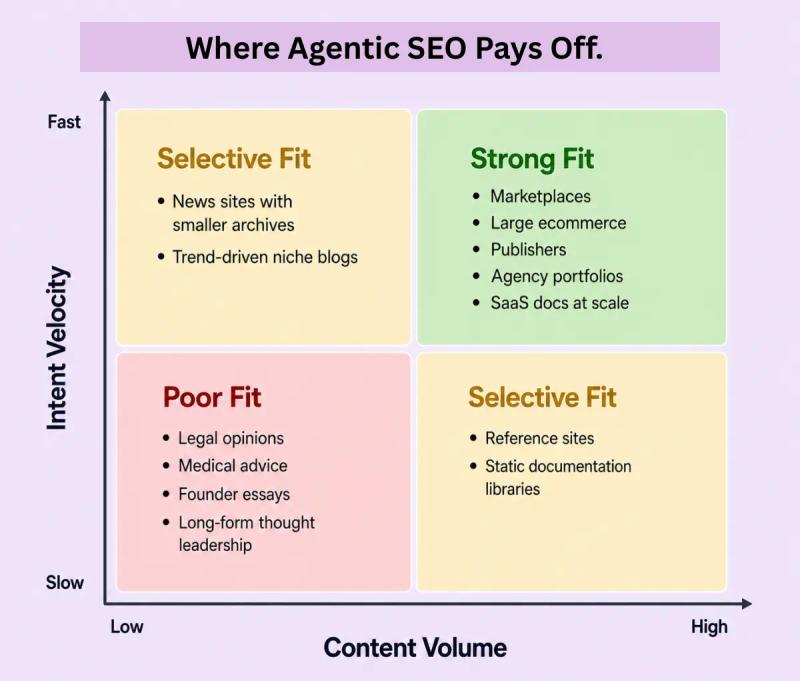
1. Marketplaces and large ecommerce: Catalogs change weekly, intent shifts seasonally, and category page count makes manual optimization mathematically impossible. Agents earn their keep on day one.
2. Publishers: Archive decay is a slow-moving emergency. Agentic monitoring catches drift across thousands of legacy URLs that no human team revisits.
3. SaaS with dense documentation: Every product release breaks something in your help center, your comparison pages, your integration docs. Agents keep alignment as the product moves.
4. Agencies managing portfolios: The economics only work when the same workflow runs across 30 client sites. Agentic execution is what turns retainer math from break-even to profitable.
The mismatches are worth naming, because no one else does. Agentic SEO is a worse fit for low-volume, high-trust content.
Legal opinions, medical guidance, long-form thought leadership, founder-voice essays. The page count is too low to justify the architecture, and the cost of a hallucination is too high to absorb.
For those teams, a sharp human writer with light AI assistance still beats anything agentic.
The pattern under the pattern: agentic ai seo wins when scale is the bottleneck. But when craft is the bottleneck, it doesn't.
Frequently Asked Questions
Everything you need to know about this topic.
They overlap but aren't the same. AI SEO and GEO describe what you're optimizing for: visibility inside AI-generated answers. Agentic SEO describes how the optimization runs - autonomous agents executing multi-step workflows. You can do agentic SEO targeting Google rankings only, AI citations only, or both at once.
It replaces the execution layer, not the strategic one. Audits, briefs, optimizations, and monitoring - those compress dramatically. Signal architecture, intent modeling, governance design, brand judgment - those expand. Most teams end up smaller in headcount but operating at a higher altitude than before.
The range is wide. A single-stage workflow on top of existing tools runs four figures annually. A full multi-agent stack with custom integrations and orchestration sits in the low six figures. Most cost lives in setup and data integration, not in ongoing compute. Scale doesn't move the number much once it's running.
Google's spam policies target manipulative or low-value content regardless of origin. Agentic content that's accurate, original in framing, and adds genuine value sits within guidelines. Mass-produced thin content gets penalized whether a human or an agent produced it. The threshold is value, not authorship.
Which are the best agentic SEO tools to start with?
Start with the gap you’re trying to close. Frase covers the content workflow end to end. Search Atlas leans more toward technical SEO and execution. RankSaver covers everything from entity building, knowledge graphs, and AI visibility to SERP tracking, content planning, and creation for your site as well as UGC platforms like Medium and LinkedIn Pulse.
So, choose based on where your stack is weakest instead of feature count.
Three signals: your data infrastructure is clean enough that you trust your own dashboards, you have at least one stage of your workflow that's repetitive and high-volume, and someone on the team has bandwidth to design and supervise the system instead of just operating it. Missing any of those, fix it before deploying.
Written By
Want help getting your brand ranked on Google and cited by AI?
We help businesses build AI visibility through SEO, content, and authority with clear revenue impact.
Book a Strategy Call