
Market research for target audience helps you figure out exactly who to sell to — and how to reach them.
Skip this step, and you're guessing. And guessing is expensive, as 43% of startups fail because they build something nobody wants.
So, in this guide, I share a 6-step framework, real stats, and practical tools to find your ideal buyers through data — not guesswork.
- Market research for target audience combines demographic, psychographic, behavioral, and geographic data to identify your most likely buyers.
- Follow a 6-step process: analyze existing data → run surveys → study competitors → build personas → validate with ads → refine quarterly.
- Companies that personalize based on audience research see up to 40% more revenue (McKinsey).
- 89% of marketers report positive ROI from personalization (Adobe).
- So, you don't need a big budget. Google Analytics, social media insights, and free survey tools can get you started today.
What is Market Research for Target Audience?
Market research for target audience is the process of gathering data about a specific group of people — their age, income, interests, buying habits, and pain points — to determine who is most likely to buy your product.
Market research is the method. Your target audience is the result.
Most businesses treat these as separate tasks.
They research industry trends in one place and sketch a vague buyer persona in another. That disconnect is where bad marketing decisions start.
| General Market Research | Target Audience Research |
|---|---|
| How big is this market? | Who specifically is buying? |
| What are the industry trends? | What problems do they need solved? |
| What do competitors charge? | Where do they spend time online? |
General market research tells you if a market is worth entering.
Target audience research tells you who to talk to once you're in.
The demand for this people-level insight is growing fast. The global market research industry hit $140 billion in revenue in 2024, up from $102 billion in 2021.
And 47% of researchers now use AI regularly in their research workflows.
Tools are getting faster. But the fundamental question hasn't changed: who are you selling to, and how do you know?
Why Target Audience Matters in Marketing
Every marketing dollar either moves you closer to the right customer or gets wasted on the wrong one.
Your target audience in marketing is the filter between the two.
The Cost of Marketing without a Defined Audience
The #1 reason startups fail? Building something nobody wants. That accounts for 43% of all failures (CB Insights).
But there's a second failure mode that gets less attention: targeting the wrong people. The product works. The market exists. But the marketing reaches people who will never buy.
About 90% of startups don't survive long-term. In nearly every post-mortem, insufficient audience research shows up as a contributing factor.
The ROI of Audience-Driven Marketing
When you know your audience, marketing gets cheaper and more effective.
- Audience-driven personalization can cut customer acquisition costs by up to 50% (McKinsey)
- The same McKinsey research found a 5–15% revenue lift and 10–30% improvement in marketing ROI
- Personalized CTAs convert 202% better than generic ones (HubSpot)
- 81% of customers prefer brands that offer personalized experiences (Forbes, 2024)
How Your Target Audience Shapes Every Channel
Your audience research directly drives decisions across every marketing channel.
SEO: Your audience's search queries become your keyword strategy. But it goes deeper than that. The language they use in surveys and support tickets often reveals long-tail keywords that tools like Semrush or Ahrefs miss.
We've seen this at RankSaver — some of our highest-performing pages target phrases pulled directly from customer interviews, not keyword research tools.
AEO (Answer Engine Optimization): AI search engines like ChatGPT, Gemini, and Perplexity pull answers from content that directly matches user questions.
So, when you know your audience's exact pain points, you can structure content around those questions in a way that gets cited by LLMs. Short, clear definitions. Direct Q&A formatting.
Concise answers followed by supporting detail. That's how AI engines select sources — and audience research tells you which questions to answer.
GEO (Generative Engine Optimization): Generative search results (Google AI Overviews, Perplexity answers) favor content that is self-contained, well-structured, and factually grounded.
Audience research helps here because it tells you what level of detail your reader needs. A technical SaaS buyer wants depth and specs.
A first-time small business owner wants steps and definitions. Matching content depth to audience expertise is a GEO signal most brands overlook.
Email: Segmentation quality depends entirely on how well you've defined your audience. The more granular your personas, the more precisely you can segment — by behavior, lifecycle stage, or product interest.
Social media: Platform choice is an audience decision. If your research shows your buyers are 35–50-year-old B2B executives, LinkedIn is where your content should live — not TikTok.
Paid ads: Targeting layers on Meta and Google are only as good as the audience data you feed them. Demographic + interest + behavioral targeting combined produces the best ROAS. Audience research gives you all three.
Content marketing: Topics, tone, format, and depth all flow from your audience profile. A 3,000-word technical guide works for one audience. A 90-second video works for another. The research tells you which.
Types of Target Audiences
Not every audience is segmented the same way. The right approach depends on your product, business model, and what you're trying to achieve.
The five main types:
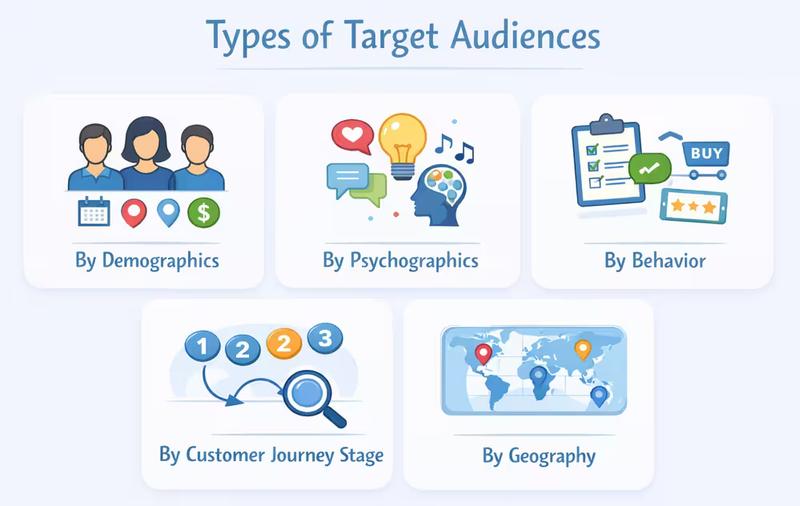
1. By Demographics: Segmented by age, gender, income, education, family status, and occupation.
Best for product positioning, pricing decisions, and ad targeting on Meta or Google — where demographic filters are built into the platform.
2. By Psychographics: Segmented by values, interests, lifestyle, and attitudes.
Best for brand messaging, content strategy, and community building.
Example: Two 30-year-old women earning the same salary. One shops at Zara because she follows trends. The other shops at Patagonia because she values sustainability. Same demographics. Completely different buying motivations.
3. By Behavior: Segmented by purchase history, brand interactions, product usage, and loyalty patterns.
Best for email marketing, retargeting, upselling, and churn prevention.
Behavior-based email automation generates 320% more revenue than standard batch campaigns.
4. By Customer Journey Stage: Segmented by where someone sits in the buying process: awareness, consideration, purchase, or retention.
Best for funnel-specific campaigns. Someone discovering your brand needs education. Someone comparing you to a competitor needs proof.
Which type should you start with? Demographics and behavior. They're the easiest to measure with existing tools. Add psychographics once you have survey or interview data.
5. By Geography: Segmented by country, region, city, or urban vs. rural.
Best for local businesses, regional campaigns, and international expansion.
How to do Market Research for Target Audience
A clear process is essential to identify your target audience accurately. Each step builds on the previous one, adding depth and precision to your insights.
So, if you skip a step, gaps appear, leading to an incomplete audience profile that can weaken your marketing decisions and overall strategy.
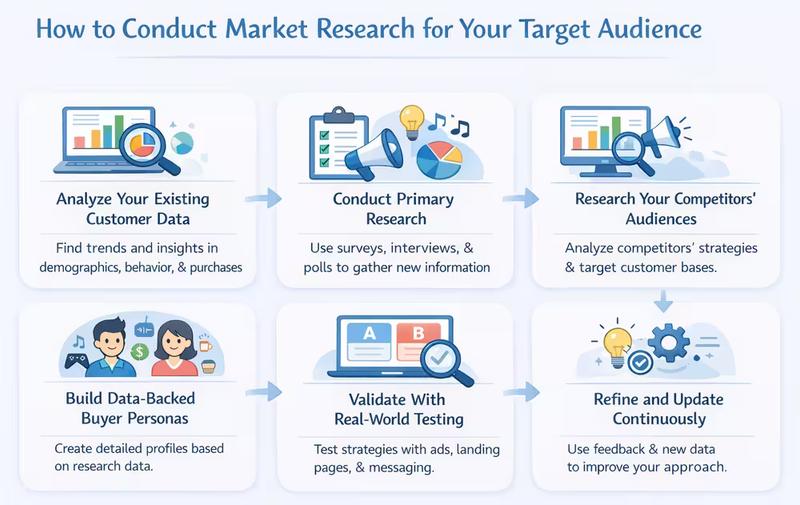
1. Analyze Your Existing Customer Data
Start with what you already have.
Your CRM, Google Analytics, email platform, and sales records contain patterns you've probably never looked at.
Who are your best customers?
What do they have in common?
Who buys more than once?
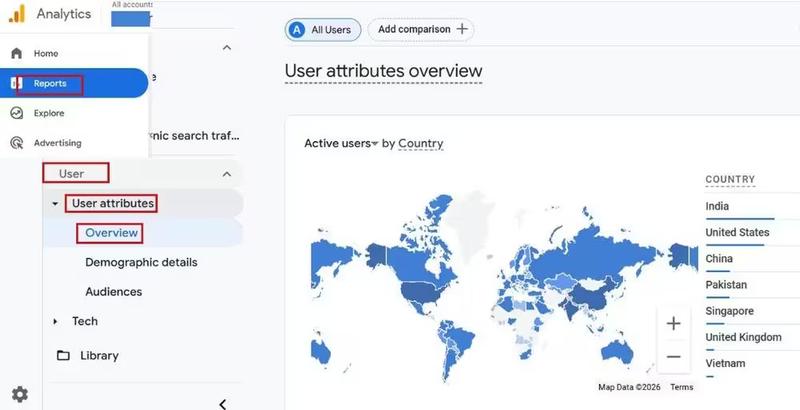
In Google Analytics 4, navigate to Reports → User → User Attributes → Overview. You'll see your audience broken down by age, gender, location, and interests.
65% of marketers say they lack high-quality data about their target audience (HubSpot, 2024). Which means the minority who actually analyze their data hold a real advantage.
What if you're a new business with no customers yet? Skip to Step 3 (competitor analysis) and work backward.
2. Conduct Primary Research
Surveys, interviews, and focus groups give you insights that analytics tools can't.
| Method | Best For | Cost |
|---|---|---|
| Online surveys (Typeform, Google Forms) | Quantitative patterns at scale | Free – $500 |
| 1-on-1 interviews (10–15 people) | Deep qualitative insights | Free (your time) |
| Focus groups (6–10 people) | Testing messaging and positioning | $4,000–$6,000 per session |
What to ask: current pain points, buying motivations, objections, how they solve the problem today, and where they spend time online.
How many survey responses do you need?
For most small businesses, 100–300 responses give you statistically meaningful patterns. Enterprise teams should aim for 1,000+.
Online surveys are used by 85% of market research professionals worldwide. They're the most common method for a reason — fast, cheap, and scalable.
3. Research Your Competitors' Audiences
Pick 3–5 direct competitors. Then figure out who they're targeting.
Tools that help:
- Semrush One2Target: Enter a competitor's domain and get audience demographics, interests, and behavior data
- Facebook Ad Library: See your competitors' active ads and infer who they're targeting from the creative and copy
- SimilarWeb: Analyze traffic sources and audience overlap across competing sites
Look for gaps. If every competitor targets the same age group or geography, there might be an underserved segment you can own.
Don't target the same audience as your competitors. Their blind spots are your opportunity.
4. Build Data-Backed Buyer Personas
Combine everything from Steps 1–3 into 2–4 buyer personas.
Each persona should cover:
- Who: Name, age, job title, income
- Goals: What they're trying to achieve
- Pain points: What frustrates them right now
- Channels: Where they spend time online
- Objections: Why they might not buy
The difference between a useful persona and a useless one? Data. A persona based on assumptions is fiction.
A persona built from analytics, surveys, and competitor research is a strategic tool.
How many personas do you need? 2–4 for most businesses. More than that and you're diluting your focus.
5. Validate With Real-World Testing
Research gives you a hypothesis. Testing confirms it.
Run small ad campaigns on Meta or Google targeting each of your persona segments.
A/B test different messaging, offers, and creatives. Track which segments actually convert.
How much budget do you need? $500–$1,000 across 2–3 audience segments is enough for initial validation. You're not trying to scale yet — you're trying to learn.
6. Refine and Update Continuously
Your audience will shift. A persona built last year may not match your buyers today.
Set a quarterly review: re-check your analytics, re-survey a sample of customers, and update your personas. Watch for signals like declining open rates, shifting traffic sources, or new competitors entering your space.
83% of research professionals say their organizations plan to increase AI investment for research in 2026 (Qualtrics).
The tools are accelerating. Your review cadence should keep up. So...
How to Use AI Deep Research Tools for Target Audience Analysis
Traditional audience research takes weeks of gathering data, reading reports, and synthesizing findings. AI deep research tools compress that into hours.
4 Major platforms can help with target audience analysis:
1. Claude (Research)
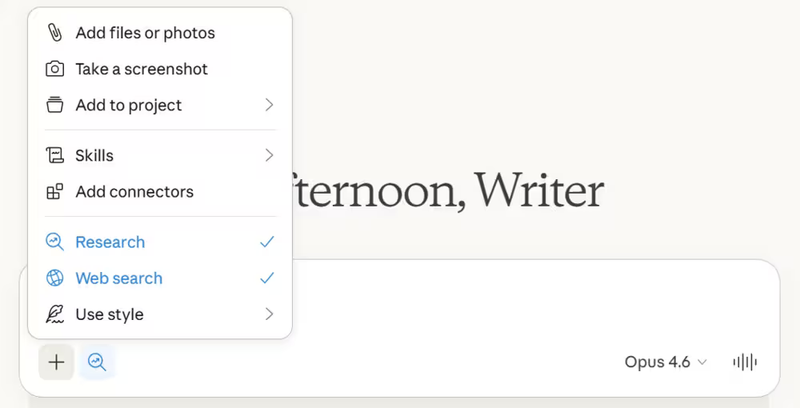
Claude's research reads and synthesizes dozens of web sources (Always on 'Web search' to avoid hallocination and current data) in a single session.
Give it your product description plus 3–5 competitor URLs, and it will cross-reference their content, messaging patterns, and public data to draft an audience profile.
Best for: Competitor audience analysis, building personas from scratch, analyzing customer reviews at scale.
Unique edge: Handles long, multi-step research workflows in one conversation — from competitor analysis to persona drafting without losing context.
ChatGPT (Deep Research)
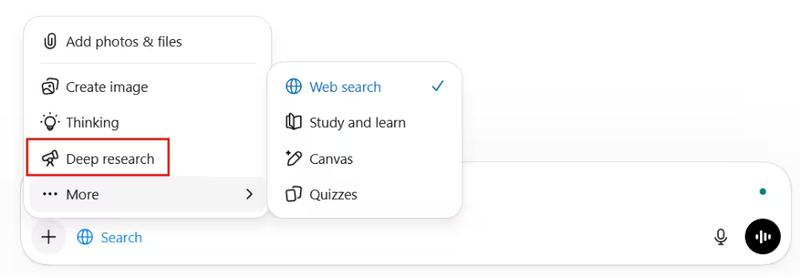
ChatGPT's deep research browses the web in real time and compiles structured reports with citations.
Best for: Quick market size estimates, trend analysis, gathering demographic data from public sources, and generating survey question frameworks.
Unique edge: Fast synthesis across broad topics. Good for the first pass before you commit to primary research.
Gemini (Deep Research)
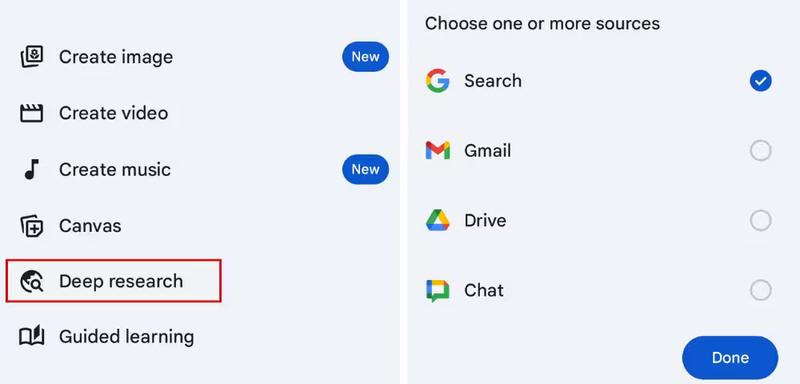
Gemini's deep research pulls from Google's search index and data ecosystem to produce cited reports.
Best for: Geographic interest data, search behavior patterns, and trend identification using Google Trends signals.
Unique edge: Native Google integration gives it a natural advantage for understanding what your audience searches for and where search interest concentrates by region.
Perplexity (Deep Research)
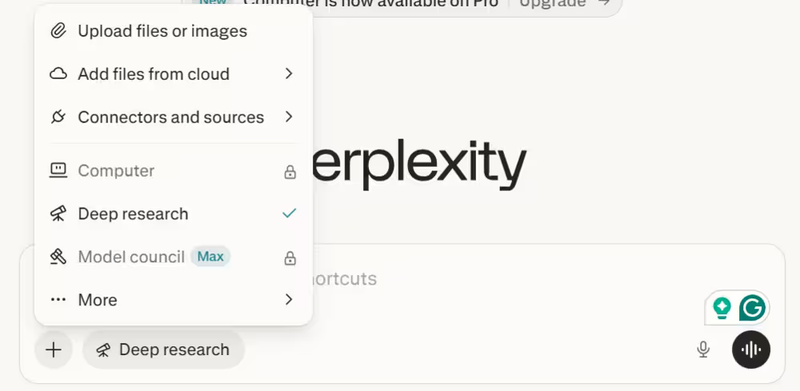
Perplexity's Pro Search runs multi-step web research and returns concise, source-linked answers.
Best for: Validating specific audience stats, fact-checking persona assumptions, and answering pointed questions like "What social platforms do B2B buyers in India use most?"
Unique edge: Every claim comes with a clickable citation. Ideal for building research-backed personas where you need to show your sources.
| Task | Best Tool |
|---|---|
| Full competitor audience analysis | Claude |
| Fast market overview with stats | ChatGPT |
| Search behavior and geographic trends | Gemini |
| Specific cited stats for persona validation | Perplexity |
None of these replace primary research (surveys, interviews, customer conversations). But they dramatically reduce the time between "I have a question about my audience" and "I have a data-backed answer."
Target Audience Examples — How real brands define theirs
Theory is useful. Examples make it stick. Here's how three brands in different categories approach target audience research.
Nike (B2C, Mass Market)
Target market: Athletes and fitness enthusiasts worldwide.
Target audience (specific campaign): Women aged 18–34 in urban areas, interested in running and self-improvement, active on Instagram and TikTok.
How research shaped the campaign: Nike's "You Can't Stop Us" campaign was built on psychographic data showing their female audience responds to empowerment narratives more than product specs. The result was split-screen storytelling featuring diverse athletes.
Takeaway: Nike sells to a psychographic profile, not a product category. The shoe is secondary to the identity.
Slack (B2B, SaaS)
Target market: Businesses that need team communication tools.
Target audience (specific campaign): Mid-size companies (50–500 employees) with remote/hybrid teams, targeting IT decision-makers and team leads.
How research shaped the messaging: Slack's content addresses specific frustrations: "too many emails," "lost context in threads," "disconnected remote teams." Every blog post, case study, and ad speaks to those pain points — not generic "collaboration" messaging.
Takeaway: Slack's audience is defined by behavior and frustration, not just company size.
A D2C Skincare Brand (Small Business)
Target market: Skincare consumers in the US.
Target audience: Women aged 25–38 with sensitive skin who prefer clean ingredients, shop via Instagram and Google, and spend $30–$60 per product.
How research shaped the business: Before launching, the founder ran a 200-person Typeform survey. Key findings: 68% read ingredient lists before buying. 42% had switched brands due to skin reactions. That data shaped the product formula, packaging copy ("free from X, Y, Z"), and the decision to invest in SEO over paid ads.
Takeaway: A free survey tool and 200 responses gave this founder more actionable insight than most enterprise marketing teams have.
Target Audience vs. Target Market vs. Buyer Persona
These three terms get used interchangeably. They shouldn't be.
| Term | Definition | Example |
|---|---|---|
| Target Market | The broadest group — everyone who could buy | All small business owners in the US |
| Target Audience | A specific segment within the market, aimed at by a particular campaign | Solo ecommerce founders with $10K–$50K monthly revenue who need inventory management |
| Buyer Persona | A fictional, data-backed profile of one ideal customer | Sarah, 34, runs a Shopify jewelry store, struggles with holiday inventory, spends time on Instagram and Etsy forums |
How they connect:
Target Market (broadest) → Target Audience (campaign-specific) → Buyer Persona (individual-level)
Do you need all three?
Yes. Your target market sets the boundaries. Your target audience narrows the focus per campaign. Your buyer persona makes the audience actionable — it tells you what to say, where to say it, and how.
Where to Find Target Audience Data (Free and Paid Sources)
You don't need a $50,000 research budget. Some of the best audience data sources are free.
Free Sources
- Google Analytics 4: Demographics, interests, acquisition channels, and behavior flow for your existing visitors
- Social media analytics: Meta Business Suite, LinkedIn Analytics, X Analytics, TikTok Analytics — each provides follower demographics and engagement data natively
- Government databases: U.S. Census Bureau, Bureau of Labor Statistics, Bureau of Economic Analysis — population, income, employment, and industry data
- Google Trends: Search interest by region, related queries, and seasonal patterns
- Reddit, Quora, niche forums: See what real people ask, complain about, and recommend in your category
Paid Tools
- Semrush One2Target: Competitor audience demographics, socioeconomics, and behavior
- SimilarWeb: Traffic sources, audience overlap, and referral data
- SparkToro: Find where your audience hangs out, what they read, and who they follow
- Brandwatch: Social listening — mentions, sentiment, and trending topics in your niche
Underrated Sources Most Businesses Ignore
- Customer support tickets: Real language, real objections, real pain points — straight from the people who already buy from you
- Sales call recordings: Why customers buy, why they don't, and who they compared you to
- Competitor reviews on Amazon, G2, or Capterra: Unsolicited feedback from your competitors' customers. These reviews reveal exactly what their audience wants and what's missing
How to Reach Your Target Audience After Identifying Them
Research gives you clarity. These channels give you reach.
SEO and Content Marketing
Map each persona to their search journey.
What do they type into Google at the awareness stage?
What about when they're comparing options?
Build content around those queries, and use entity SEO to identify and structure them effectively.
But don't just target the keywords — match the search intent behind them. A "what is" query needs a clear definition up top. A "best tools for" query needs a comparison. A "how to" query needs steps.
From our experience at RankSaver, the pages that perform best in organic search aren't the longest — they're the ones that answer the query in the first 100 words and then go deeper. Google rewards content that gives the answer fast, then earns the scroll.
Tip: Use your audience's own language in your headings and body copy. If your survey respondents say "find new clients," don't write "acquire prospective customers." Search engines — and people — respond to natural phrasing.
AEO — Getting Cited by AI Search Engines
AI-powered search engines (ChatGPT, Perplexity, Gemini, Claude) don't rank pages the way Google does. They pull and synthesize answers from sources they consider authoritative and well-structured.
To get your content cited in AI answers:
- Answer questions directly in the first 1–2 sentences under each heading. LLMs extract concise, front-loaded answers.
- Use natural Q&A formatting. If your audience asks "How much does target audience research cost?" — make that an H3 and answer it immediately.
- Include real stats with sources. AI engines prefer claims backed by cited data over unsourced opinions.
- Cover the full topic entity. AI search favors pages that address related subtopics (target market, buyer personas, audience segmentation) in one place — not pages that only scratch the surface of one angle.
We've tracked this at RankSaver: pages structured around question-based H2s and H3s with direct answers get pulled into AI Overviews significantly more often than narrative-style content that buries the answer in paragraph three.
GEO — Showing Up in Generative Search Results
Google's AI Overviews and Perplexity's answers are generative — they synthesize information from multiple sources into a single response.
To increase your chances of being sourced:
- Structure content in extractable chunks. Each section should be self-contained. If Google's AI pulls just your "Types of Target Audiences" section, it should make complete sense on its own.
- Use tables, definitions, and parallel structures. Generative engines prefer content they can chunk and reassemble. A clean comparison table is easier to extract than five paragraphs explaining the same differences in prose.
- Cite authoritative sources. Pages that reference data from McKinsey, ESOMAR, HubSpot, or CB Insights signal trustworthiness to generative models. Unsourced content gets skipped.
- Maintain topical depth without redundancy. Cover the full scope of the topic — but don't repeat the same point across sections. Generative engines penalize repetitive content by selecting cleaner, more concise alternatives.
Social Media Marketing
Go where your audience already spends time. Not everywhere.
Use native analytics (Meta Business Suite, LinkedIn Analytics, TikTok Analytics) to verify that your followers match your target audience profile.
If there's a mismatch, your content strategy needs adjusting — not your posting frequency.
76% of consumers say personalized messages were key in getting them to consider a brand.
Email Marketing
Segment your list by persona, behavior, or lifecycle stage. The more specific the segment, the higher the engagement.
Personalized email campaigns generate 122% higher ROI than generic ones (Idomoo). And segmented emails account for 58% of all email revenue.
So, start with three segments: new subscribers, active customers, and lapsed buyers. Personalize the message for each. That alone puts you ahead of most competitors.
Paid Advertising
Use your audience research to build custom audiences on Meta, Google, and LinkedIn. Layer demographic, interest, and behavioral targeting for precision.
Equally important: set up exclusions. Negative targeting prevents budget waste on people who will never convert. If your product is for mid-market SaaS companies, exclude enterprise and solopreneur segments from your campaigns.
Influencer and Partnership Marketing
Find creators your audience already follows and trusts. SparkToro surfaces these quickly by showing which podcasts, publications, and social accounts your audience engages with.
Micro-influencers (10K–50K followers) consistently deliver stronger engagement rates for niche audiences than macro influencers. The reach is smaller, but the trust is higher — and trust converts.
Final Verdict
So, it is clear: Market research and target audience identification aren't two separate tasks. They're one process.
The businesses that get this right don't treat audience research as a one-time exercise before launch. They build it into their quarterly rhythm — checking analytics, re-surveying customers, and updating personas as their market shifts.
You don't need a massive budget or a research agency to start. Open your analytics. Pull your customer data. Look for the patterns. That's Step 1 — and you can do it today.
Frequently Asked Questions
Everything you need to know about this topic.
Yes. Most businesses have 2–4 distinct audiences. Each needs its own messaging and channel strategy. Beyond four, you risk diluting your marketing effectiveness.
Open Google Analytics or your CRM. Look at the demographic and behavioral patterns among your top 20% of customers by revenue. That's your starting audience. Validate with 50–100 survey responses.
Use Google Analytics 4 for visitor demographics, social media native analytics for follower data, Google Trends for search interest by region, and Reddit or Quora to see what real people ask about your category. All free.
It depends on the task. Claude handles multi-step competitor analysis well. ChatGPT is fast for market overviews. Gemini excels at search behavior and geographic data. Perplexity returns cited stats for persona validation. Use them together for best results.
Start with competitor analysis — study who your competitors target through their ads, content, and social media. Then run a 100–200 person survey using a free tool like Typeform. Combine both data sets to build your initial buyer personas.
A target audience is a group — like "marketing managers aged 28–40 at mid-size SaaS companies." A buyer persona is a specific fictional profile within that group — like "Priya, 33, VP of Marketing, struggles with attribution, prefers LinkedIn over X."
It tells you what your buyers actually search for — their exact words, questions, and pain points. That language becomes your keyword strategy, your H2s, and your FAQ sections. Pages built around real audience language rank better in Google and get cited more often by AI search engines like ChatGPT and Perplexity.
Written By
Want help getting your brand ranked on Google and cited by AI?
We help businesses build AI visibility through SEO, content, and authority with clear revenue impact.
Book a Strategy Call