
Profound and AirOps both promise better visibility in ChatGPT, Perplexity, and Google AI results. Their case studies look convincing, and the positioning sounds similar at first glance.
Still, many teams keep searching for “AirOps vs Profound AI” because the two platforms take completely different approaches to AI search.
AirOps helps brands create and scale AI-optimized content, while Profound tracks visibility and citation performance across AI engines.
The wrong fit can send your strategy in the wrong direction for months. So, in this comparison, I explain what each platform does best, where each falls short, and who should use which.
- AirOps is a content production engine. It takes your existing strategy and executes it at scale through automated workflows, bulk content pipelines, and direct CMS publishing to Webflow, WordPress, and Shopify.
- Profound is a strategic intelligence platform. Its core differentiator is Prompt Volume data - the leading tool in the AEO category that shows actual AI search demand by topic before you create content.
- AirOps works best when you already know what to create. And Profound works best when figuring out what to create is the harder problem.
- AirOps pricing starts at $199/mo, while Profound starts at $99/mo. But in practice, most teams will need the higher-tier plans for serious use cases, around $1,999/mo for AirOps and $399/mo for Profound. So neither platform is really designed for small teams without an established content operation or a defined AI search strategy.
- The better choice depends on where your team is struggling most: scaling content production or figuring out where to focus your AI search efforts.
AirOps vs Profound: What the tools solve
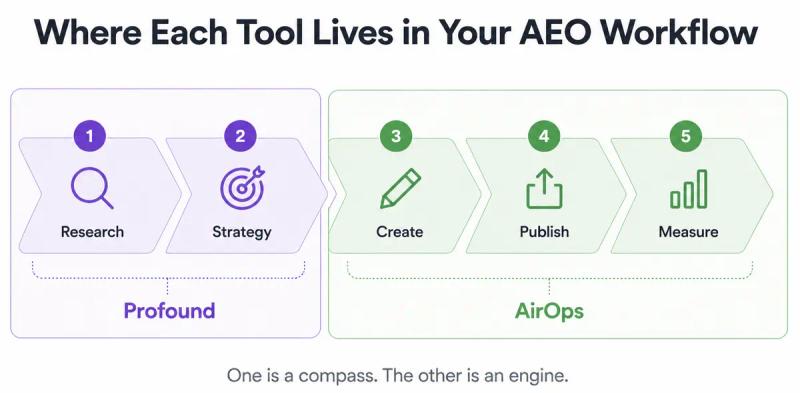
AirOps and Profound sit at opposite ends of the same workflow. AirOps is where
execution happens: you feed it a strategy, and it ships the content that gets you cited across ChatGPT, Perplexity, Gemini, and Google.
Profound is where strategy gets built: it shows you which topics have real AI search demand, how your brand appears in AI-generated answers, and where competitors are gaining ground before you've written anything
The practical difference matters more than it sounds. Ramp, which is listed as a customer of both platforms, achieved a 7x increase in AI visibility.
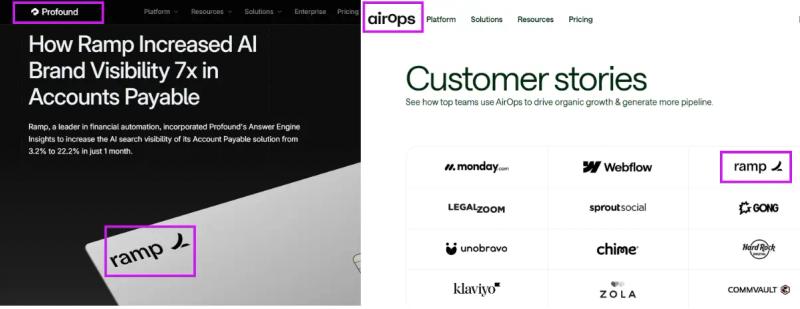
That result required both knowing where to invest and producing the content to back it up. Teams that buy only one and expect the other's output consistently underperform on at least one of those two dimensions.
So the clearest way to frame the choice: if your content calendar is full but your AI citations aren't moving, you have an execution problem and AirOps is built for that.
But if you're not sure which topics to prioritize or why your brand appears in some AI answers and not others, you have a strategy problem and that is Profound's core job.
AirOps vs Profound: Feature-by-Feature Comparison
Now let's look at every dimension that matters for your decision, starting with a quick reference table and then a breakdown of what the differences actually mean in practice.
| Feature | AirOps | Profound |
|---|---|---|
| AI Engine Coverage | ChatGPT, Google, Perplexity, AI Studio (Pro). Custom on Enterprise | ChatGPT, Perplexity, Claude, Gemini, Grok, Copilot, Meta AI, DeepSeek, Amazon Rufus, Google AI Overviews (10+ total) |
| Prompt Volume Data | Prompt gaps only, plan-gated | Full demand data from 400M+ real user queries. Unique in category |
| Answer Frequency | Daily | Daily |
| Visibility Tracking | Citation rate, mention rate, share of voice, sentiment, position | Visibility score, share of voice, sentiment, keyword themes, citation authority |
| Competitive Benchmarking | Yes | Yes, with platform-by-platform breakdown |
| Regions and Languages | Custom (Enterprise) | 150+ regions, 30+ languages |
| Content Creation | Power Agents, Grids, bulk pipelines | Agents producing one brief and draft at a time |
| CMS Publishing | Webflow, WordPress, Shopify, Contentful, Strapi, Sanity | None |
| SEO Tool Integrations | Semrush, Ahrefs, Moz, DataForSEO | None listed |
| Social and Community | Reddit, YouTube monitoring | No proactive alerts |
| Google Analytics Integration | GA4 via Page360 (owned performance) | Yes, connects AI crawler traffic to conversions |
| AI Bot Analytics | Cloudflare and Vercel CDN logs | GPTBot, PerplexityBot, ClaudeBot via server logs and CDN integrations |
| Brand Kit | Yes, up to unlimited on Enterprise | No dedicated brand kit |
| Knowledge Bases | Up to unlimited on Enterprise | Google Drive and Notion integrations |
| Data Export | CSV (API on Enterprise) | CSV |
| SOC 2 Type II | Yes (paid plans) | Yes (Enterprise tier) |
| SSO | Enterprise only | Yes (SAML and OIDC) |
| HIPAA Compliance | No | Yes |
| Pricing Entry Point | Free plan, paid tiers require sales call | $99/mo Starter, $399/mo Growth (published) |
| Free Trial | 14 days with 50,000 credits | Free AEO report, no paid trial |
| Shopping AI Visibility | No | Yes (ChatGPT Shopping tracking) |
AI Engine Coverage
AirOps covers 4 engines on its Pro plan: ChatGPT, Google, Perplexity, and AI Studio. Profound covers 10 or more including Amazon Rufus for shopping queries and DeepSeek at enterprise tier.
For most teams, four engines cover the bulk of their audience. Where the gap matters is for brands in retail, finance, or healthcare, where visibility on emerging platforms is already a business question, not a future one.
Prompt Volume Data
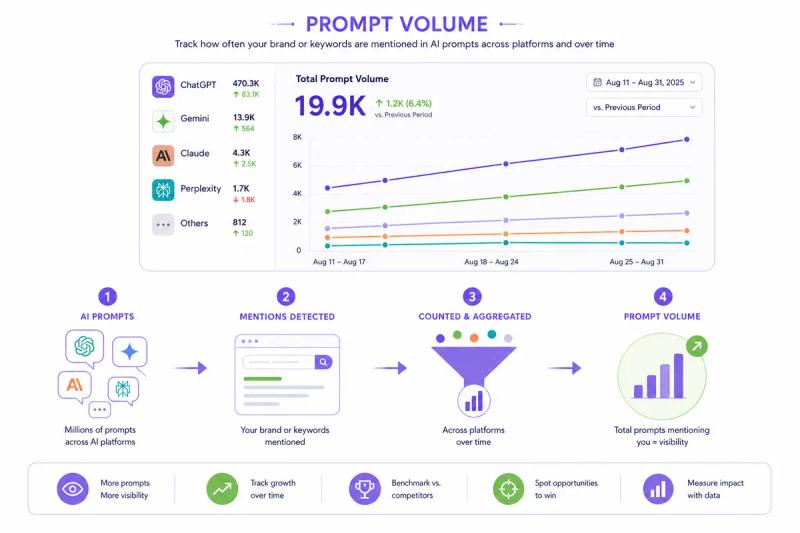
This is the single biggest functional gap between the two platforms and it deserves more than a table cell. AirOps surfaces prompt gaps, meaning queries where competitors appear and you don't.
Profound shows you total monthly query volume for topics across AI platforms before you decide whether to invest in them at all.
The first tells you where you're losing. The second tells you whether the fight is worth having in the first place. No other tool in the AEO category has this.
Visibility Tracking Depth
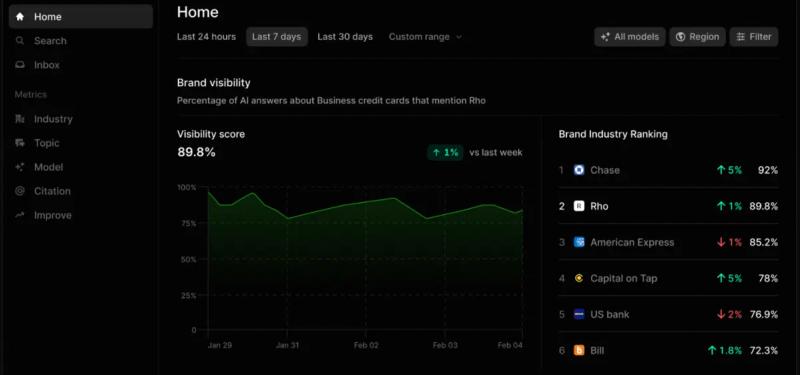
Both platforms track share of voice, citation rate, and sentiment. Profound goes further with keyword theme analysis, which shows the recurring narratives AI platforms build around your brand, and citation authority scoring, which shows which external domains are most influential in shaping how AI talks about you.
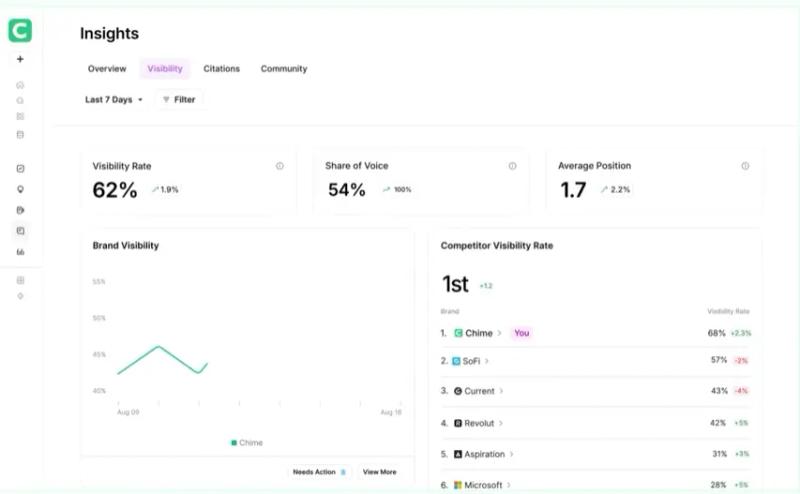
AirOps adds page-level performance through its Page360 feature, combining AI citation data with Search Console and GA4 traffic in a single view. That unified owned-performance layer is something Profound does not have in the same way.
Content Creation
AirOps has a genuine production infrastructure. Power Agents chain multiple research and writing steps into a single automated pipeline. Grids run those pipelines across dozens of topics simultaneously.
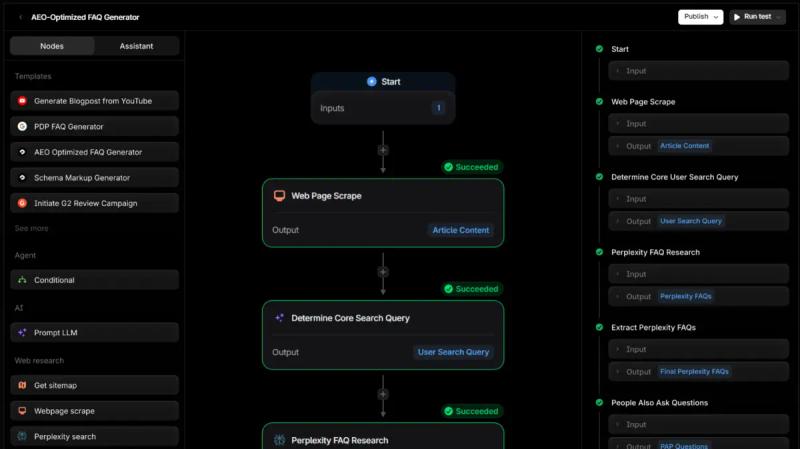
The result is that a team of 3 can produce the output a team of 10 used to require. Profound's Agents are strategically sharper, producing briefs grounded in what AI models are actively citing, but they run one piece at a time.
So, for teams publishing at volume, this gap is the deciding factor in the comparison.
CMS Publishing
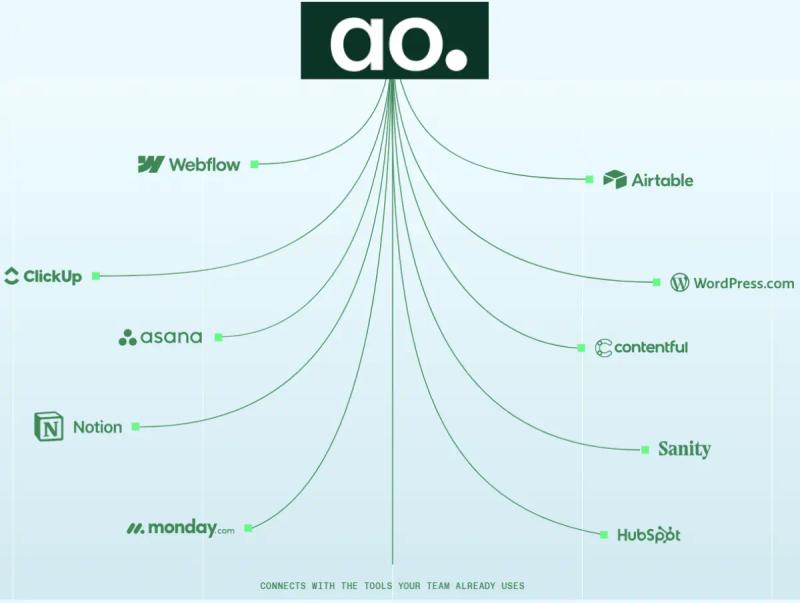
AirOps connects directly to Webflow, WordPress, Shopify, Contentful, Strapi, and Sanity. Content moves from generation to live page without a manual handoff.
Profound has no publishing integration. Every draft must be exported and handled separately. Over a month of publishing, the time difference compounds quickly.
SEO Tool Integrations
AirOps connects to Semrush, Ahrefs, Moz, and DataForSEO, which means your traditional keyword and backlink data feeds directly into your content workflows. Profound has no listed SEO tool integrations.
It focuses entirely on AI search signal. If you are running a combined SEO and AEO program, which most teams are, AirOps fits the existing toolstack more naturally.
Google Analytics and Bot Tracking
Both platforms connect AI crawler activity to human traffic outcomes, but in different ways.
AirOps does this through Page360, combining CDN logs from Cloudflare and Vercel with GA4 data at the page level.
Profound uses server log analysis to track GPTBot, PerplexityBot, and ClaudeBot behavior and then connects those crawl patterns to actual visitor conversions through its Google Analytics integration.
Profound's bot analytics layer is more granular on the intelligence side. AirOps' Page360 is more immediately actionable for content teams because it surfaces which specific pages need attention.
Security and Compliance
Both platforms hold SOC 2 Type II certification, though AirOps applies this across paid plans while Profound reserves it for Enterprise tier.
Profound additionally supports HIPAA compliance, which matters for any healthcare brand, and offers SSO via SAML and OIDC as a standard feature.
AirOps offers SSO on Enterprise only. If your procurement process requires compliance documentation upfront, Profound is the more straightforward path.
Pricing Transparency
Profound publishes its Starter at $99 per month and Growth at $399 per month openly on its pricing page. AirOps shows a free Insights plan but every paid tier, from Solo upward, requires a sales conversation.
You cannot build an internal business case for AirOps without talking to their team first, which adds friction for anyone evaluating on a deadline.
Shopping Visibility
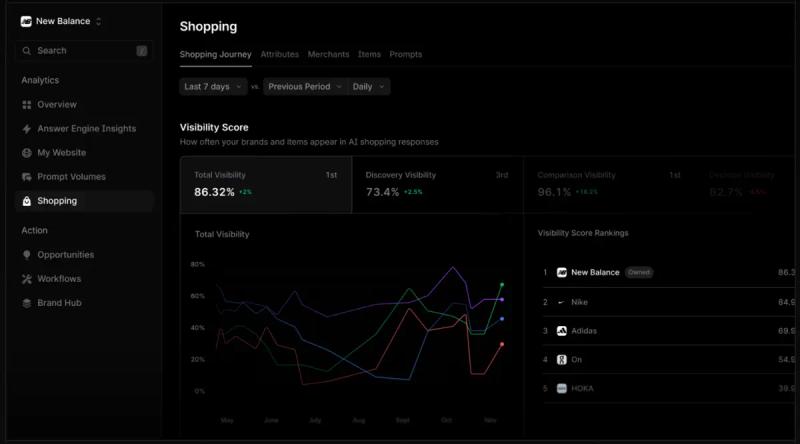
Profound tracks how products and brands appear inside ChatGPT Shopping responses. AirOps has no equivalent.
For e-commerce or SaaS brands with product-level visibility goals in AI shopping experiences, this is a meaningful gap in AirOps' coverage.
The Pricing Reality (What You Will Actually Pay)
Both platforms have a headline price and a real price. They are not the same number, and the gap between them is where most teams get caught out.
Profound Pricing
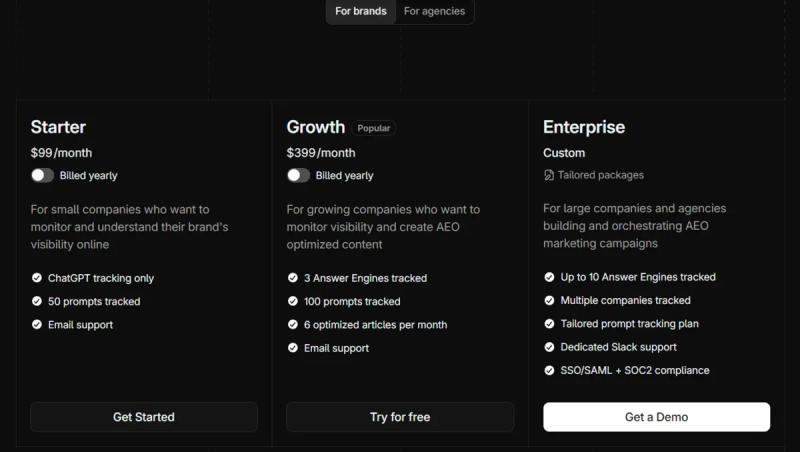
Profound publishes its pricing openly, which is worth noting before anything else. Three tiers, no sales call required to understand your costs.
The Starter plan is $99/month, or $82.50/month billed annually. It covers ChatGPT tracking only, 50 prompts tracked, and email support.
That is enough to understand how the platform works. It is not enough to run a real AEO program. Fifty prompts on a single platform gives you a surface-level read on your visibility, not the depth you need to make content investment decisions.
The Growth plan is $399/month, or $332.50/month billed annually, and this is where Profound becomes genuinely useful. You get three answer engines tracked, 100 prompts, and six optimized articles per month from Agents. This is the real entry price for anyone serious about AEO.
Enterprise is custom. It unlocks up to ten answer engines, multiple company tracking, tailored prompt plans, dedicated Slack support, and SSO plus SOC2 compliance.
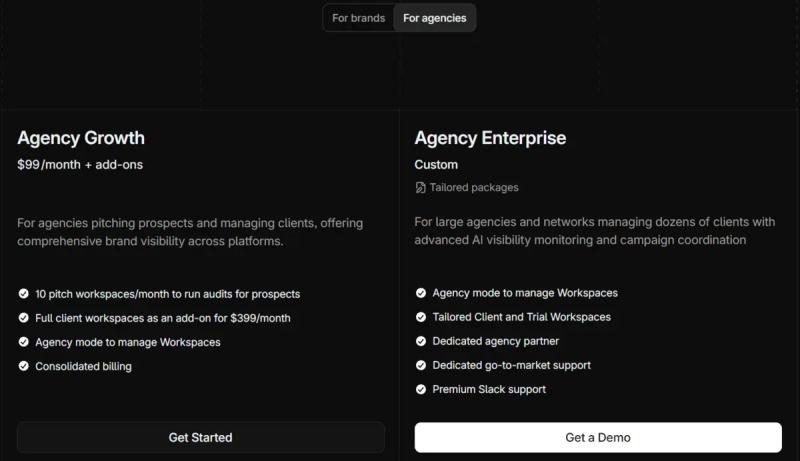
For agencies, Profound has a separate Agency Growth tier at $99 per month plus add-ons, which includes 10 pitch workspaces per month and the ability to add full client workspaces at $399 each. Agency Enterprise is custom for larger networks.
The honest read on Profound pricing: budget $399 per month as your starting point. The $99 Starter is a trial in all but name.
AirOps Pricing
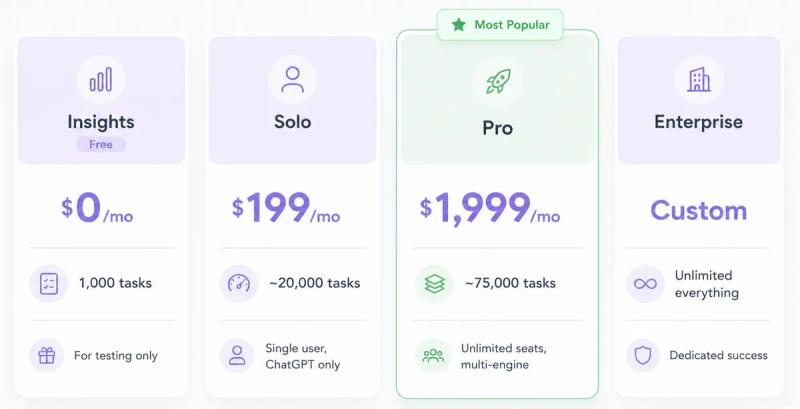
AirOps takes a different approach. The free Insights plan exists and gives you 1,000 tasks per month to explore the platform. Every paid tier beyond that requires a conversation with their sales team before you see a number.
Based on publicly available information, the Solo plan starts at around $199 per month and covers 100 tracked prompts and pages, ChatGPT insights only, 20,000 tasks for content production, one Brand Kit, and three Knowledge Bases.
The Pro plan starts at around $1,999 per month, which is a significant step up. It covers 250 tracked prompts and pages, multi-engine insights across ChatGPT, Google, Perplexity, and AI Studio, 75,000 tasks, and unlimited team seats.
Overage fees apply when you exceed your monthly task allocation. Solo plan overages run approximately $9 per 1,000 tasks. Pro plan overages run approximately $6 per 1,000 tasks.
For teams running bulk content pipelines through Grids, these costs can compound quickly if you are not monitoring usage actively.
The Pages plan, which adds the full content refresh and creation suite, is custom pricing requiring a sales call. Enterprise is also custom.
The honest take on AirOps pricing: the Solo plan at $199 is limited enough that most growing teams will quickly outgrow it, and the jump to Pro at $1,999 is steep. The inability to evaluate any paid tier cost without a sales conversation adds friction that Profound does not have.
| Profound | AirOps | |
|---|---|---|
| Entry price (published) | $99/month | Free only |
| Useful entry price | $399/month | ~$199/month (Solo) |
| Full functionality price | $399/month (Growth) | ~$1,999/month (Pro) |
| Annual billing discount | Yes (2 months free) | Not published |
| Overage fees | Not applicable | ~$6 to $9 per 1,000 tasks |
| Free trial | Free AEO report | 14 days with 50,000 credits |
| Pricing transparency | Full | Free plan only |
The decision here is not about which platform is cheaper. At the growth stage where AEO becomes a serious investment, both tools are significant budget line items. The question is which one closes the bottleneck that is costing you the most right now.
If your bottleneck is knowing what to create, $399 per month for Profound's Growth plan is a defensible spend.
So, if your bottleneck is producing content at speed and scale, AirOps Pro at $1,999 per month needs to justify itself through measurable output gains. For most teams, it does, but only if the content strategy feeding it is already clear.
Profound AI vs AirOps: The scenario that determines your choice
Now it’s time to decide which platform fits your business best, or whether a hybrid strategy makes more sense based on your current stage, goals, and organic marketing priorities for generating qualified inbound leads.
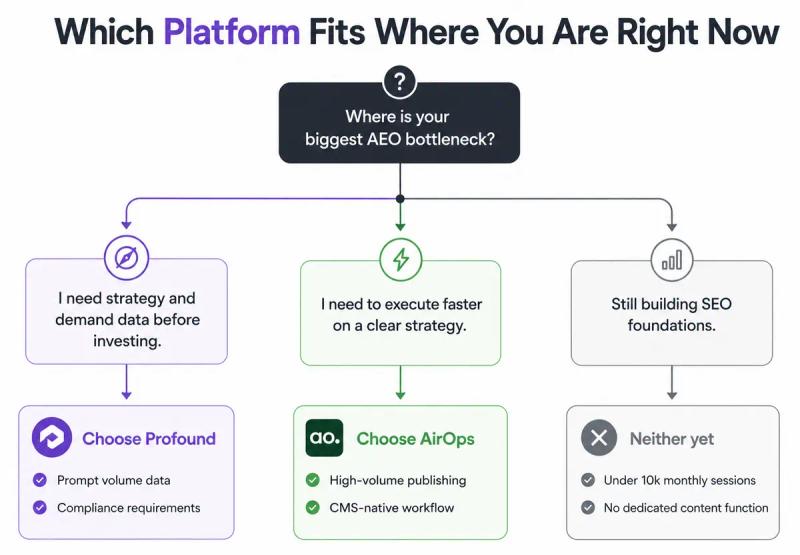
Choose AirOps If You Need Better Content Operations
There is a specific moment when AirOps becomes the obvious choice. Your content strategy is clear. You know which topics to target. You have a team that understands AEO. But the output is too slow, the refreshes are piling up, and competitors are outpacing you on volume.
That is exactly the problem AirOps is built for. Webflow grew AI-attributed signups from 2% to over 10% in under a year without adding headcount. Chime tripled its AI search citations in four weeks.
Neither of those results came from discovering a new strategy inside AirOps. They came from executing a known strategy faster than a human team could manage manually.
So, AirOps is the right call:
- If your team publishes to Webflow, WordPress, or Shopify and currently loses hours moving content from draft to live.
- You are running 25 or more pieces per month and the team itself is the bottleneck.
- When you need the content production to match the ambition of the strategy you already have.
Choose Profound If Your Team Needs Better Strategic Clarity
The situation Profound solves is different. You are about to invest 3 to 6 months of budget and team time into AEO content, but you are not fully confident you are targeting the right topics.
Or you are responsible for reporting AI share of voice to a CMO or a client, and you need numbers that hold up in a board meeting.
Profound's prompt volume data answers the question that no other AEO tool can answer right now: how many people are actually asking AI platforms about this topic every month?
That single data point changes how you plan content. Knowing a topic drives 40,000 real monthly queries on ChatGPT versus 200 is the difference between a content investment and a content gamble.
Add to that the compliance requirements. If your procurement process requires SOC 2, SSO, or HIPAA sign-off before a vendor touches your data, Profound is the best platform in this comparison that meets those requirements without jumping straight to custom enterprise pricing.
Consider Neither If You are Still Building the Foundation
This is the scenario both platforms quietly avoid in their marketing. Your business is growing. AEO is on your radar. You understand it matters.
But your organic traffic is still under 10,000 monthly sessions, your content team is 1 or 2 people, and the $400 to $2,000 per month commitment gives you pause.
That hesitation is well-founded. Both platforms assume you already have a content engine running. AEO compounds on top of existing search authority. Without that base in place, both tools will surface gaps you do not yet have the infrastructure to close.
The better investment at that stage is in the fundamentals: topical authority, consistent publishing, and a clear content strategy.
So build that foundation first with a more affordable, all-in-one platform like RankSaver. It helps brands move from strategy to execution by tracking, planning, creating, and optimizing content across your own websites and community-driven platforms like Reddit, LinkedIn, and Medium.
It also makes the transition from execution tools to advanced intelligence platforms far more practical and worth the investment.
Profound and AirOps Limitations
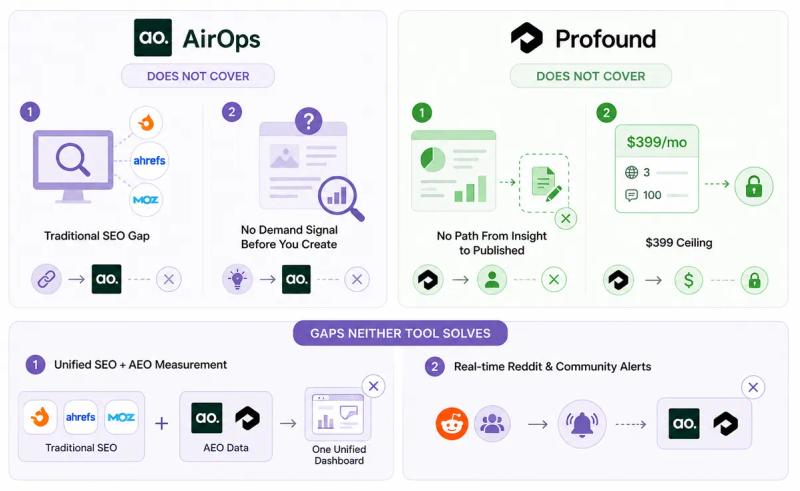
No AEO platform in 2026 does everything well. Understanding where each tool stops is as useful as knowing what it does, especially if you are about to commit serious budget to one of them.
What AirOps Does Not Cover
1. The Traditional SEO Gap: AirOps integrates with Semrush, Ahrefs, and Moz, but it uses those tools as data inputs, not as a replacement for a dedicated SEO workflow.
So if you are running a combined SEO and AEO program menas AI SEO, which most growth-stage teams are, you still need a separate subscription and a separate workflow for keyword research, backlink analysis, and technical audits. AirOps does not close that loop.
It assumes your traditional SEO foundation is already solid and builds the AEO execution layer on top of it.
2. No Demand Signal Before You Create: AirOps shows you where you are losing in AI search. It surfaces gaps, declining citations, and underperforming pages.
What it cannot tell you is whether a topic has meaningful AI search demand in the first place. You are making content investment decisions based on competitive gaps rather than actual user query volume.
So, for teams that are workable and about to invest heavily in a new content vertical, it is a meaningful blind spot.
What Profound Does Not Cover
1. No Path From Insight to Published: Profound's biggest limitation is the distance between its intelligence and any actual output. The platform will tell you precisely which topics have demand, which competitors are winning citations, and which content gaps exist in your category.
Then the execution falls entirely to you. There is no bulk production pipeline, no CMS integration, and no way to go from Profound's Opportunities panel to a published article without switching tools entirely.
2. The $399 Ceiling: The Growth plan at $399/mo covers 3 answer engines and 100 prompts. For a brand competing across multiple product lines or markets, 100 prompts is a tight constraint.
Meaningful multi-platform coverage with the depth Profound's dashboard promises requires Enterprise pricing, which means a sales conversation and a budget conversation before you see what that actually costs.
What Neither Tool Solves
Both platforms leave two gaps that the AEO category has not fully addressed yet.
The first is unified SEO and AEO measurement in a single workflow. You still need Ahrefs or Semrush running alongside either platform to get the full picture of organic performance.
No tool currently combines traditional search authority signals with AI citation tracking in one coherent dashboard.
The second is real-time Reddit and community monitoring with proactive alerts. Both tools surface community opportunities reactively.
Neither sends you an alert when a high-traffic Reddit thread about your category starts gaining traction right now, which is the signal that often matters most for AEO because AI models weight community discussions heavily as citation sources.
But these are not reasons to avoid either platform. They are reasons to go in with clear expectations about what you will still need to handle elsewhere.
AirOps vs Profound: Final Verdict
AirOps and Profound are both serious platforms built for a real problem. AI search is reshaping how buyers discover brands, and teams that figure out how to show up in those answers early will compound that advantage over time. Both tools are worth the investment at the right stage.
Profound is where you go when the question is what to build. It gives you the demand signal, the competitive intelligence, and the compliance infrastructure to make content investment decisions with confidence rather than instinct.
AirOps is where you go when the question is how to build it faster. It takes a clear strategy and turns it into published content at a pace and volume no manually operated team can match.
Most mature content teams like Ramp, as I mentioned earlier, will eventually need both. The sequencing matters more than the choice. Get the intelligence right first, then build the execution engine on top of it.
Frequently Asked Questions
Everything you need to know about this topic.
Yes, and several enterprise teams do so, such as Ramp. Profound handles demand research and visibility monitoring while AirOps handles content production and publishing at scale. The two platforms sit at different points in the same workflow, so they complement rather than duplicate each other.
AirOps delivers the most value for teams already publishing at volume with a clear content strategy. For a team of one or two still building that foundation, the Pro plan at approximately $1,999 per month is difficult to justify until output volume and content strategy are both in place.
Profound runs every tracked prompt daily across all monitored platforms. Since AI platforms do not return identical answers on every query, daily runs give you an averaged visibility score that reflects your true presence rather than a single snapshot. This refresh frequency is consistent across Starter, Growth, and Enterprise plans.
Power Agents are individual multi-step workflows you build in a visual node editor. Each agent handles one content task end to end, from research to draft. Grids take that same workflow and run it across dozens of topics simultaneously in a single batch. Think of Power Agents as the pipeline and Grids as the system that runs that pipeline at scale.
rofound's Starter plan at $99/mo is technically accessible for individuals, but the platform is designed around brand monitoring at scale. Solo consultants or personal brands with a narrow topic focus and limited publishing output will find the prompt limits and single-platform coverage of the Starter plan restrictive quickly. A lighter-weight AEO tracking tool is likely a better fit at that stage.
Written By
Want help getting your brand ranked on Google and cited by AI?
We help businesses build AI visibility through SEO, content, and authority with clear revenue impact.
Book a Strategy Call