
Most SEO teams still build pillar pages and topic clusters the same way - optimize for Google Search, interlink content, and aim for rankings.
That still works, but it’s no longer enough. Platforms like ChatGPT, Perplexity AI, and Claude now decide which brands get cited directly in answers.
That changes how content wins. Your strategy needs entity SEO, tight keyword clusters, and structure built for AI to scan, understand, and summarize.
In this guide, I show you how to build topic clusters and pillar pages that work across SEO, AEO, and GEO - so your content gets found when buyers search in your space and drive qualified inbound leads.
What is Topic Cluster?
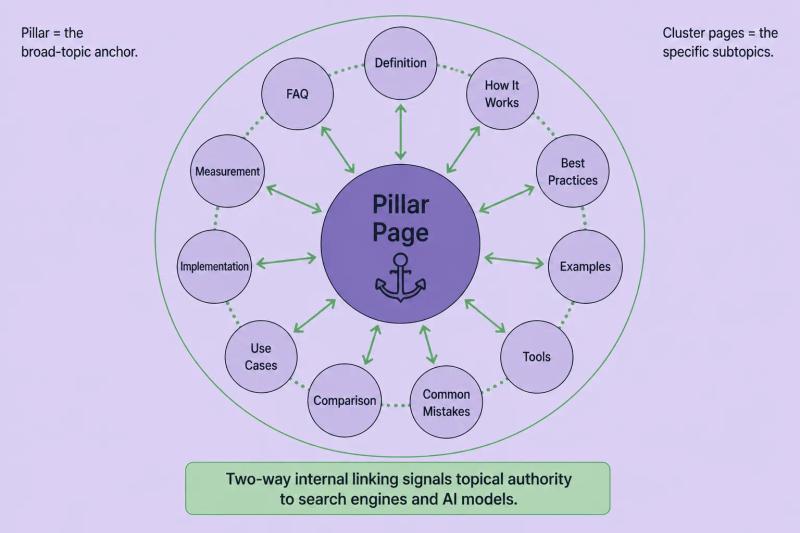
A topic cluster is a content architecture that groups one comprehensive pillar page with eight to fifteen supporting cluster pages, all connected through internal links. The pillar covers a broad topic, the cluster pages cover specific subtopics, and the internal linking signals topical authority to search engines and AI models alike.
The structure works because it mirrors how machines actually understand a subject. A single page can earn a ranking. A connected cluster earns recognition, the kind that pulls every page in the system upward as soon as one of them performs well.
A cluster page ranks, the pillar gains link equity, the next cluster page ranks faster, and the cluster compounds.
That compounding is exactly what AI search engines look for when they decide who deserves to be cited as a source.
What is Pillar Page?
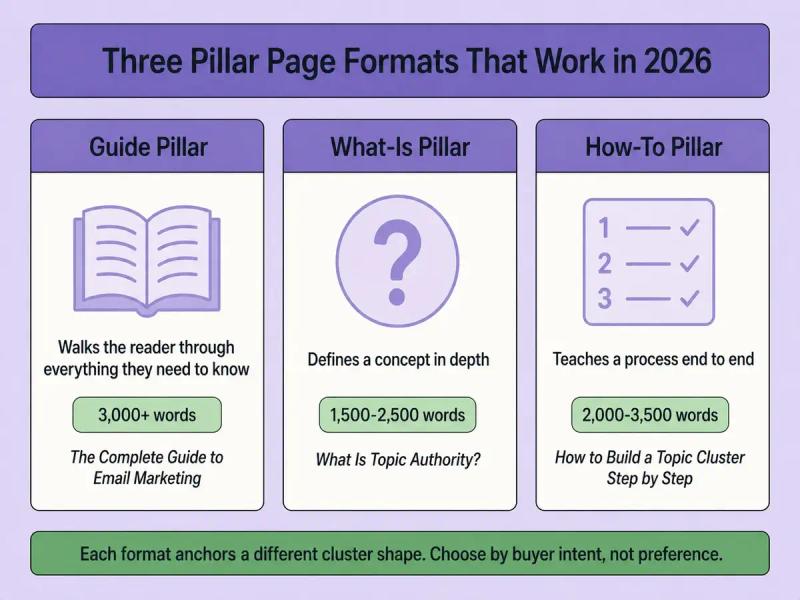
A pillar page is a single comprehensive page that anchors a topic cluster by covering one broad topic in depth. It links out to every cluster page and receives links back from each of them, which makes it both the topical authority signal for search engines and the citable source for AI engines answering broad queries.
Pillar pages come in three working shapes. A guide pillar walks the reader through everything they need to know about a topic, often 3,000 words or more.
A what-is pillar defines a concept in depth, suited to industries where definitions still drive search demand. A how-to pillar teaches a process end to end, with cluster pages going deep on individual steps.
So, if you built for both extraction and depth, it uses a clear answer-first opener for AI engines, stacked on top of long-form coverage that earns head-term rankings.
Why Pillar Pages and Topic Clusters Matter in 2026
Three forces have changed the math.
1. The way Google now reads a domain, and pages get judged inside a topical context. HireGrowth's 2025 analysis comparing clustered content against standalone pieces found that content grouped into clusters drives roughly 30% more organic traffic and holds rankings 2.5 times longer than the same content sitting alone.
The pillar earns the head term, the cluster pages earn the long tail, and the internal linking system pulls every page in the cluster upward as soon as one of them performs.
2. The new layer of AI search engines decides which brands get cited and which get reasoned around. ChatGPT, Perplexity, Gemini, AI Overviews, and Claude reward sources that look comprehensive and machine-readable.
Yext's October 2025 analysis of 6.8 million AI citations across ChatGPT, Gemini, and Perplexity found that 86% of those citations came from sources brands already control, with first-party websites alone accounting for 44%.
So, if your topic is fragmented across one or two thin pages, the AI has nothing to cite. But if it sits inside a tight cluster, the AI has a substrate to reason from.
3. The third force is more cultural than technical. The "one page, one keyword" playbook collapsed when search engines got better at understanding entities.
Modern engines expect a brand to own a topic, not rent it through one optimized URL. A pillar page on its own can rent. A pillar plus its cluster owns.
How Pillar Pages and Topic Clusters Work Together
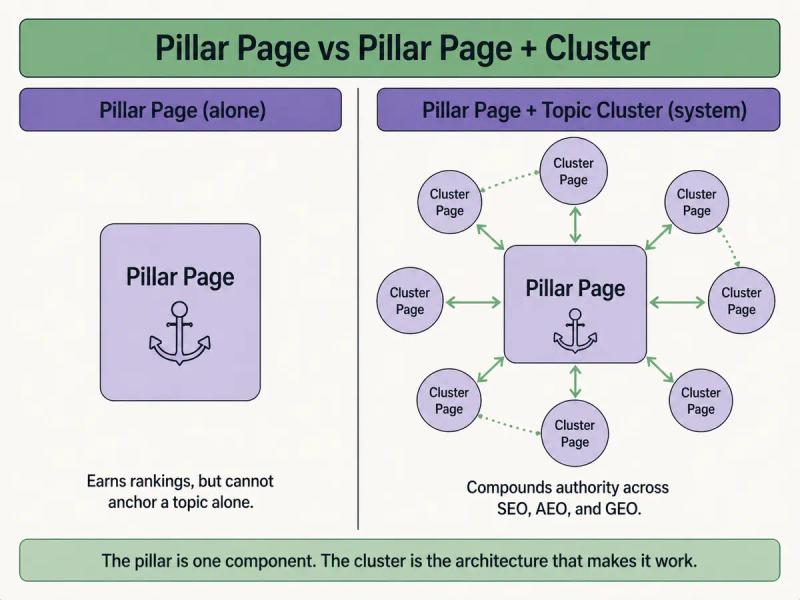
A pillar page on its own is a single document. A pillar wired to its cluster is a system. The difference shows up in three places, each rewarding the architecture for a different reason.
The SEO layer
The pillar earns the head term and the backlinks. The cluster pages earn the long-tail queries the pillar can't fully serve.
The internal linking layer binds them together, when a cluster page gains traction, link equity flows back to the pillar through the in-body link, and when the pillar ranks, it pushes a slice of that authority out to every cluster page it links to.
That two-way movement is what kills cannibalization. The pillar owns the broad query, each cluster page owns its sub-query, and Google sees a clean topical map instead of pages competing for the same intent.
The AEO layer
AI engines do not pick sources the way Google does. They synthesize, choosing fragments from multiple sources to construct an answer. The pillar gives them a citable anchor for broad queries, the cluster pages give them precise extractable answers for narrow ones.
Yext's research on how each major engine actually decides what to cite found that Gemini favors first-party brand websites, ChatGPT pulls heavily from third-party directories and consensus sources, and Perplexity rewards industry-specific authority. A wired cluster hits all three behaviors at once. A standalone page hits one.
The GEO layer
Generative engines go a step further, they reason from your content as raw material for an answer they construct on the fly. AI Overviews and AI Mode break a single query into roughly twelve to fifteen sub-questions before assembling a response.
A pillar plus its cluster naturally addresses that fan-out, the pillar answers the parent question, the cluster pages answer the sub-questions. A standalone page can only answer one slice.
So, owning the cluster makes you the substrate. And renting the keyword makes you a footnote.
How to Build a Topic Cluster: Step-by-Step
Now let's see how you can build a topic cluster in simple 6 steps.
1: Pick a topic that matches your business
Most cluster guides tell you to chase high search volume with manageable competition. That produces clusters that rank without converting.
The practitioner shortcut is sharper, pick the topic where you would lose deals if a competitor owned the AI answer. Remember, search volume is a secondary filter.
2: Map the entity, not just the keyword
Keyword research gives you phrases. Entity mapping gives you concepts, the people, frameworks, and ideas that orbit your parent topic in the way AI engines reason about it.
For a parent like "Laravel development," the orbiting entities include PHP, Symfony, Composer, MVC, Eloquent, queue management, hosting, and agency selection. So, build that map first, it will tell you what to write in a way a keyword tool never can.
3: Identify the pillar and the cluster page topics
The pillar is the broadest version of the topic that still maps to one buyer question. To find the cluster pages, run seed prompts in ChatGPT and Perplexity and collect the follow-ups, scan Reddit and Quora for poorly answered questions, then reverse-engineer the AI Overviews already showing for your seed term.
Combine those three with keyword research and the cluster page list shapes itself. For the keyword overlap and SERP-grouping side of this work, see how keyword clustering organizes raw keyword data into page-level groupings.
4: Plan the page-level intent for each cluster page
A cluster only works if the spokes hit different intents. AI engines pull from different page types for different prompts, so a cluster of ten "what is X" pages gets ignored for everything outside that one query family.
| Cluster page intent | Best format | Example query |
|---|---|---|
| Informational | Explainer guide | "What is a topic cluster" |
| Commercial | Comparison or buying guide | "Best topic cluster tools" |
| How-to | Step-by-step tutorial | "How to build a topic cluster" |
| Troubleshooting | Q&A or fix-it guide | "Why my topic cluster isn't ranking" |
| Comparison | Versus or alternative page | "Pillar page vs topic cluster" |
5: Write each page answer-first, with schema and entities baked in
Every page opens with a 40 to 60 word direct answer to its primary question, written so it can be lifted out of context and still make sense.
Below that, go deep with citable statistics linked to their sources, entity-rich body content that names related concepts, and question-style H2s where they fit.
Pillars get Article schema, FAQ blocks get FAQPage schema, tutorial spokes get HowTo schema.
6: Wire the cluster
Every cluster page links up to the pillar from inside the article body, with varied anchor text that describes the linked page. The pillar links down to every spoke, inside the relevant section rather than a list at the end.
Related cluster pages cross-link where the topics genuinely overlap. Run a crawl after launch, if any spoke is more than two clicks from the pillar, the architecture is broken.
Pillar Page Best Practices for 2026
A pillar page that ranks in 2018 is not the same shape as one that earns AI citations in 2026. The rules below come from working clusters that actually compound instead of generic content audits. So...
1. Build the page deep enough to anchor the cluster
The most common pillar failure is undercommitting to depth. Industry benchmarks across multiple 2026 word-count studies put the working range for a guide-style pillar at 2,500 to 4,000 words.
What matters is the depth ratio. If your cluster pages average 1,800 words and the pillar lands at 1,200, the architecture reads upside-down to both Google and AI engines.
2. Engineer the page for both extraction and exploration
The opening of a pillar serves two readers at once, the AI engine looking for an extractable answer and the human looking for orientation. Lead with the extractable answer, then orient the human.
A sticky table of contents with jump links is non-negotiable, AI parsers use the structure to map the page, humans use it to skim.
3. Place the pillar high in the site architecture
A pillar buried three clicks from the home page leaks crawl budget and authority. The working rule is one click from a primary navigation item. Pillars that live only inside dated blog archives never accumulate the authority their depth deserves.
4. Vary the anchor text on every incoming internal link
If every cluster page links back to the pillar with identical anchor text, the pattern flags as manipulated. The working rule is simple, no two cluster pages should use the same anchor when pointing at the pillar.
One uses the head term, another uses a question-style variation, a third uses a partial-match phrase naming the specific section it points to.
5. Refresh the pillar quarterly
Generative engines drop stale sources faster than Google does, because freshness is a citation logic signal.
Quarterly refresh means updating outdated stats, adding sections that address questions buyers have started asking since launch, and replacing aged examples. Date the refresh in the metadata so the freshness is machine-readable.
How to Use AI to Build Pillar Pages and Topic Clusters Faster
Most teams using AI for cluster work make one of two mistakes. They use AI as a writer, generating pages at scale that AEO actively penalizes for lookalike content. Or they use AI as a glorified keyword tool.
The interesting work sits between those two failure modes. AI is at its best as a strategist and an editor. The four workflows below treat it that way.
1. Surface the questions buyers actually ask
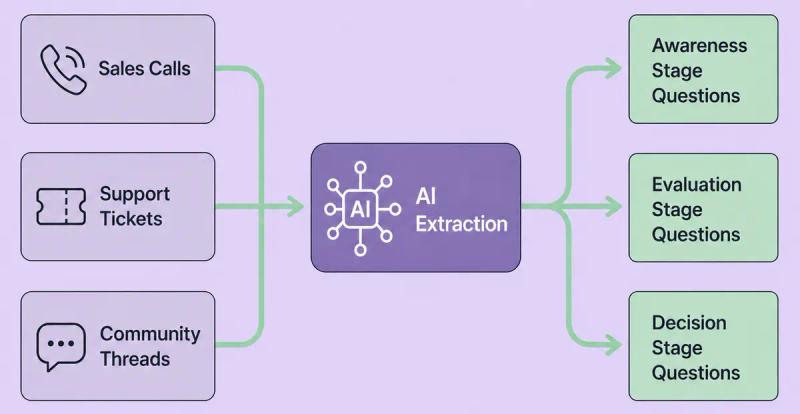
Keyword tools show what people search, not what they want answered. Feed sales transcripts, support tickets, and community threads into Claude or ChatGPT and ask it to extract the recurring questions, grouped by evaluation stage. That output gives you cluster page candidates no keyword tool will ever surface.
2. Audit your existing cluster, do not let AI build a new one
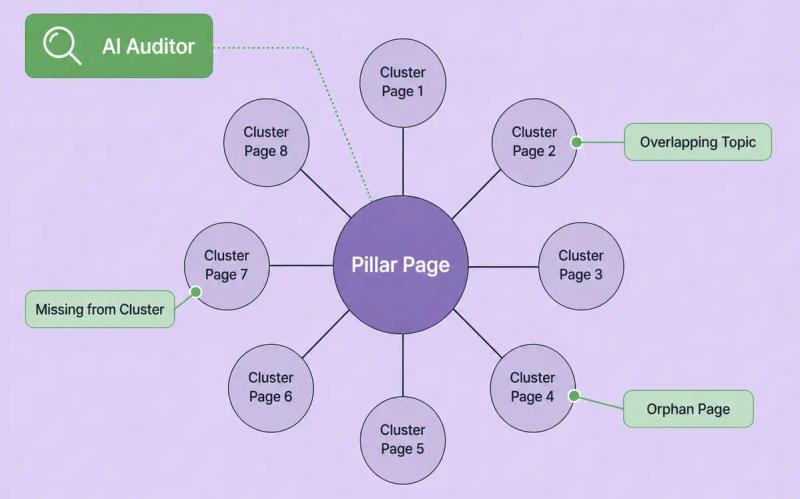
The strongest use of AI in cluster work is diagnosis, not generation. Feed Claude your sitemap with a one-line description per page and ask it to flag overlapping pages, missing pages, and topic-pillar duplication.
This catches cannibalization, gaps, and orphans faster than most automated SEO tools.
3. Test how your cluster reads to other AI engines
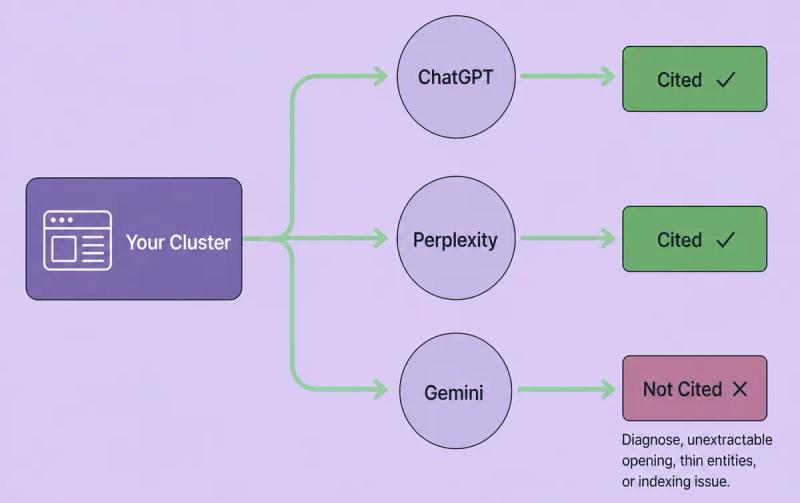
Once the cluster is live, run its target questions through ChatGPT, Perplexity, and Gemini directly.
If you are not cited, the problem is one of three things, an unextractable opening, thin entity coverage, or an indexing issue blocking the retrieval layer. AI is the only practical way to run this test at scale.
4. What to avoid
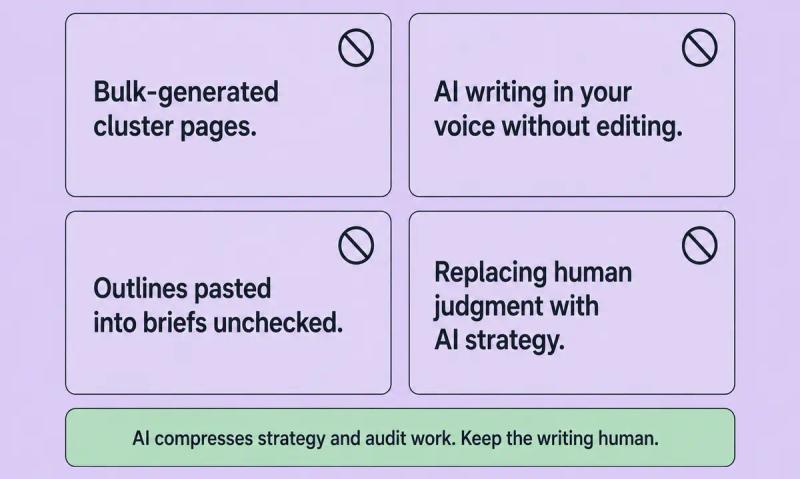
Do not generate cluster pages in bulk; let AI write entire articles in your voice without heavy editing. And, do not paste an AI's recommended outline into a brief without checking the SERP and AI Overviews. Remember, the signal that gets a brand cited is the human work AI cannot replace.
Topic Cluster Examples and Pillar Page Examples
The architecture matters more than the surface design. Below are four cluster shapes that earn rankings and AI citations, each one solving a different business problem. The infographics show how the pillar and cluster pages connect, the prose names the move that makes each shape work.
A SaaS pillar with comprehensive informational architecture
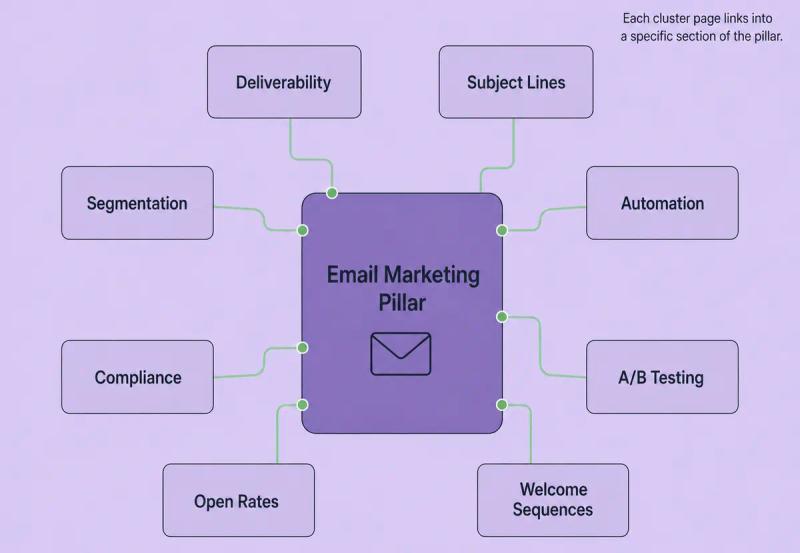
HubSpot's email marketing cluster is the most visible working example. The pillar covers every fundamental question about email marketing in one long-form hub, and roughly a dozen cluster pages handle specific subtopics, deliverability, subject lines, segmentation, automation, compliance.
The move that makes it work, every cluster page links into a specific section of the pillar rather than just the top, so internal authority distributes across sections instead of pooling at the H1.
An ecommerce pillar with intent-mixed architecture
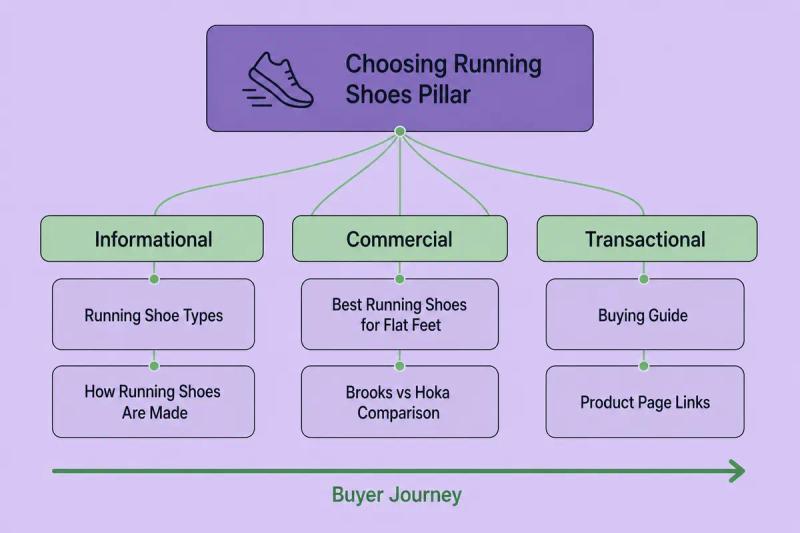
The strongest ecommerce clusters mix informational and commercial intent in the same cluster, so the pillar earns the head term while cluster pages capture both research-stage queries and buying-stage queries.
A retailer covering "running shoes" might build a guide pillar on choosing running shoes, with cluster pages on running shoe types (informational), best running shoes for flat feet (commercial), Brooks vs Hoka comparison (commercial), and a buying-guide spoke that links directly to product pages (transactional).
In short, the cluster covers the entire buyer journey under a single topical roof.
A B2B services pillar where the service page is the hub
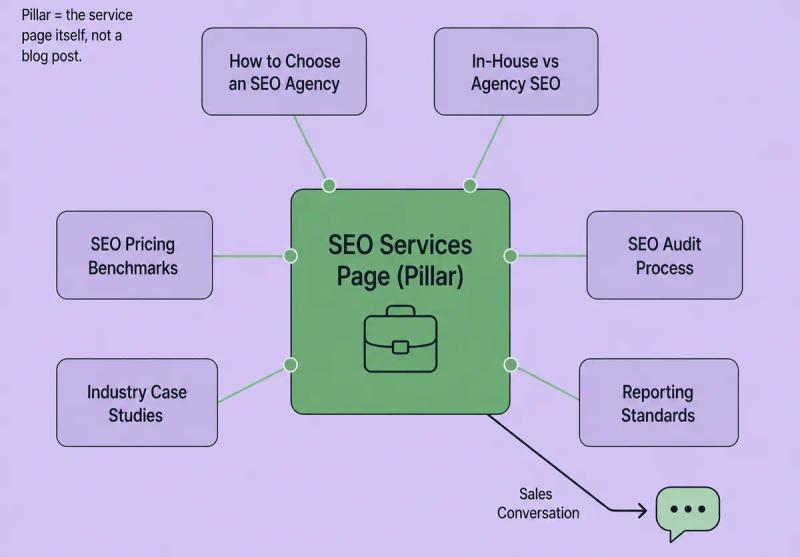
For service businesses, the pillar is not always a blog post. The most effective B2B clusters use the service page itself as the hub, with cluster pages handling objections, comparisons, pricing questions, and case studies.
An SEO agency might build the pillar as the SEO services page, with cluster pages on agency selection criteria, in-house vs agency, pricing benchmarks, and industry-specific case studies.
The move that makes it work, the cluster pages exist to walk a prospect from awareness to a sales conversation, not to rank for vanity terms.
A pillar plus cluster engineered for AI citations
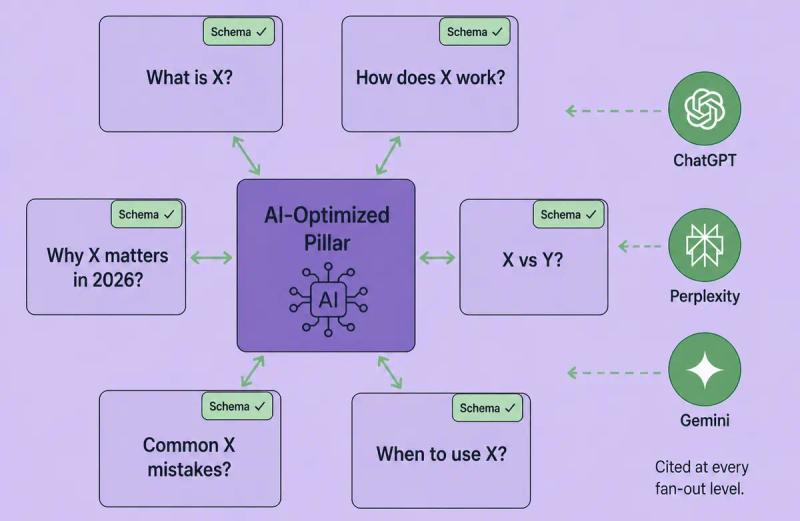
The newest cluster shape is built specifically for AI engine pickup. The pillar leads with an extractable answer, every cluster page leads with an extractable answer, every page carries entity-rich body content and the right schema, and the cluster covers a topic with enough question-style depth that AI Overviews and Perplexity have something to cite at every fan-out level.
The move that makes it work, every page is engineered to be cited even if no human ever clicks through.
Common Mistakes That Quietly Kill Pillar Pages and Topic Clusters
Most clusters underperform quietly, ranking for a few terms but never compounding. The five mistakes below show up in almost every audit.
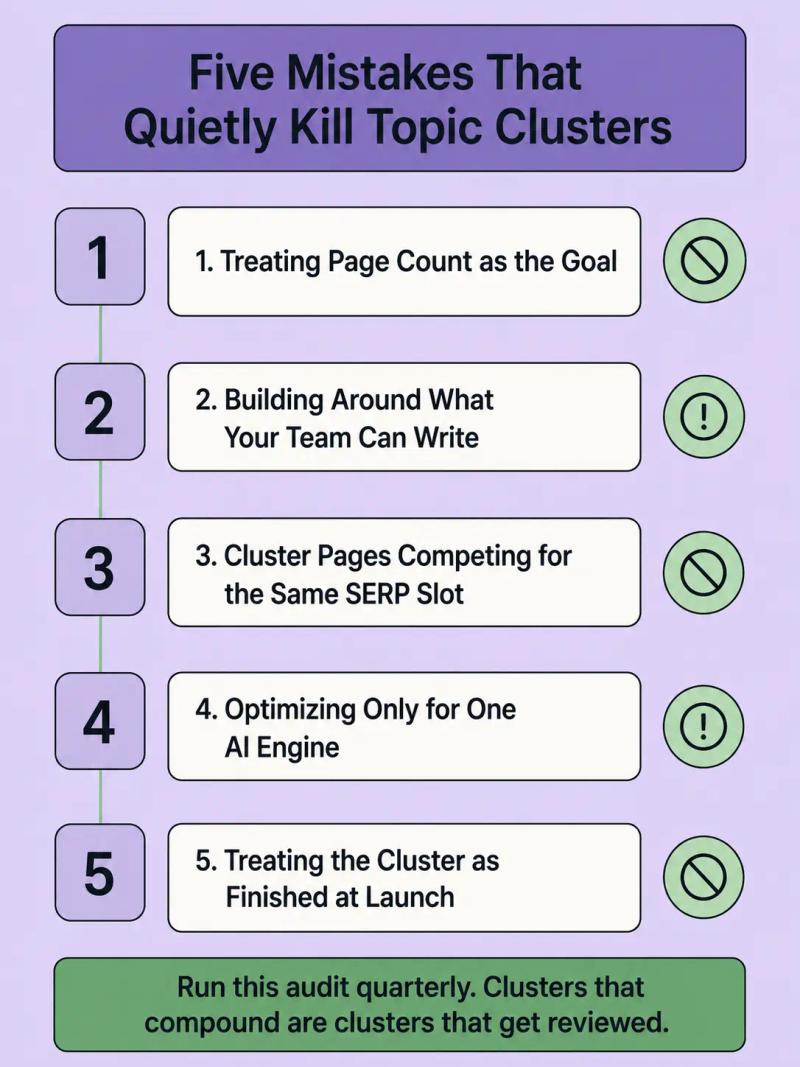
1. Treating cluster page count as the goal
A cluster with eight tightly scoped pages outperforms one with twenty thin pages every time. AI engines reward coverage, not volume, and Google's December 2025 helpful content update penalized thin pages directly.
So, measure whether the cluster covers every reasonable sub-question, not how many URLs sit under the topic.
2. Building the cluster around what your team can write
The team writes about what the team knows, and the cluster ends up reading like a content portfolio instead of an answer engine.
The fix is uncomfortable, build the cluster around the questions that matter to buyers, then figure out how to write them, even if it means interviewing your own engineers or hiring a subject matter expert.
3. Letting cluster pages compete for the same SERP slot
Two cluster pages can drift toward the same query family over time, and internal linking cannot fix it.
So, run a quarterly check in incognito mode. If two of your pages show up for the same query, one is bleeding the other.
4. Optimizing only for one AI engine and assuming the rest follow
A cluster cited in ChatGPT will not automatically get cited in Perplexity or Gemini. Each engine pulls from different source types and weighs different signals.
Run your target queries through all three and audit where you appear and where you do not.
5. Treating the cluster as finished at launch
Buyer questions evolve, retrieval logic changes, competitors publish. The clusters that compound get a structured review every quarter. The clusters that go live and sit untouched lose ground without the team noticing.
Closing
Pillar pages and topic clusters used to be an SEO tactic. but in 2026, they are the architecture that decides whether AI engines mention your brand or pretend it does not exist.
The teams winning right now are not the ones publishing more, they are the ones publishing connected, building entity coverage that compounds, and treating their clusters as living systems instead of finished projects.
Pick one topic where being the cited answer would change your business. Build the cluster around it. Then build the next one.
Frequently Asked Questions
Everything you need to know about this topic.
A pillar page is a single document. A topic cluster is the entire connected system, the pillar plus its supporting cluster pages plus the internal linking that ties them together. The pillar is one component of the cluster, the cluster is the architecture that makes the pillar work. You build the pillar to anchor the cluster, you build the cluster to amplify the pillar.
A topic cluster is a content architecture, multiple pages connected by internal links and topical relationships. A keyword cluster is a SERP-overlap grouping that maps related search terms to a single page. Keyword clustering happens during research and tells you which keywords share a SERP. Topic clustering happens during architecture and tells you which pages share a topic.
A working cluster typically holds eight to fifteen cluster pages around one pillar. Below eight, the cluster lacks the entity coverage AI engines reward. Above fifteen, individual pages start to compete with each other for similar query families. The right number is whatever covers every reasonable sub-question a buyer would ask, not a fixed target.
AI tools can generate the entity map, surface unanswered questions, audit existing clusters for gaps, and test how a cluster reads to other AI engines. They should not write the cluster pages themselves, AEO penalizes AI-generated lookalike content. The strongest workflow uses AI as a strategist and editor, not a writer.
Yes, more than they help with classic SEO. AI engines synthesize answers from comprehensive sources with extractable fragments, which is exactly what a wired cluster provides. The pillar gives the AI a citable anchor for broad queries, the cluster pages give it precise answers for narrow ones. A standalone page can rarely deliver both.
Initial ranking signals usually appear within sixty to ninety days of publishing the full cluster. Meaningful traffic compounds at six to twelve months as internal links mature, AI engines re-index the architecture, and the pillar accumulates backlinks. Clusters that get quarterly maintenance hold rankings two to three times longer than abandoned ones.
Three layers of measurement matter. SEO, keyword breadth across the cluster and share of voice for the parent topic. AEO, citation rate in ChatGPT, Perplexity, and Gemini for cluster keywords. GEO, entity association strength and citation diversity across cluster pages. Track all three, not just organic traffic.
Standalone pages outperform blog-located pillars in almost every case. Blog URLs signal "article" to crawlers, standalone URLs signal "resource." Place the pillar one click from the home page or primary navigation, ideally at a clean URL like yoursite.com/topic-name rather than yoursite.com/blog/topic-name. The architecture rewards prominence.
Pillar pages use Article schema with full author and Organization markup. FAQ blocks on any page use FAQPage schema. Tutorial-format cluster pages use HowTo schema. Comparison pages can use ItemList schema. Consistent author bylines and Organization schema across every page in the cluster reinforce the topical authority signal.
Written By
Want help getting your brand ranked on Google and cited by AI?
We help businesses build AI visibility through SEO, content, and authority with clear revenue impact.
Book a Strategy Call