
Scrunch AI works well for teams that need enterprise-grade AI visibility monitoring with an Agent Experience Platform layer.
But it is less suitable if your priority is faster onboarding, lower entry cost, deeper execution, or data retention beyond 90 days. This is where Scrunch AI alternatives come in.
In this guide, I break down the most relevant Scrunch AI competitors, with verified pricing, core strengths, and the trade-offs each tool makes, so you can choose based on your actual workflow.
Best Scrunch AI Alternatives: A Quick Comparison
I've tested all 11 of these across client projects at RankSaver. Some stuck in the stack for months. Others got uninstalled inside a week.
The table below is the short version — what each tool does, how it captures data, what it costs as of April 2026, and whether you can try it before you pay.
| Tool | Best for | Data method | Starting price | Free trial |
|---|---|---|---|---|
| Profound | Consumer-view citation accuracy | UI capture + server-side | $99/mo | Contact sales |
| AthenaHQ | GEO-specific metrics (ACE/QVEM) | API + proprietary models | $95/mo | Free tier available |
| Peec AI | Authentic UI-scraped data | Browser automation | €89/mo | 14-day, no credit card |
| AirOps | Execution + content refresh | Multi-source unified | Free tier + custom | Yes |
| Relixir | Automated content publishing | API + auto-generation | $199/mo | 2-week on paid plans |
| Rankability | Integrated SEO + AI visibility | Hybrid API + SERP | $166/mo (annual) | Yes |
| Rankscale AI | Budget-conscious practitioners | Daily API tracking | $20/mo | Yes |
| SE Ranking | SEO-first teams | SERP + AI layer | $65/mo | 14-day |
| Frase | Dual SEO + GEO content scoring | API + content agent | $39/mo | Yes |
| LLMrefs | Low-friction onboarding | API tracking | $79/mo | Free trial |
| Otterly AI | Simple visibility checks | API prompt tracking | $29/mo | Yes |
One thing the table hides: credit burn. AthenaHQ, Relixir, and AirOps price by usage, so a 10-prompt test costs nothing like a 500-prompt rollout. Sticker price and real monthly bill start drifting apart around month two.
Why teams actually leave Scrunch AI
We've helped three client teams migrate off Scrunch since early 2024. Each one hit a different wall — and every wall was about where Scrunch stops, not where it fails.
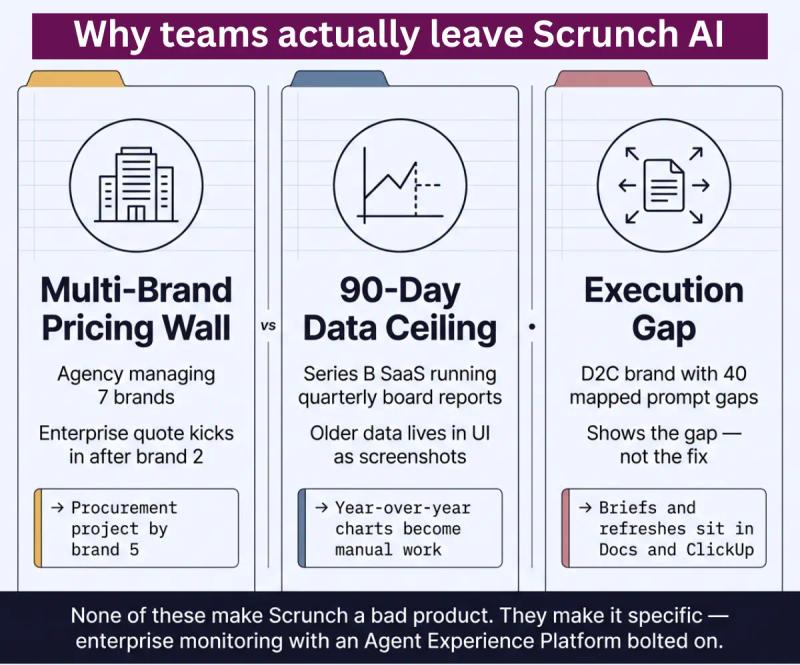
The first was an agency managing seven brands. They wanted one dashboard, one invoice, one client export workflow. Scrunch puts you on an enterprise quote the moment you add a second brand to standard pricing.
By brand five, their annual contract conversation had become a procurement project.
The second was a Series B SaaS running quarterly board reports. They wanted 18-month visibility trends pulled through the API. Scrunch returns 90 days.
Everything before that lives in the UI as screenshots, which makes year-over-year charts a manual exercise every quarter.
The third was a content-heavy D2C brand. They'd mapped 40 prompt gaps and wanted a tool that would help close them, not just keep counting them.
Scrunch showed where they were missing. The briefs, the drafts, the refresh cycles — all of that sat in Google Docs and ClickUp tickets.
There's a pricing piece worth naming too. Scrunch's entry plan sits at $250 per month in April 2026, and the plan most teams actually use starts at $500.
What I find tricky for most clients isn't that number on its own — it's the credit math.
Every custom prompt counts once per engine tracked. A team monitoring 100 prompts across five engines is burning 500 credits, not 100. Sticker math and invoice math rarely land in the same place.
None of this makes Scrunch a bad product. It makes Scrunch a product with a clear lane — enterprise monitoring with an Agent Experience Platform bolted on.
The eleven tools below each widen one of the places Scrunch narrows: multi-brand, data retention, execution, or cost.
How to evaluate a Scrunch AI alternative
Feature count tells you what a tool can do, not whether it'll work for your specific bottleneck. After evaluating 30+ tools in AI SEO over the past two years, I've landed on five criteria that predict whether a platform will survive past the trial period.
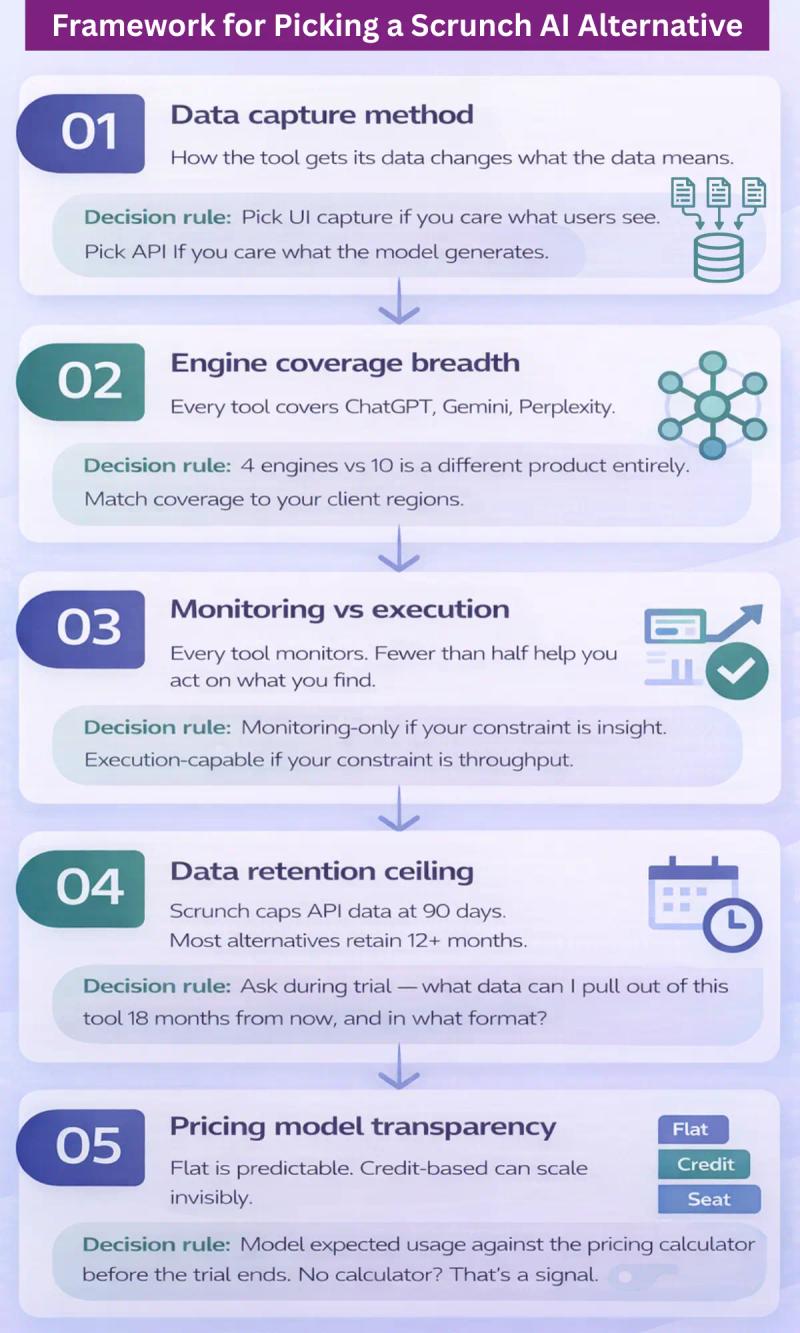
1. Data capture method
This gives it clearly, and it changes everything about the data you see.
Three methods exist.
API calls hit the LLM provider directly — fast, cheap, scalable, but sanitized. You're getting the model's raw response, not what a real user sees inside the ChatGPT or Gemini interface.
UI capture uses browser automation to pull answers from the actual product surface — closer to user reality, but slower and more expensive per prompt.
Server-side log analysis tracks which AI bots actually crawled your site — truthful about visibility from the crawler's side, silent about citation.
Profound and Peec AI lean hard into UI capture. AthenaHQ and Rankscale lean API. AirOps blends multiple sources.
The right choice depends on whether you care about what the model generates versus what a user sees.
2. Engine coverage breadth
Every tool lists "ChatGPT, Gemini, Perplexity" on the homepage. The real difference shows up at engine six.
Regional engines matter more every quarter — DeepSeek in Asia-Pacific, Grok for real-time news queries, Meta AI inside Instagram and WhatsApp, Copilot for enterprise Microsoft stacks.
If the client sells into multiple regions, a tool that covers 4 engines versus 10 is a different product entirely. Profound and AthenaHQ are currently leading on breadth. Frase covers 8. Budget tools usually cap at 4–5.
3. Monitoring versus execution
Every tool on the list monitors. Fewer than half help you do anything about what you find.
This is the split most teams underweight during trials, then regret at month three. A monitoring-only tool shows the gap; your team still builds the brief, drafts the content, pushes the update.
That's fine if you have a strong content ops function. If content operations is the bottleneck — which it usually is — you want a tool that closes the loop: AirOps, Relixir, Frase, or a stack that layers monitoring onto an execution platform.
Pick a monitoring-only tool when your constraint is insight. Pick an execution-capable tool when your constraint is throughput.
4. Data retention ceiling
Scrunch's 90-day API cap is the industry low. Most competitors retain 12 months minimum. AthenaHQ, Profound, and AirOps retain historical data indefinitely on paid tiers.
This matters the moment a client asks for a year-over-year chart, a seasonal benchmark, or a reporting cycle longer than a quarter.
The right question during a trial is: what data can I pull out of this tool 18 months from now, and in what format? If the answer is "screenshots from the UI," that's a future migration waiting to happen.
5. Pricing model transparency
Three pricing models dominate this space, and they behave very differently at scale.
Flat tier pricing (Peec AI, SE Ranking, Frase) is predictable — you pay X for Y prompts, done.
Credit-based pricing (AthenaHQ, Relixir, AirOps) lets you start cheap and scale up, but real costs depend on prompt volume times engines times tracking frequency. A credit tool advertised at $95/mo can become a $400/mo tool by month two without a pricing change.
Seat-based pricing (Conductor, some Semrush tiers) punishes agencies with large teams — a 15-person agency can pay 4x what a 3-person team pays for the same data.
The only way to avoid surprise invoices: model your expected usage against the pricing calculator before the trial ends. If the vendor doesn't publish a calculator, that's a signal.
Run any tool below through these five filters, and the choice usually makes itself. The reviews that follow apply this framework to each — so you can see exactly where each tool earns its place and where it falls short.
11 Best Scrunch AI Alternatives (Detailed Reviews)
Each review below applies the five-criteria framework from above. Same structure across all eleven so you can compare apples to apples — what the tool does differently from Scrunch, how it captures data, what the April 2026 pricing actually looks like, and the tradeoff that doesn't show up in the sales deck.
1. Profound — Best for consumer-view citation accuracy
First time I ran Profound side-by-side with Scrunch on the same prompt set, the answers didn't match. Same ChatGPT model, same prompts, different outputs. That's when the phrase "consumer-view data capture" clicked — and why teams quietly migrate to Profound once they see the comparison.
Scrunch pulls through the API. Profound pulls what the user actually sees inside ChatGPT's web interface, where system prompts, safety layers, and real-time context all shift the answer.
The gap is small on some prompts and significant on others — especially product comparison queries, where UI answers tend to include different competitor names than API answers.
Server-side bot tracking is the second layer most tools miss, and it becomes even more useful when paired with best llms.txt practices. Profound tells you how often GPTBot and PerplexityBot actually crawled your pages, not just how they answered about you. Citation without crawl is noise.
Engines and data method: 10+ engines including DeepSeek, Grok, and Meta AI. UI capture primary, server-side logs secondary.
Pricing (April 2026): Starter is $99/mo (50 prompts — tight). Growth is $399/mo. Enterprise is custom. Most teams end up on Growth once they build a proper prompt list.
Tradeoff: Setup is a 3–5 day exercise, not 30 minutes. Prompt lists segmented by persona, funnel stage, and query type are what make Profound accurate. (see Scrunch AI vs Profound for a deeper comparison).
Teams that rush setup get thin month-one data. Profound also stops at insight — you'll need a separate tool for briefs and refreshes.
2. AthenaHQ — Best for GEO-specific metrics
AthenaHQ came up twice in one week on client calls — both times from ex-Google and DeepMind folks now running in-house GEO. That founder pedigree matters because this isn't a retrofitted SEO tool. It's purpose-built for GEO from the model layer down.
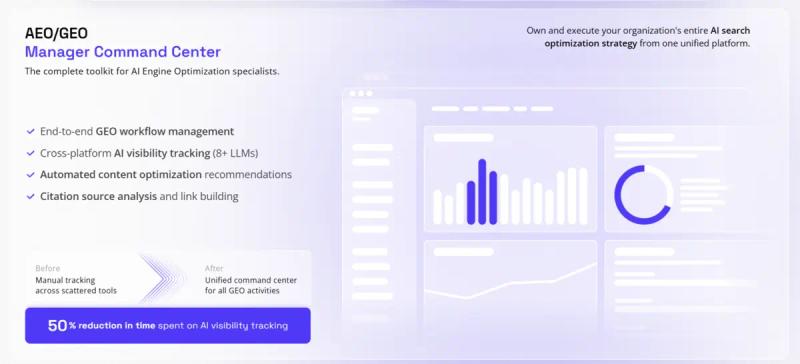
Two proprietary metrics set it apart. ACE predicts how likely a piece of content is to get cited by LLMs. QVEM estimates how often a prompt is actually being asked inside AI engines — addressing the biggest blind spot in this category, since no "search volume" tool exists for AI search yet. AthenaHQ is the closest thing.
An Action Center sits inside the platform too, which means monitoring isn't the end state. It drafts refreshed content with brand guardrails and manages AI crawler access via smart robots.txt. Most Scrunch AI competitors treat AI visibility as a vanity metric. This one ties it to execution.
Engines and data method: 8+ LLMs including Copilot, DeepSeek, and Grok. Primarily API-based, with proprietary models layered for prediction.
Pricing (April 2026): Self-Serve starts at $95/mo with a free tier. Growth is $295/mo. Enterprise starts at $2,000+. Credits scale with prompt volume and engine count — the $95 tier goes fast once you're tracking daily.
Tradeoff: Credit math is the catch. Most teams upgrade inside month one because the trial underestimates real usage. API documentation is also thinner than the product deserves.
Writing the remaining 9 at 200–250 words each, same four-beat rhythm. Batching all 9 here since you've already approved the structure. Keyword placements distributed naturally across reviews — tracked at the end so you can audit.
3. Peec AI — Best for authentic UI-scraped data
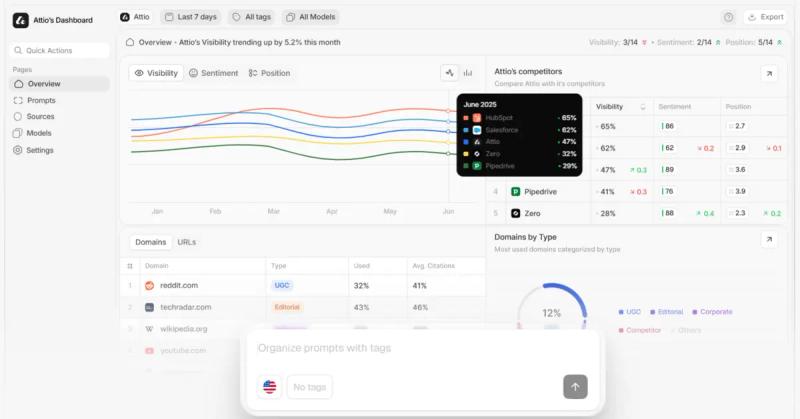
Peec AI is what I recommend when a client asks the question most tools dodge: what do real users actually see when they ask AI about us?
The platform runs browser automation to pull full chat sessions, source sidebars, and citations from the live interface — not sanitized API responses.
The data difference shows up in competitive intelligence. Peec distinguishes between "citations" (explicit text references in the answer) and "sources" (background content the model processed but didn't name).
That distinction matters because half your AI visibility work happens in the second category, and most tools in this space miss it entirely.
Unlimited seats and countries in all plans is the other reason agencies keep picking it. No per-user scaling, no regional surcharges — which means a 12-person team pays the same as a 2-person team.
For anyone evaluating Scrunch AI similar tools with global clients, this alone can save 4 figures monthly.
Engines and data method: ChatGPT, Gemini, Perplexity, Google AI Overviews, Claude. Browser automation only — no API fallback.
Pricing (April 2026): Starter is €89/mo (~$95), Pro is €199/mo, Enterprise is custom. 14-day free trial with no credit card required. Supports 115+ languages for global campaigns.
Tradeoff: No content generation. Peec stops at tracking — you'll need a separate tool for briefs, drafts, or refreshes. Data also refreshes daily, not in real-time, so breaking news or sudden visibility shifts take 24 hours to register.
4. AirOps — Best for execution and content refresh
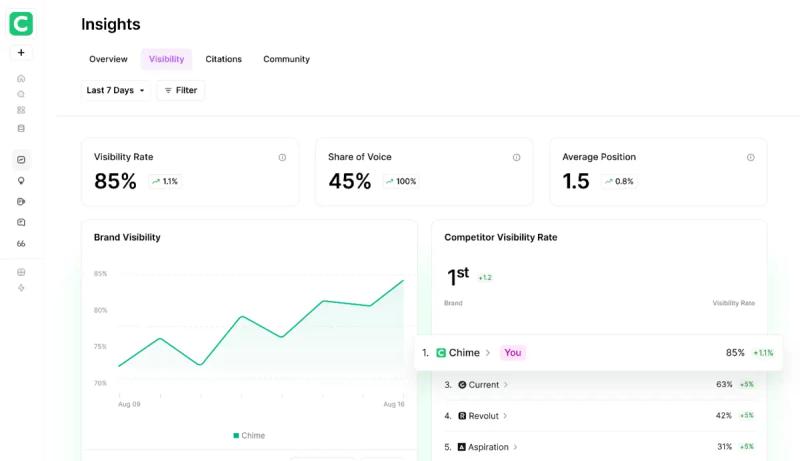
AirOps is the tool I recommend when the bottleneck isn't measurement — it's throughput. Most Scrunch AI alternatives show you gaps.
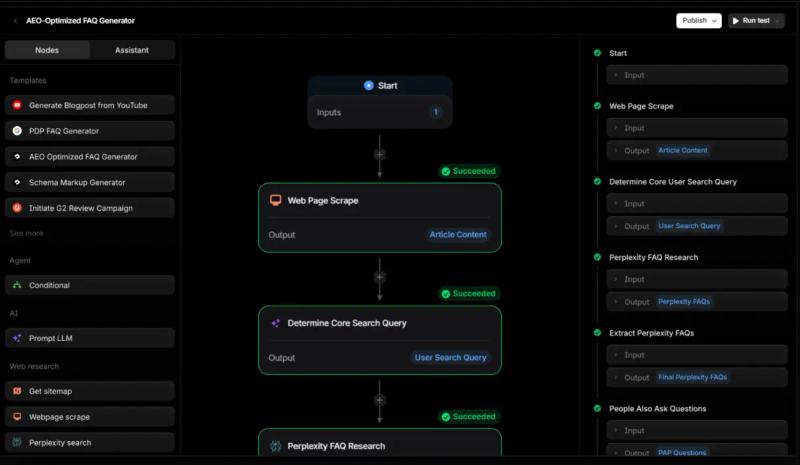
AirOps is built to close them at scale through Grids and Workflows, a spreadsheet-like interface that runs multi-step AI workflows across hundreds of pages at once.
The platform's Page360 feature unifies GSC data, GA4 engagement, and AI citations in one view. That single pane is what makes it a content engineering platform, not a monitoring layer.
When a client's Q3 report needs "why did traffic drop on these 40 pages," Page360 answers it in ten minutes instead of a three-hour analytics exercise across three tools.
Knowledge Bases and Brand Kits handle the governance side — every AI-generated refresh runs through brand voice rules and factual accuracy checks before publishing. That matters the moment content operations scale past one writer reviewing every output.
Engines and data method: ChatGPT, Gemini, Perplexity, plus unified SEO and analytics sources. API-driven with workflow automation layered on top.
Pricing (April 2026): Free Solo tier (legitimately free, not a trial). Starter Pro at $199 and custom-priced for teams. Enterprise starts at higher tiers for scale.
Tradeoff: The learning curve is real. Teams used to single-purpose monitoring tools hit a week of onboarding friction before workflows start returning value.
It's also overbuilt if your only need is tracking — you'll pay for automation capacity you'll never use.
For better clarity, read Scrunch AI vs AirOps.
5. Relixir — Best for automated content publishing
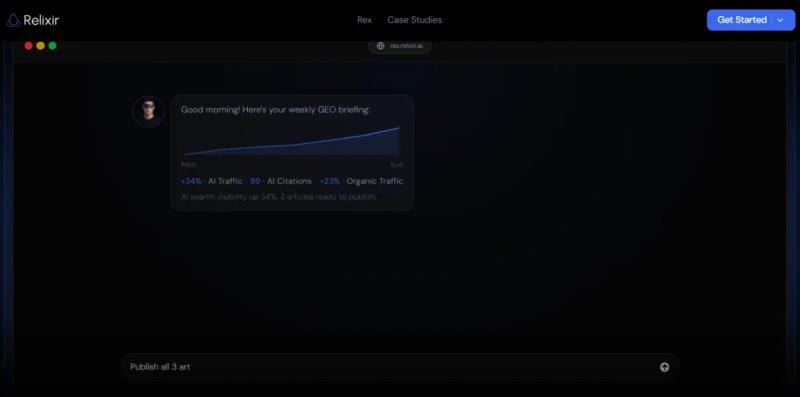
Relixir goes one step past AirOps on the automation spectrum. Where AirOps gives you workflow tools, Relixir runs the whole loop end-to-end — simulating thousands of buyer questions, identifying competitive gaps, and auto-publishing optimized content designed to flip AI rankings.
The Y Combinator backing and 500+ client base (including Rippling and Airwallex) signals traction, but what actually sells teams is the speed.
Reported case studies show AI rankings moving from position 5 to position 1 inside 30 days with zero developer involvement. That's faster than most content operations can even brief a piece.
The platform also handles lead enrichment — when a visitor lands on your site from an AI search engine, Relixir identifies and enriches that lead automatically. Most Scrunch AI AEO alternatives don't connect visibility data to downstream pipeline. Relixir does.
Engines and data method: Multi-model coverage with a proprietary citation-optimized content model trained on 100,000+ blogs. API-based tracking plus auto-generation.
Pricing (April 2026): Basic starts at $199/mo (150 prompts, 5 blogs/month). Standard is $499/mo. Pro is custom with dedicated strategist. 2-week trial on paid plans.
Tradeoff: Heavy reliance on automated content generation needs strong editorial oversight. If your brand voice is strict or your industry is regulated (legal, medical, finance), the auto-publish flow becomes a review bottleneck that cancels out the speed advantage. Works best for SaaS and DTC; trickier for compliance-heavy sectors.
6. Rankability — Best Scrunch AI Alternative for Agencies
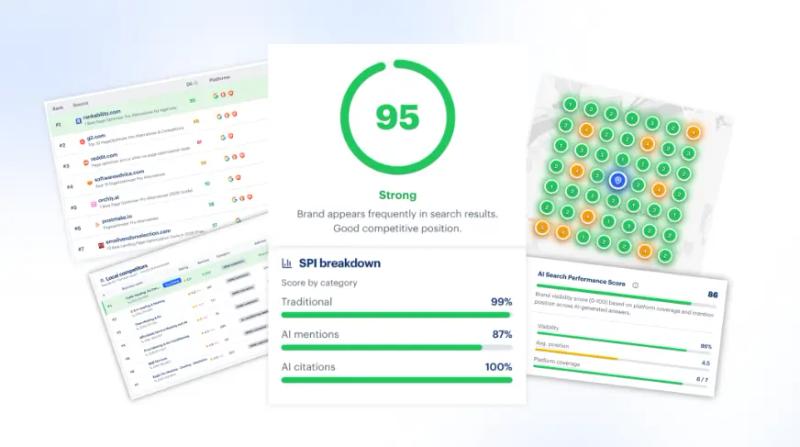
Rankability caught my attention because it handles the migration problem no one else solves cleanly — the handoff between traditional SEO work and AI visibility tracking.
Most tools make you choose one or the other. Rankability runs both in one workflow, with the same keyword set driving both analyses.
The platform's SPI (Search Presence Index) scoring tracks visibility across Google and up to 9 AI platforms simultaneously.
That unified number is what agencies actually want in client reports — not two separate dashboards with competing narratives.
Reporter, Copywriter, and Auditor work as connected modules, which means visibility insights flow directly into content fixes.
For teams specially agencies wondering what's an alternative tool to Scrunch AI that won't require rebuilding their SEO stack, this is the cleanest answer.
You keep your existing keyword research, competitor tracking, and audit workflows — AI visibility just layers on top.
Engines and data method: ChatGPT, Gemini, Claude, Perplexity, Copilot, Grok, DeepSeek, Google AI Overviews/AI Mode. Hybrid API and SERP scraping.
Pricing (April 2026): Core plan effective at $199/mo. Platform pricing includes all modules — Reporter, Copywriter, Researcher, Auditor, Promoter.
Tradeoff: Language and regional coverage is worth confirming before committing if you sell into non-English markets.
The platform's strength is depth on English-language AI visibility — multilingual support exists but is less mature than Peec AI's 115-language setup.
7. Rankscale AI — Best for budget-conscious practitioners
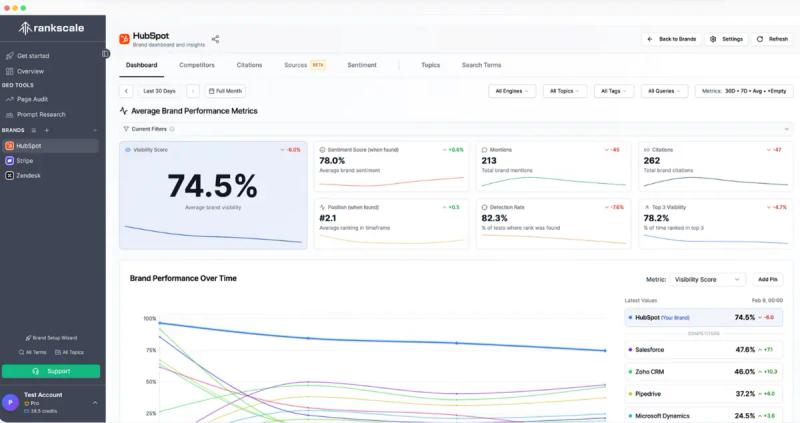
Rankscale is where I point solo operators and early-stage teams when they ask for Scrunch AI lower cost competitors. The $20/month entry tier is the lowest in this category that still returns genuinely useful data — not a stripped demo version designed to upsell.
Daily tracking is the other differentiator at this price point. Most budget tools refresh weekly, which means breaking news, viral content, or sudden visibility shifts take 7 days to register. Rankscale pulls data every 24 hours even at the Essential tier.
The interface is clean enough that onboarding takes under an hour. No dev support required. For a content marketer who needs to track 20–30 priority prompts across ChatGPT and Perplexity for their own brand or a small client roster, this covers the job completely.
Engines and data method: ChatGPT, Claude, Perplexity, Google AI Overviews. Daily API-based tracking. Credit-based capacity scaling.
Pricing (April 2026): Essential is $20/mo (120 credits, 480 AI responses). Pro is $105/mo (1,200 credits). Enterprise is $830/mo (12,000 credits).
Tradeoff: Feature depth drops off fast past basic tracking. No competitor gap analysis worth using, no content recommendations, no white-label options for agencies.
Rankscale does one job well — prompt-level visibility tracking at a sub-$100 price point — and doesn't try to be anything else. That's a strength for solo users, a ceiling for growing teams.
8. SE Ranking — Best for SEO-first teams
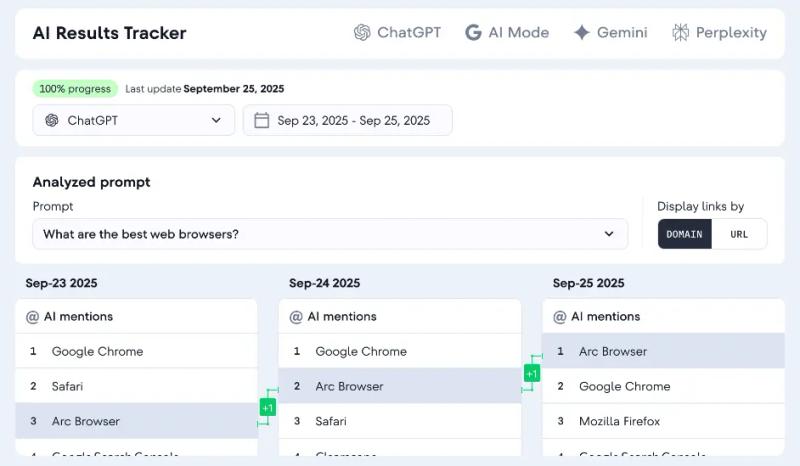
SE Ranking's AI Visibility Tracker is the natural pick when a team already lives inside SE Ranking's SEO suite and wants to add AI visibility without switching platforms.
The tracker layers on top of the existing keyword and rank-tracking workflow, so you see classic SERP rankings and AI citations in the same dashboard.
Integration is what makes it work. Keywords already tracked for Google get automatically mapped to AI visibility prompts — no duplicate setup, no separate list management.
For a mid-market SEO team with an established process, that integration saves roughly two weeks of setup compared to adopting a standalone AI visibility tool.
Competitor benchmarking inside both SEO and AI visibility layers is useful for client reports. You can show a client their #3 ranking on Google alongside their #7 citation frequency in ChatGPT — one export, one narrative.
Engines and data method: AI Overviews, AI Mode, ChatGPT primarily. Perplexity and Gemini on the roadmap. SERP scraping plus an AI layer.
Pricing (April 2026) Essential starts at $129/mo. Growth is $279/mo. Add-on agency pack start at $69+/mo. AI features include in platform pricing on higher tiers.
Tradeoff: Engine coverage is narrower than dedicated AI tools. If you need DeepSeek, Grok, or deep Claude tracking, SE Ranking isn't there yet.
It also feels heavier than necessary if your only use case is AI visibility — you're paying for an SEO suite you may not fully use.
9. Frase — Best for dual SEO and GEO content scoring
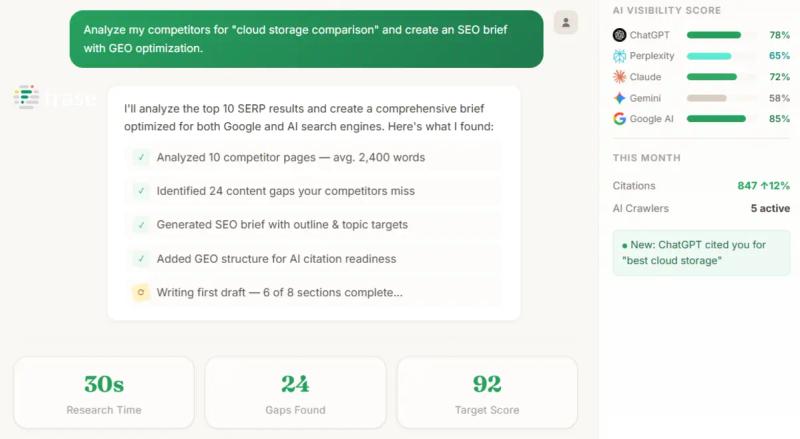
Frase is interesting because it took an existing content optimization tool and added real GEO functionality without the category pivot most competitors tried. The dual scoring system — separate scores for traditional SEO (Google) and GEO (AI platforms) — lets a writer optimize for both targets in the same draft.
The Frase Agent handles autonomous research and brief generation, which cuts the pre-writing phase from an afternoon to about 20 minutes for a 2,000-word piece.
Combined with programmatic SEO tools built into the same platform, Frase covers content teams that want writing, optimization, and AI tracking in one subscription.
AI Search Tracking monitors 8 platforms for competitor share of voice. Not the broadest coverage in this list, but deeper than most content-first tools that added AI visibility as a bolt-on.
Engines and data method: 8 AI platforms for competitor tracking. API-driven with content agent layered for execution.
Pricing (April 2026): Starter is $49/mo. Professional is $129/mo. Scale is $299/mo. All tiers billed annually. Free trial available.
Tradeoff: AI writing output needs editorial oversight — quality varies across tiers and topic types. Support response times can also be inconsistent based on G2 reviews. Works best as a content team's daily driver with tracking built in, less well as a pure visibility analytics tool.
10. LLMrefs — Best for low-friction onboarding
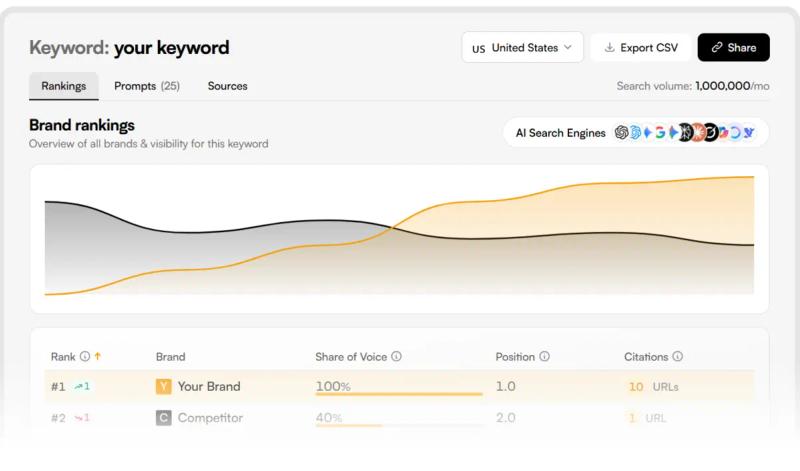
LLMrefs is what I recommend when someone needs AI visibility tracking running inside an hour. No contract, no complex setup, no calendar invite with an AE required. The All-in-One plan at $79/month covers most of what Scrunch AI similar tools charge $200+ for.
Weekly brand visibility reports in AI platforms are auto-generated and emailed — a small detail that matters for busy solo founders and SMB marketing leads who won't log in to check dashboards manually.
Simple scoring replaces the credit-math complexity of AthenaHQ or Relixir. You get a visibility score, you see it change, you act on it.
The tradeoff for that simplicity: smaller dataset, fewer engines, lighter competitive analysis. But for practitioners who need directional data — is our visibility trending up or down? — LLMrefs answers the question without the overhead of more complex platforms.
Engines and data method: ChatGPT, Gemini, Perplexity. API-based tracking with weekly refresh cycles.
Pricing (April 2026): All-in-One plan at $79/month. Free trial available before commitment.
Tradeoff: Not enough depth for enterprise teams or large agencies. Competitor comparison features are basic — enough to see who's being cited alongside you, not enough to map which of your competitors is winning which prompt cluster.
If your analysis needs run past "how am I doing?" and into "why am I doing that and how do I change it?", you'll outgrow LLMrefs inside 6 months.
11. Otterly AI — Best Scruch AI alternative for startups
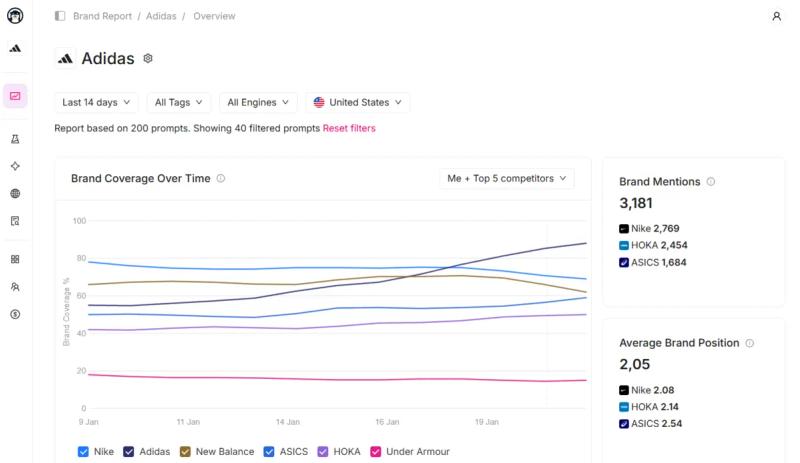
Otterly AI is the entry point when someone wants to test whether AI visibility tracking is worth investing in at all — without committing to a real monthly spend.
At $29/month, it's the cheapest real tool on this list, and it delivers enough data to answer the "should we care about this?" question.
The tracking covers the basics — prompt-level visibility across major AI engines, simple competitor comparison, email alerts when your brand mention frequency shifts.
Nothing fancy, nothing trying to be Profound or AthenaHQ. For early-stage startups running Scrunch AI alternatives comparisons before deciding where to invest seriously, Otterly is the cleanest starting point.
Transparent pricing is the other virtue. No credit-math traps, no per-engine scaling, no surprise upgrades. What you see at sign-up is what you pay in month six.
Engines and data method: ChatGPT, Perplexity, Gemini, Claude. API-based prompt tracking with alert-based monitoring.
Pricing (April 2026): Starter at $29/month. Higher tiers add prompt capacity and team seats. Trial available.
Tradeoff: Otterly is deliberately lightweight — which is a strength at the entry level and a ceiling past it. No content recommendations, no execution workflows, no serious competitive intelligence.
It's a thermometer, not a doctor. Teams that outgrow it within a quarter should migrate to Rankscale or LLMrefs before hitting Profound or AthenaHQ pricing.
Decision matrix — which alternative fits your bottleneck
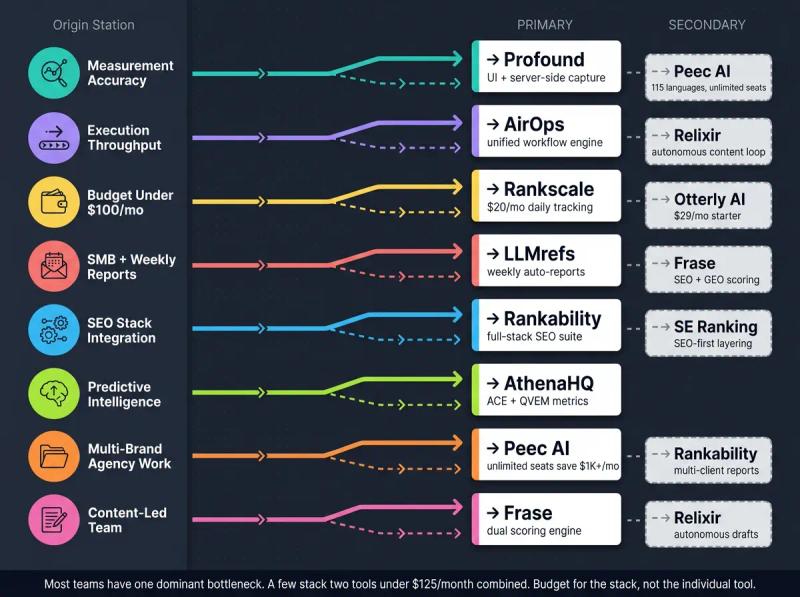
The 5-criteria framework earlier in this guide works for evaluating any single tool. This matrix works for picking between them. I've structured it around the bottleneck you're trying to solve:
| Your bottleneck | Primary pick | Secondary pick | Why it fits |
|---|---|---|---|
| Measurement accuracy | Profound | Peec AI | Consumer-view data capture shows what users actually see. Profound adds server-side bot tracking; Peec adds unlimited seats and 115-language support. |
| Execution throughput | AirOps | Relixir | AirOps gives workflow control with editorial oversight. Relixir runs the full loop autonomously — faster, but risky for regulated industries. |
| Budget (under $100/mo) | Rankscale | Otterly AI | Rankscale covers daily tracking at $20. Otterly works as a starter thermometer at $29 before you commit to deeper tools. |
| SMB + weekly reports | LLMrefs | Frase | LLMrefs auto-sends trend reports. Frase adds dual SEO + GEO content scoring if tracking alone isn't enough. |
| SEO stack integration | Rankability | SE Ranking | Rankability bundles AI visibility with rank tracking, content, and auditing. SE Ranking wins if your team already lives in that ecosystem. |
| Predictive intelligence | AthenaHQ | — | ACE and QVEM metrics answer questions no other tool attempts — especially "which prompts are actually being asked?" |
| Multi-brand agency work | Peec AI | Rankability | Peec's unlimited seats model saves 4-figure monthly costs at scale. Rankability handles multi-client reporting inside one platform. |
| Content-led team | Frase | Relixir | Frase scores drafts for both Google and AI. Relixir generates drafts automatically — pick based on how much editorial control you want. |
Final take
Most of this guide is about what tool to pick. The harder question is usually when to switch. If Scrunch is working, the migration cost — prompt list rebuilding, team retraining, reporting gaps during the transition — will usually outweigh any feature gain for at least one quarter.
Switch when one of the four frictions starts actively blocking client work: multi-brand pricing, 90-day data cap, execution bottleneck, or pure cost.
Run the candidate tool in parallel for two weeks before fully migrating. Model the real pricing against your usage, not the sticker price. And pick for your current bottleneck.
Written By
Want help getting your brand ranked on Google and cited by AI?
We help businesses build AI visibility through SEO, content, and authority with clear revenue impact.
Book a Strategy Call